SecurityThreats & vulnerabilitiesAnalysis
1Password: one employee’s GitHub account led to stolen customer records, not vaults
1Password’s statement of 25 November, read against its security white paper: what one GitHub account reached, what records left, why vaults stayed shut, and what an admin checks.

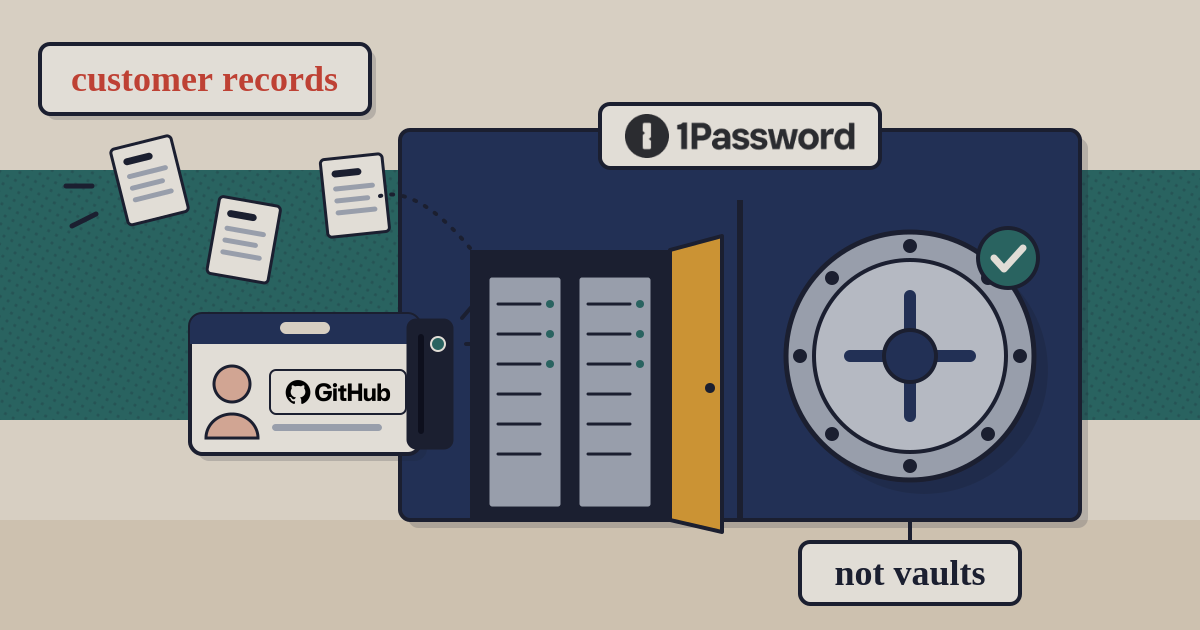
An attacker who gained access to one 1Password employee’s corporate GitHub account used it to push malicious code to the company’s backend services, and that code downloaded account records belonging to “a subset of our users”, 1Password said on 25 November. The attacker also copied source code from private repositories and got into the CI/CD system, the machinery that builds and deploys 1Password’s software. “At no time were customer vault contents accessed by, or available to, the attacker,” the company wrote. It gives no count of the users whose records were taken.1
A password manager breach raises one question first: can the thief open the vaults? 1Password’s answer rests on a design it has documented in public since 2015, and its own documents also say where that design stops protecting a customer.1 We read the incident post against the white paper, to set out what left, why the vaults stayed shut, and what the stolen pieces could still be used for.
1
employee’s corporate GitHub account used to reach the backend
1Password
6 days
from the start of the investigation (19 November) to the disclosure (25 November)
1Password
6 → 10
length of the emailed verification code: six digits before, ten alphanumeric characters now
1Password
0
vaults, vault keys or recovery keys affected, 1Password says
1Password
01One GitHub account, then the backend
1Password describes four moves. The attacker gained access to the employee’s GitHub account; used it to read source code and to push malicious code to backend services; that code downloaded what the company calls “administrative data pertaining to our customers”; and the attacker reached the CI/CD system, which “contains infrastructure related secrets in order for our product to work”. 1Password says it has rotated or revoked every internal credential that may have been exposed, and that there is “no impact to 1Password’s services, availability, or product security”.1
One employee’s GitHub account was enough to put the attacker’s code on 1Password’s backend
How the intrusion ran, as 1Password describes it, investigation from 19 November 2026
- 01
One account
An employee’s corporate GitHub account. 1Password does not say how access to it was gained.
- 02
Code read and pushed
Source code copied from private repositories; malicious code pushed to backend services.
- 03
Records downloaded
The pushed code downloaded account records for “a subset of our users”.
- 04
CI/CD reached
The build and deploy system, which holds infrastructure secrets. All credentials that may have been exposed were rotated.
Source: 1Password, incident post (25 Nov 2026) · as of 26 November 2026, 7:30pm IST
The sequence matters because the GitHub account was a door to production, not only to code. Source code in a private repository is a company’s own property; 1Password says its code “is not customer data, and contains no user secrets”. Code that is pushed and then runs on backend services acts with the backend’s own access to customer records. 1Password has disabled the account, revoked “the stolen token”, removed the access the attacker created, and tightened its GitHub, CI/CD and endpoint controls with new detections for this kind of attack.1 A developer account used as the way into build secrets was also the route in this month’s campaign of hijacked GitHub accounts, and a supplier’s exposed key was the start of Cursor’s fake-extension incident.
02What left: records for “a subset of users”, and code
1Password lists six kinds of account record the attacker downloaded. We set them out in its own words, with the notes it attached, beside what it says was not affected. It does not say how many users the subset covers, or which countries they are in.1
Account records and source code left; vault contents and the keys to them did not
What 1Password lists as taken, copied, reached and not affected, in its words, 25 November 2026
Show tableHide table
| Item | Status | 1Password’s note |
|---|---|---|
| Names and email addresses | Taken | For a subset of users |
| Account and user identifiers; creation and last sign-in times | Taken | Non-secret metadata |
| Public keys | Taken | Public by design; no impact on user security |
| Secure Remote Password (SRP) protocol parameters | Taken | Cannot be used to access an account |
| Tokens in emailed invitation, provisioning and recovery links | Taken | Work only with an SSO sign-in or an emailed code |
| Other non-secret metadata (version and file numeric identifiers) | Taken | Relative to internal architecture |
| Source code from private repositories | Copied | Not customer data; no user secrets |
| CI/CD system and its infrastructure secrets | Reached | Credentials rotated |
| Vaults and the items in them | Not affected | Never available to the attacker |
| Keys that protect vaults | Not affected | Account password and Secret Key are not stored |
| Account recovery keys | Not affected | |
| Apps and browser extensions | Not affected |
Source: 1Password, incident post (25 Nov 2026) · as of 26 November 2026, 7:30pm IST
03Why the vaults stayed shut: two secrets the server never has
1Password is built on end-to-end encryption: items are encrypted and decrypted on the customer’s device. Its white paper says decrypting a vault needs three things together: the account password, the Secret Key and a copy of the encrypted data. The account password exists only in the user’s memory. The Secret Key is generated on the user’s computer at sign-up, holds 26 random characters (slightly more than 2128 possibilities) and is stored by the 1Password app on the device, not by the company.2
The design answers the usual worry about a stolen authentication record: that it can be used to test password guesses offline. The white paper concedes that a plain password-authenticated scheme “would still leave something crackable on the server”. 1Password’s fix, which it calls two-secret key derivation, mixes the Secret Key into everything derived from the password, so that “the information held on our systems cannot be used to check whether an account password guess is correct or not”. An attacker would have to guess the password and also hold the user’s 128-bit Secret Key.4
What the servers hold is one secret short: 1Password never has the account password or the Secret Key
Where each piece of a 1Password vault lives, as the white paper describes it, release of 28 October 2026
On 1Password’s servers
- Encrypted vault data and encrypted private keys
- Public keys (public by design)
- For sign-in: salt, SRP group and verifier, all made on the device
- Account records: names, emails, identifiers, sign-in times
Only with the customer
- The account password, in the user’s memory
- The Secret Key, generated and stored on the user’s devices
- The Emergency Kit, if the user printed or saved it
Source: 1Password Security Design White Paper, chapters 3 and 4; 1Password SRP post (2018) · as of 26 November 2026, 7:30pm IST
04The one live item: tokens in emailed links
The tokens matter more than the rest of the list because they belong to processes that were under way. An invitation to provision an account (through 1Password’s SCIM Bridge or Hosted Provisioning) or to accept the recovery of an account arrives by email with a token in the link. 1Password says a “small number” of users were in that state during the incident and have been notified. The token completes the process “only when combined with an SSO sign-in or a six digit code sent to the user’s registered email address”, and cannot reach an account by itself. As a precaution the code is now ten alphanumeric characters instead of six digits; 1Password found no evidence of account takeover using any exposed provisioning token.1
Recovery is where a token sits closest to a vault, and the white paper walks through it. A member of the team’s recovery group starts it; the user follows the emailed link, sets an account password and gets a new Secret Key; then a recovery group member must “complete the recovery”, which re-encrypts the vault keys to the user’s new key set. The paper is plain about the weak point: “it remains possible that a malicious member of a recovery group who gains control of Carol’s email could come to control Carol’s 1Password account”, and “recovery requests should be verified independently of email”.5
A recovery token opens nothing alone: an emailed code and a recovery group member’s confirmation come after it
The steps of a 1Password account recovery, from the white paper and the incident post, November 2026
Step 1 of 6
Recovery starts
A recovery group member starts it; the server puts the account into a pending state and emails the user.
Source: 1Password Security Design White Paper, chapter 12; 1Password incident post (25 Nov 2026) · as of 26 November 2026, 7:30pm IST
05What a business using 1Password checks now
1Password’s advice to customers is short: be wary of unexpected emails, texts or calls that mention 1Password, invitations or account recovery; it will never ask for an account password or Secret Key; enter them only in the official app or on its website, opened by the user; and report anything odd to support@1password.com. The Secret Key, it notes, is needed only the first time a user signs in on a new device or browser, so a prompt for it at any other moment is a warning sign.1
For an administrator of a 1Password Business account, the white paper adds three checks that fit this incident. Confirm, by phone or in person, that any recovery request or invitation sent in recent weeks was genuine before completing it. Treat a recovery that a user did not ask for as a signal and leave it uncompleted. Prefer the signed desktop and mobile apps to the web client, which the paper lists as its own first mitigation for web risks. Then expect phishing that is well informed: a message that knows a user’s name, company and the date their account was opened is now possible for whoever holds the records.56
1Password disclosed six days after it began investigating, and says it will update the same post
Dated events in 1Password’s incident, 19 to 26 November 2026
Show tableHide table
| Date | Event | Detail |
|---|---|---|
| 19 Nov 2026 | Investigation begins | Indications that an employee’s corporate GitHub account was accessed |
| 25 Nov 2026 | Disclosure | Incident post: records taken, vaults not affected, codes lengthened |
| 26 Nov 2026 | No update yet | Still the only post on the incident when we checked, 7:35pm IST |
Source: 1Password, incident post and blog index (25 Nov 2026) · as of 26 November 2026, 7:30pm IST
Two things are open. 1Password has not said how many users’ records were downloaded, or how the attacker got into the GitHub account in the first place; it has brought in outside specialists to validate its containment, and says it will update the post “if we find anything that changes what we’ve said here”.1
Sources
- 1Password, “Update on a security incident involving 1Password’s backend systems” — 25 November 2026
- 1Password Security Design White Paper, chapter 3: Account password and Secret Key (release 0.5.3) — 28 October 2026
- 1Password, “Developers: How we use SRP, and you can too” — 14 February 2018
- 1Password Security Design White Paper, chapter 4: A modern approach to authentication (release 0.5.3) — 28 October 2026
- 1Password Security Design White Paper, chapter 12: Restoring a user’s access to a vault (release 0.5.3) — 28 October 2026
- 1Password Security Design White Paper, appendix A: Beware of the leopard (release 0.5.3) — 28 October 2026
- Digital Personal Data Protection Act, 2023: sections 8(1) and 8(6) — 11 August 2023
- MeitY: commencement notification under the DPDP Act, G.S.R. 843(E) (copy on MediaNama) — 13 November 2025
Disclosure. TechBag is a software reseller: it earns when companies buy through it, including from vendors named here. The analysis is TechBag’s own; no vendor paid for or saw this piece before publication. Facts are labelled reported, TechBag count or our view. How the Journal works.
Keep reading