SecurityEmail & phishingAnalysis
Japan’s ARARA lost 81.3 million email addresses from up to 380 clients
What ARARA, its clients and Nitori disclosed from 29 October to 9 November: how one mailing service exposed up to 380 firms’ lists, and why 81.3 million addresses are not 81.3 million people.

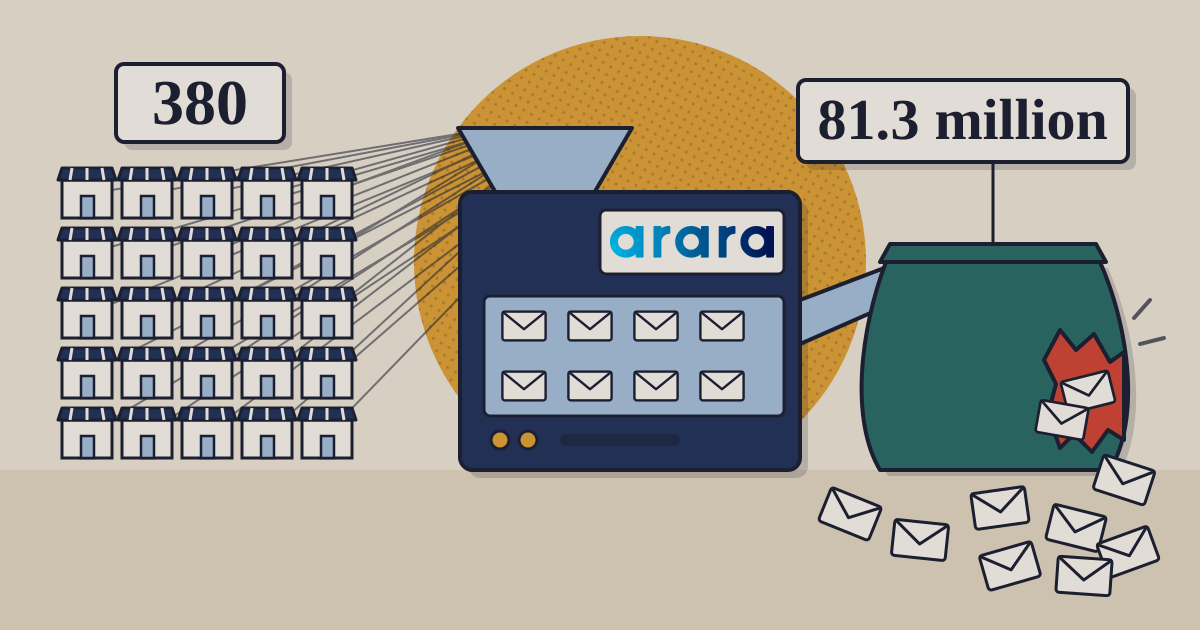
Most companies that send newsletters do not run their own mail servers. They upload a list to a delivery service and press send. We read ARARA’s three reports and the notices of the clients that have named it, in Japanese, to answer four questions: how one supplier’s breach reached hundreds of companies, how the count grew from 3 million to 81 million in eight days, why that number is not a number of people, and what a company that mails through such a service can check. A separate breach at Nitori, disclosed the same week, carries the same counting problem.
01Three million on day one, 81 million eight days later
81,329,467
email addresses taken from ARARA Message, duplicates removed
ARARA’s third report, 6 November. The first estimate, on 29 October, was about 3.01 million.
ARARA’s first notice, on 29 October, said one system had been entered through a web-server vulnerability and that about 3.01 million email addresses held by the companies using it had been taken. ARARA is a consolidated subsidiary of PayCloud Holdings, listed on the Tokyo Stock Exchange’s Growth market.1 Four days later the second report added client environments on 97 servers. An intruder had got into one of the service’s own servers and moved from there into many others between 28 and 31 October, copying database contents. That added about 77 million addresses and up to about 380 client firms.2
On 6 November the third report found a second cloud environment, B, from which 3,249,492 addresses had been taken over the same four days with misused credentials, and gave the total after removing duplicates.3 The count grew because the investigation widened, not because the attacks went on: ARARA says environment B “is not the result of a new unauthorised access”. It also cut the shared environment’s figure from 3,386,187 to 2,842,400, and its counts include addresses that “may have been taken”, judged from the volume of records read.23 The service has been stopped since 31 October, with no restart date, and PayCloud says the effect on its results for the year to August 2027 is still under review.45
ARARA's count rose 27-fold in eight days as each report found more
Email addresses ARARA reported taken, and the steps between, 28 October to 9 November 2026 (Japan time)
Show tableHide table
| Date | Event | Detail |
|---|---|---|
| 28 Oct 2026 | Intrusion; fake card mails sent | Admin-screen login and export on the shared environment, 11:09 to 15:43; shut at 16:31. Phishing from news@arara.com from about 03:59. |
| 29 Oct 2026 | First report: about 3.01m | One system, a web-server vulnerability. |
| 31 Oct 2026 | Whole service stopped | Theft through the service itself found that morning; all delivery halted by 19:53. |
| 2 Nov 2026 | Second report: about 77m more | Client environments on 97 servers; up to about 380 firms; up to about 7.13m phishing mails. |
| 6 Nov 2026 | Third report: 81,329,467 | Environment B adds 3,249,492; duplicates between routes removed. |
| 9 Nov 2026 | SEGA: 2,196,044 of them | One client's share, from eleven newsletters sent 2 July to 28 October. |
Source: PayCloud Holdings and ARARA, first, second and third reports; SEGA · as of 11 November 2026
02How one mailer reaches hundreds of companies
An email-delivery service holds three things for each client: the list, the fields the client chose to upload with it, and a record of every send. ARARA lists what was taken through its service as the addresses, the items each client registered (“name, gender, date of birth, phone number, member number, address and so on, which differ by client”) and “records such as delivery destinations”. It holds no card numbers.2 The clients’ notices show how far back those records go. SMBC’s loss covers recipients of mail sent from 1 July to 31 October; Studio Atao’s covers addresses on its send lists for up to the past 120 days; SEGA lists eleven newsletters from 2 July to 28 October.61518
In ARARA’s account the service was reached three ways: an unauthorised login to the shared environment’s admin screen on 28 October, using its data-export function; a jump from one of the service’s servers into many others; and credentials used without permission on environment B. It gives the cause as a web-server vulnerability together with “problems in the system environment”; when and how the intruder first got in is still under investigation.23
The client list is wider than ARARA’s own contracts. Ryobi Bus names the service it used as repica, whose provider is ARARA. GMO Payment Service says its contractor, the law firm Martial Arts, sent mail through ARARA Message.1617 A ministry was a direct client: the English newsletter of the Ministry of Internal Affairs and Communications lost 775 addresses and 21 names.19 By the count of the Japanese security blog piyolog, 232 organisations and services had named ARARA in their own notices by 10 November.24
A Sanrio shopper's address sat at ARARA three companies down the chain
How customer data from one online shop reached ARARA Message, and what was taken, mail sent 20 July to 30 October 2026
- 01
The shop
A Sanrio Online Shop customer pays later with GMO deferred payment, run by GMO Payment Service.
- 02
The payment provider
GMO Payment Service’s contractor, the law firm Martial Arts, emails customers about their bills.
- 03
The mailer
Martial Arts sends that mail through ARARA Message, where the list and send records sit.
- 04
The theft
Up to 106,997 addresses taken, 5,771 with name, amount and items billed; 196 were Sanrio shoppers.
Source: GMO Payment Service, 5 November; Sanrio Online Shop notice; ARARA second report · as of 11 November 2026
Sanrio and GMO Payment Service both say their own systems were not affected; the data left from the fourth company in the chain.16 The same pattern ran through the earlier pieces on one booking system that exposed ten airlines and on a vendor’s credentials that opened its clients’ AWS accounts.
03What the clients were told, and when
Clients learned their share in steps, and several were first told they were clear. SMBC says ARARA told it on 28 October that its logs showed no leak, and on 2 November that 227,216 of its addresses had left.15 Workman was told on 29 October that its members were not included, and by phone on 2 November that up to about 1.45 million addresses were.9 SEGA asked ARARA on 29 October and was told no leak had been found; an email on 3 November said otherwise, and a formal report followed between 5 and 8 November.6 Shogakukan was told on 2 November that its environment was included, and says it saw no technical evidence until 5 November.8
The counts in the clients’ own notices run from 775 addresses at the ministry to 15,821,184 at Asoview, a leisure-booking site, whose records include names, phone numbers, postcodes and ticket purchases. The chart shows the ten largest counts we read, each from the client’s own notice.7191114
One client, Asoview, accounts for 15.8 million of the 81.3 million addresses
Email addresses each client says were taken from ARARA Message, millions, the ten largest counts we read, published 3 to 9 November 2026
Source: Each company's own notice (sources 6 to 15) · as of 11 November 2026 · Workman and Matsui Securities give an upper limit; counts are per client and can overlap
ARARA reported to the Personal Information Protection Commission on 29 October and 2 November, with a further report planned for 6 November; to the Kanto telecoms bureau of the same ministry on 4 November; and to the police on 29 October.3 SEGA says ARARA proposed a joint report to the commission in both companies’ names.6
04Addresses are not people
ARARA says it plainly: “the count is the number of email addresses, not the number of people”. One person can hold several addresses.23 The clients’ counts mix units further. Ryobi Bus counts 43,221 cumulatively, so an address mailed twice can count twice; Chobirich says its 1,348,525 is addresses, not members; Shogakukan says its 1,993,665 may include provisional registrants and people who are no longer members.81017
For a person, what matters is what came with the address. Of the 81,329,467, ARARA counts 47,044,380 with member details and 34,285,087 as addresses alone, and says the split is still being checked. Nearly all the detailed records came through the route into client environments.3
58% of the stolen addresses came with member details, almost all through the client servers
Email addresses taken from ARARA Message by route, with and without member details, millions, as reported 6 November 2026
- Address only
- Address with member details
Show tableHide table
| Address only | Address with member details | |
|---|---|---|
| Through the service, client servers | 31.35 | 46.76 |
| Shared environment | 2.51 | 0.34 |
| Environment B | 3.25 | 0 |
| Total, duplicates removed | 34.29 | 47.04 |
Source: ARARA third report, table 1 · as of 6 November 2026 · Duplicates removed within each route; the total also removes 2,865,362 duplicates between routes
The reports also reconcile. Added as if nothing overlapped, the second report’s categories make 80,386,187; the third report’s total is 943,280 higher. In between, the client-server count was refined from about 77 million to 78,102,937, environment B added 3,249,492, the shared environment fell by 543,787, and 2,865,362 duplicates between routes came out.23
05Nitori: a separate breach, counted in records
Nitori Holdings, the furniture and homewares retailer, disclosed its own breach on 9 November. It found unauthorised access to “a system we manage” on Friday 6 November, cut it off, and found in its logs that a third party may have had access from mid-to-late October. Up to 37.62 million records may have left: individual members and buyers (member number, name, email, address, phone, date of birth, gender), corporate members (company and contact details), and orders placed through Nitori’s official shops on online marketplaces. Login passwords and card data are not among them.20
Nitori: up to 37.62 million records, found on 6 November, no passwords or cards
What Nitori Holdings disclosed about unauthorised access to a system it manages, as of 9 November 2026
37.62m
Records that may have left (件), at most
Nitori
Mid-Oct
Earliest possible access, found in logs after the discovery
Nitori
6 Nov
Intrusion found and cut off
Nitori
None
Login passwords or card data in the set
Nitori
Source: Nitori Holdings notice, 9 November · as of 9 November 2026 · 件 counts records, not people; Nitori says the count may change
Nitori’s unit is 件, items or records, and its notice says the combination of data differs from customer to customer, so a person who is a member, a buyer and a marketplace customer can sit in more than one set. It says the scope and the count may change as log analysis continues, that it is reporting to and consulting the commission and the police, and that it will contact affected customers by email or post. Its notice names no supplier and is not part of ARARA’s count.20
Three things to watch: a restart date for ARARA Message and the final count behind it, PayCloud’s statement on what the incident costs, and whether Nitori’s 37.62 million moves as its log analysis ends.
Sources
- PayCloud Holdings: unauthorised access to ARARA Message, information leak and service stop (first report, TDnet; Japanese) — 29 October 2026
- ARARA: unauthorised access to ARARA Message, information leak and service stop, second report (Japanese) — 2 November 2026
- ARARA: unauthorised access to ARARA Message, information leak and service stop, third report (Japanese) — 6 November 2026
- PayCloud Holdings and ARARA: apology and next steps on the ARARA Message intrusion (Japanese) — 6 November 2026
- PayCloud Holdings: third report, TDnet copy, effect on the year to August 2027 (Japanese) — 6 November 2026
- SEGA: personal data leak through unauthorised access at a contractor (Japanese) — 9 November 2026
- Asoview: unauthorised access to a contracted email-delivery service (Japanese) — 3 November 2026, updated 6 November
- Shogakukan: possible leak of personal data through unauthorised access at ARARA (Japanese) — 6 November 2026
- Workman: leak of Workman Online Store newsletter addresses through ARARA (Japanese) — 4 November 2026
- Chobirich: unauthorised access to a contracted email-delivery service (Japanese) — 4 November 2026
- St.Cousair: leak of customer data through unauthorised access to an email-delivery service (Japanese) — 3 November 2026
- Matsui Securities: leak of customer email addresses through unauthorised access at a contractor (Japanese) — 5 November 2026
- Belc: results of the investigation into the email-delivery service intrusion (Japanese) — 29 October 2026, updated 3 November
- Kinko's Japan: customer data leak through ARARA Message, second report (Japanese) — 9 November 2026
- Sumitomo Mitsui Banking Corporation: leak through unauthorised access at an email-delivery contractor (Japanese) — 5 November 2026
- GMO Payment Service: personal data leak from the intrusion at ARARA (Japanese); Sanrio Online Shop notice on the same chain — 5 November 2026 Sanrio: https://shop.sanrio.co.jp/news/86 (undated)
- Ryobi Bus: unauthorised access at the newsletter delivery provider (Japanese) — 2 November 2026
- Studio Atao: unauthorised access at the newsletter delivery provider, ARARA (Japanese) — 6 November 2026
- Ministry of Internal Affairs and Communications: leak at the contractor for the English newsletter (Japanese) — 4 November 2026
- Nitori Holdings: possible leak of personal data through unauthorised access to our system (Japanese) — 9 November 2026
- Digital Personal Data Protection Act, 2023, section 6(6) illustration and sections 8(1), 8(5), 8(6), 8(7) — 11 August 2023
- MeitY, Digital Personal Data Protection Act, 2023 and DPDP Rules, 2025 (notified 13 November 2025; Rule 7 from 13 May 2027) — 13 November 2025
- CERT-In, Directions under section 70B(6) of the IT Act (six-hour reporting; Annexure I items xi and xii, Data Breach and Data Leak) — 28 April 2022
- piyolog: a summary of the unauthorised access to ARARA Message (Japanese; tally as of 10 November) — 5 November 2026, updated to 10 November
Disclosure. TechBag is a software reseller: it earns a margin when a reader buys through it, including from vendors named here. The analysis is TechBag’s own; no vendor paid for or saw this piece before publication. Facts are labelled reported, TechBag count or our view.
Keep reading