Cloud & DevOpsAnalysis
FAA ground stop: router work at one remote site destabilised 17 of 22 centres
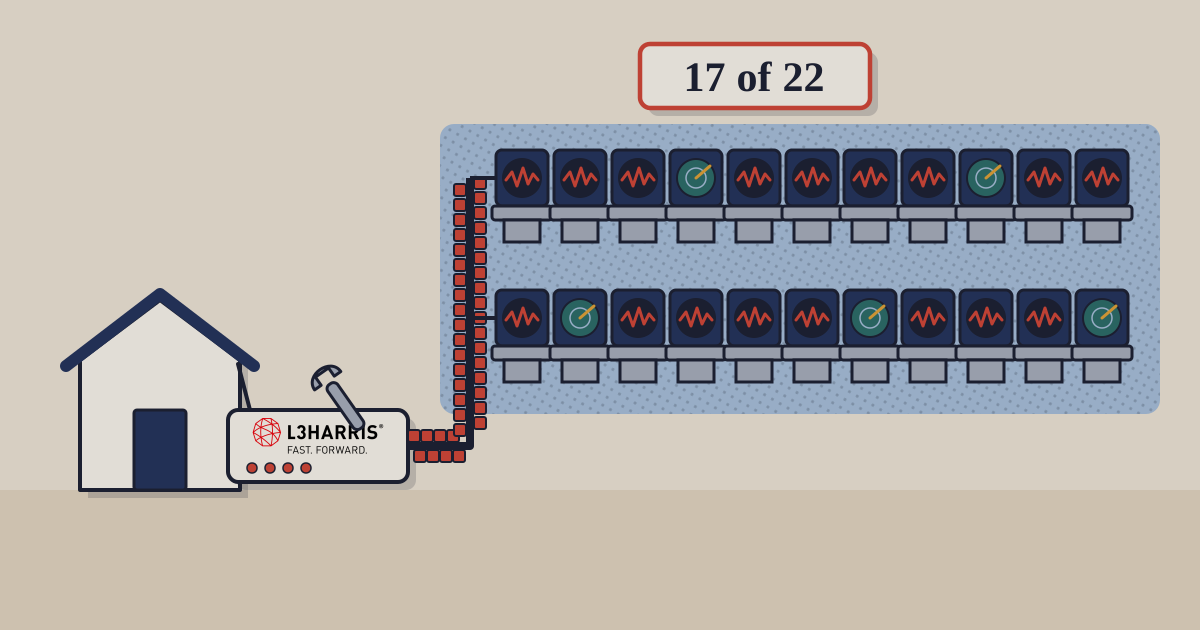
The FAA’s account of 13 November: a data flood on its telecom network, 17 of 22 en-route centres unstable, a 4-hour 25-minute nationwide stop and about 12,462 cancellations that day.

A ground stop of the whole United States began with routine work at a remote site. Anyone who runs a network, an airline schedule or a payments system will want to know how one router job travelled that far, why the FAA points at its oldest equipment rather than its newest, and what was changed afterwards. We read the FAA’s answers, its command centre’s advisories, L3Harris’s statement and the FAA’s own paper on its network, and set the week’s other outages beside it, each with the cause its owner gave.
01Four hours and 25 minutes with every departure held
The FAA says that “on November 13 at approximately 3:30 p.m. ET, the FAA experienced a technical problem that resulted in issuing a nationwide ground stop.”1 Its Air Traffic Control System Command Center put the order out as advisory 111, signed at 20:54 UTC (3:54pm ET; 2:24am on 14 November in India): “by order of the Federal Aviation Command Center all airports are ground stopped. All departing traffic should remain ground stopped until further notice. Inbound international flights will be managed on a case by case basis.”2 The FAA’s glossary describes a ground stop as a process that “requires aircraft that meet a specific criteria to remain on the ground”, normally tied to one airport, one stretch of airspace or one type of aircraft; here the criterion was every airport.8
The FAA says the system was stable and air traffic resumed “as of 8:15 p.m. that same day”.1 Advisory 005, signed at 01:19 UTC on 14 November (8:19pm ET; 6:49am IST), reads: “The FAA Command Center nationwide ground stop has been cancelled.”3 United Airlines said at 8:10pm Central time that it was resuming operations.9
The nationwide stop ran from 20:54 to 01:19 UTC: an afternoon in the US, the small hours in India
FAA nationwide ground stop of 13–14 November 2026, in UTC, with Eastern and India times in each detail
Show tableHide table
| Date | Event | Detail |
|---|---|---|
| 13 Nov, 20:30 UTC | Instability begins | FAA: about 3:30pm ET; 2:00am IST, 14 Nov |
| 13 Nov, 20:54 UTC | Advisory 111: all airports stopped | 3:54pm ET; 2:24am IST |
| 13 Nov, 21:30 UTC | United holds new domestic departures | Statement at 3:30pm CT (4:30pm ET); 3:00am IST |
| 14 Nov, 01:15 UTC | Traffic resumes | FAA: 8:15pm ET; 6:45am IST |
| 14 Nov, 01:19 UTC | Advisory 005: stop cancelled | 8:19pm ET; 6:49am IST |
| 14 Nov, 02:10 UTC | United resumes operations | Statement at 8:10pm CT (9:10pm ET); 7:40am IST |
Source: FAA Q&A (15 November); ATCSCC advisories 111 and 005; United Airlines statements · as of 17 November 2026, 10:30pm IST · The 20:30 and 01:15 UTC times are the FAA's 'approximately 3:30 p.m.' and '8:15 p.m.' ET
02How one router job reached 17 of 22 centres
The network that failed is the FAA Telecommunications Infrastructure, FTI, which L3Harris operates for the FAA. L3Harris says FTI “securely connects more than 4,400 facilities, manages more than 29,000 services, and supports the safe operation of 45,000 daily flights”, and that “every clearance delivered to a pilot, every radar return displayed to a controller” flows through it.56 The FAA calls L3Harris “the FAA’s current network service provider”.1
The FAA’s account of the failure is short. “The FAA’s legacy equipment became unstable when data began flooding the FAA FTI network, at a rate of 1,000 connection attempts every 4 to 5 seconds. This disrupted the system and created instability with aircraft communications and radar feeds.” The initial investigation points to “two potential locations”: a radar site in Amarillo, Texas, and a radio communications site in El Dorado, Arkansas. “L3 Harris … had been doing work at the El Dorado site, including deployment of a new router.” When the inconsistencies appeared, L3Harris blocked both locations “and the network stabilized”.1
A flood from two remote sites unsettled the shared network until both were cut off
The FAA's account of the 13 November 2026 failure on its FTI telecommunications network, in four steps
- 01
Router work at a remote site
L3Harris deploys a new router at a radio site in El Dorado, Arkansas, during the day. A radar site in Amarillo, Texas, is the second suspected source. - 02
A flood on the shared network
Data floods FTI at “1,000 connection attempts every 4 to 5 seconds”. - 03
Legacy equipment wobbles
Radio and radar feeds turn unstable at 17 of 22 en-route centres, then at several TRACONs; some frequencies and feeds keep working. - 04
Block, disable, wait
Both sites are blocked; the router function is disabled on more than 60 similar routers; the stop lifts once the network has held.
Source: FAA, Nationwide Ground Stop: Questions and Answers · as of 15 November 2026 · Initial findings; the FAA and L3Harris are still investigating the root cause
The FAA has not described the flood beyond its rate. It says “the broadcasting function was also disabled on all the new routers as a precaution”, and later that “we disabled the same functionality on more than 60 similar routers in the system.”1 In networking, a broadcast is a message a device sends to every other device on its segment. The FAA has not said what the routers were broadcasting, or why the El Dorado installation began to.
On timing, the FAA’s answer is direct: “Maintenance at major air traffic control facilities is typically conducted at night, when there’s less traffic. This disruption was a result of a routine replacement at a remote facility, which has regularly been done for decades, without any impacts to the systems at these times.” It adds: “based on what happened Friday, we will reevaluate when we do replacement/maintenance work.”1 L3Harris’s own description of its method is a “build-then-switch” approach, “cutting over during carefully coordinated low-traffic periods with full backup systems in place”.6
03Seventeen centres, 3,500 aircraft and 12,462 cancellations
“We began experiencing instability at 17 of our 22 Air Route Traffic Control Centers, and it spread into several Terminal Radar Approach Controls,” the FAA says.1 The two are different layers of the same system. In the FAA’s glossary, an Air Route Traffic Control Center is “a facility established to provide air traffic control service to aircraft operating on IFR flight plans within controlled airspace and principally during the en route phase of flight”: the cruise between airports. A radar approach control facility, the TRACON, is “a terminal ATC facility that uses radar and nonradar capabilities to provide approach control services to aircraft arriving, departing, or transiting” the airspace around an airport.8 The instability reached most of the cruise layer and part of the layer that brings aircraft down.
Instability reached 17 of 22 centres; every aircraft in the air landed safely
The FAA's figures for the 13 November 2026 nationwide ground stop
17 of 22
en-route centres (ARTCCs) with unstable radio and radar feeds
FAA
~3,500
aircraft in the air when the stop began; all landed safely
FAA
~12,462
flights cancelled by operators on 13 November, 9,082 of them by major airlines
FAA
60+
similar routers with the same function disabled
FAA
Source: FAA, Nationwide Ground Stop: Questions and Answers · as of 15 November 2026 · Cancellations are all operators' cancellations that day; the FAA says not all were caused by the stop
It was not a blackout. “No, this was not a full outage. Some frequencies and radar feeds remained reliable,” the FAA says, and “frequencies remained available to safely land commercial aircraft” while life-saving, law-enforcement and military flights went on. “Approximately 3,500 aircraft safely landed, and every passenger arrived safely.”1 On cancellations the FAA’s wording is careful, and we quote it in full: “operators canceled approximately 12,462 flights, including 9,082 cancellations by major airlines, out of an abundance of caution. While not all cancellations were directly caused by the nationwide ground stop, all flights landed safely.”1
On the cause, the FAA is equally plain: “Based on all available evidence, we have no indication that this was a cyberattack or an outside nefarious actor.”1 L3Harris says it is “supporting the FAA in its investigation to understand the conditions that led to the Nov. 13 ground stop”.4 United’s chief executive, Scott Kirby, wrote on 15 November that the air traffic control system “needs more investment in modern technology to ensure better redundancy and reliability now.”10
04The FAA blames its legacy TDM equipment, not the move to fibre
Asked whether its upgrades caused the failure, the FAA says: “No, this is due to the legacy TDM system causing instabilities. None of the upgraded towers that received modifications from the down payment in the Working Families Tax Cuts went down.” It describes the work as years of moving “from old copper wires that are being disconnected due to their obsolescence”, and asks readers to “distinguish routine equipment upgrades from the FAA’s broader modernization effort.”1
TDM, time-division multiplexing, gives each connection a fixed, recurring slot on a circuit, the way telephone networks were built; IP networks send traffic as packets that can be routed around a fault. The FAA’s own FTI programme office set out how much of its operational network still runs the old way in a 2015 paper: “more than 90% of the 23,000+ services obtained under the FTI contract are TDM-based and support critical NAS services such as surveillance radar, air/ground voice, and interphone (ground/ground voice).” Carriers had said they would retire TDM services “as early as 2020”.7
The FAA's own paper: TDM carried over 90% of FTI services; IP was the more flexible path
The two network types as the FAA's FTI programme office and L3Harris describe them, 2015 to November 2026
TDM on copper: the legacy
- More than 90% of 23,000+ FTI services in 2015
- Carries surveillance radar, air/ground voice and interphone
- Required by the interfaces of the systems that plug into it
- The equipment the FAA says became unstable on 13 November
IP on fibre: the replacement
- “More cost-effective”, in the FAA’s 2015 words
- Can “dynamically route communications”, improving resiliency
- Fibre, satellite and wireless links, says L3Harris
- More than 70% of the conversion done by 14 November
Source: FAA FTI-2 Program Office, TDM-to-IP Migration (27 October 2015); L3Harris (11 May and 14 November 2026) · as of 17 November 2026 · The 90% share is the FAA's 2015 figure; no newer split has been published
The pace of the change is in L3Harris’s own updates. On 11 May it said it had completed 50% of the effort, was deploying 150 to 200 new network paths a month, and was “on track for completion in 2027”.6 On 14 November it said that L3Harris, “together with its telco partners and the FAA, has completed more than 70% of the planned airspace communications conversion from legacy copper wires to a fiber optic system.”4 Its FTI page claims “99.99971% network reliability by working during maintenance windows, deploying parallel systems and coordinating closely with FAA technical operations staff”; that is L3Harris’s figure, and it does not say over what period.5 The failure came mid-conversion: the FAA names a newly installed router as one likely source, and its legacy equipment as what became unstable.
05The same week: three more outages, three more stated causes
Three other services that Americans use every day failed between 12 and 16 November. Each company gave its own account of the cause, and none of them connects its failure to any other. We set them side by side because they fell in the same five days; nothing in any of the statements says they were linked. Earlier in the month, a fault in AWS’s Tokyo region ran 5 hours 45 minutes, and Google Cloud’s 6-hour London outage began with generators that got no start signal.
Four outages in five days, four different stated causes, and none claimed as an attack
Outages felt in the US, 12 to 16 November 2026: what failed, when, and the cause as its owner stated it
Open the table for the four outages, side by side:
Show tableHide table
| Outage | When (UTC) | Cause, as stated | Cyberattack? |
|---|---|---|---|
| FAA telecom network (FTI): nationwide ground stop | 13 Nov, stop 20:54 to 01:19 (14 Nov) | Data flood from two remote sites, one with a new router; legacy TDM equipment unstable | FAA: no indication |
| Microsoft 365 networking gateway (Exchange Online hit hardest) | 12 Nov to 14 Nov 06:09 | Latent defect in a fix deployed from July: lock contention, set off by a failover and missing capacity | Not addressed in the abridged report |
| JPMorgan Chase transactions | 16 Nov; statement 20:57 | A software bug in on-premise hardware systems | Chase: no evidence |
| United Airlines departures | 16 Nov; resolved about 23:00 | Not stated by United; reported loss of pilots' final weight data | United: no indication |
Source: FAA; Microsoft; JPMorganChase; United Airlines; AeroTime (dates in Sources) · as of 17 November 2026, 10:30pm IST · United has not stated a cause; the weight-data detail is reported, not United's statement
Sources
- FAA: Nationwide Ground Stop: Questions and Answers — 15 November 2026
- FAA ATCSCC Advisory 111: National Ground Stop — 13 November 2026, signed 20:54 UTC
- FAA ATCSCC Advisory 005: CNX Nationwide Ground Stop — 14 November 2026, signed 01:19 UTC
- L3Harris: Statement on the Nov. 13 Ground Stop — 14 November 2026
- L3Harris: FAA Telecommunications Infrastructure (FTI) — progress tracker last updated 2 November 2026
- L3Harris: L3Harris Reaches Over 50% in FAA Telecommunications Modernization — 11 May 2026
- FAA, FTI-2 Program Office: TDM-to-IP Migration — 27 October 2015
- FAA: Pilot/Controller Glossary (Air Route Traffic Control Center; Radar Approach Control Facility; Ground Stop) — edition in force, November 2026
- United Airlines: Statements on FAA's Nationwide Ground Stop — 13 November 2026, updated 14 November 8:50am CT
- United Airlines: An Update on the FAA Nationwide Ground Stop from Scott Kirby — 15 November 2026
- Charles Lamanna (Microsoft) on X: abridged preliminary post-incident report on the Microsoft 365 networking gateway outage — 16 November 2026, 06:06 UTC
- Microsoft 365 Status on X: service restored to the remaining impacted customers and regions — 14 November 2026, 06:09 UTC
- JPMorganChase (@Chase) on X: statement on the transaction delays — 16 November 2026, 20:57 UTC
- CNBC: JPMorgan Chase says temporary software bug is affecting consumer banking — 16 November 2026
- United Airlines (@united) on X: technology-related issue resolved — 16 November 2026, 23:13 UTC
- AeroTime: United outage delays departures as pilots lose access to aircraft weight data — 17 November 2026, 00:58 UTC
- Fox Business: Details emerge about United Airlines outage that forced departure delays (United's statement; AP report) — 17 November 2026, 7:35am EST
- Reserve Bank of India: Master Direction on Information Technology Governance, Risk, Controls and Assurance Practices, paragraph 13 — 7 November 2023; in force from 1 April 2024
Disclosure. TechBag is a software reseller: it earns when companies buy through it, including from vendors named here. The analysis is TechBag’s own; no vendor paid for or saw this piece before publication. Facts are labelled reported, TechBag count or our view.
Keep reading