MapmyIndia: automotive revenue up 52%, government down 38%
MapmyIndia’s results for July to September: how a map company earns per vehicle, per API call and per solution, and why its quarters swing on one-off hardware and government work.

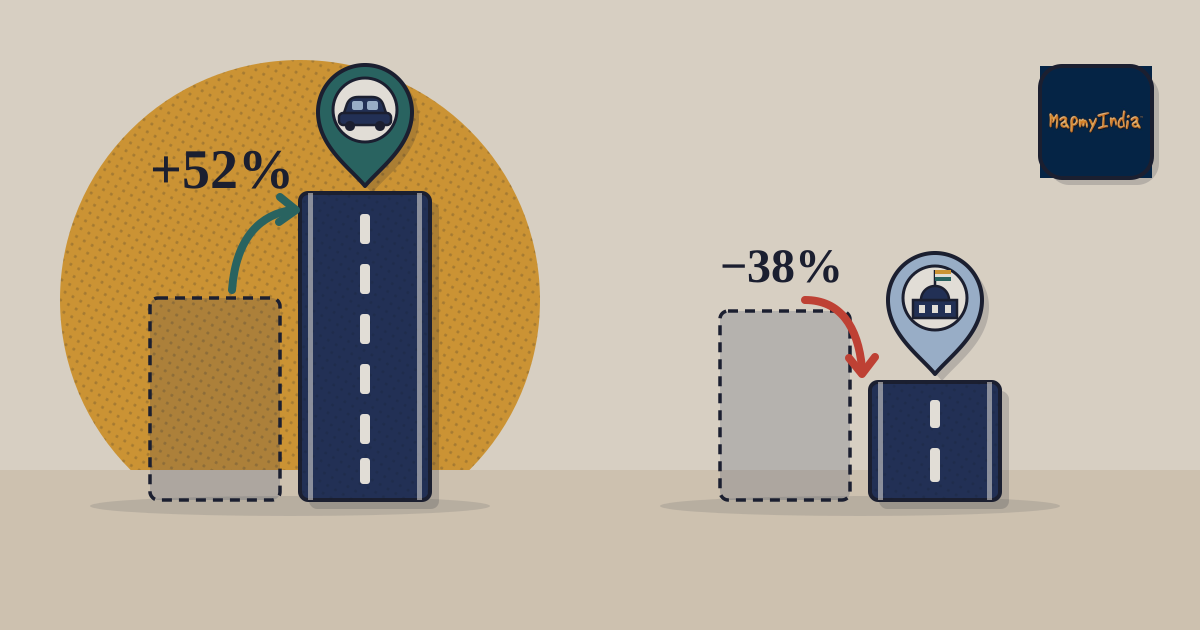
Vehicle makers and the businesses around them paid MapmyIndia ₹71.3 crore in the three months to September, 51.9% more than a year earlier and 54% of its revenue; government work fell 37.5% to ₹27.5 crore.1 Revenue from operations rose 15.8% to ₹131.7 crore and profit after tax 90.6% to ₹35.3 crore, the figure in the company’s headline. That profit is measured against a weak quarter: a year earlier it had fallen 39.2%, to ₹18.5 crore from ₹30.4 crore.2
01How a map company earns
C.E. Info Systems, which trades as MapmyIndia and Mappls, prices “per vehicle, per API transaction, per user, per solution”, for set periods. It earns three ways: licences and subscriptions for maps, software and platforms; sales of devices, or devices rented as a service; and solutions and systems integration.1
Two product lines carry that. Map-led (maps, navigation, analytics, GIS) brought in ₹76.7 crore at a 41.6% EBITDA margin. IoT-led (telematics units, dash cameras, infotainment hardware, and mobility and logistics software) brought in ₹55.1 crore at 23.8%.1 The deck names the cars: the Mahindra BE6 Sporteq, Maruti Suzuki Brezza and Force Motors Urbania went live on its NCASE in-car suite, and the Bajaj Pulsar 125, Samarth Mobility Avore and Ampere Magnus GMax on its two-wheeler stack; VinFast widened its telematics deployments. Enterprise and government customers are unnamed: a parcel company, a quick-commerce customer that “scaled parcel volumes 5x”, an NBFC underwriting with its Geo-Fi product, a bank verifying customers with Geo-Verify, an oil and gas GIS order, and a “National Indirect Tax Territory Planning” win. PhonePe, with 13.64%, is its largest shareholder outside the promoters.1
02Why its quarters swing
Automotive revenue rose 52% from a weak quarter and is 6% above two years ago; government's one-off has passed
MapmyIndia revenue from operations by market, July–September quarter, FY25 to FY27, ₹ crore
- Jul–Sep 2024
- Jul–Sep 2025
- Jul–Sep 2026
₹ crore
Show tableHide table
| Jul–Sep 2024 | Jul–Sep 2025 | Jul–Sep 2026 | |
|---|---|---|---|
| Automotive | 67.1 | 46.9 | 71.3 |
| Enterprise | 21 | 22.9 | 33 |
| Government | 15.5 | 44 | 27.5 |
Source: C.E. Info Systems (MapmyIndia), investor presentation Q2 & H1 FY2027, slide 6 · as of 4 November 2026 · segments as restated by the company in FY27; FY = April to March
The company gives the reasons. Government revenue fell because of a “one-off revenue win last year”. Hardware sales rose to ₹33.1 crore from ₹13.3 crore; higher hardware revenue in the half year “primarily reflects capex-based sale as part of a line-fit programme with a new OEM entrant”, devices bought outright for fitting at the factory rather than rented as a service. IoT services fell to ₹22.0 crore from ₹37.8 crore as a large government IoT project moved from upfront technical-services revenue to a recurring subscription.1 A year ago the same deck blamed that quarter’s margins on a government project’s upfront outsourcing cost, “lumpy” corporate map revenue and a larger loss at its international joint venture.2
03What to watch
Customers took 122 days on average to pay in the half year, against 120 a year earlier, while inventory fell to 48 days from 108.1 The chairman and managing director, Rakesh Verma, says the company is “embedding AI, ML and neural networks across our map-led and IoT-led platforms”. Two things to watch in the next deck: how much of the growth is hardware (₹56.1 crore of the half year’s IoT-led revenue, against ₹20.5 crore a year earlier), and whether enterprise returns to the first quarter’s ₹64.2 crore.1
Sources
Disclosure. TechBag is a software reseller: it earns a margin when a reader buys through it, including from vendors named here. The analysis is TechBag’s own; no vendor paid for or saw this piece before publication. Facts are labelled reported, TechBag count or our view.
Keep reading