Cloud & DevOpsAnalysis
Only Commvault covers all 7 workloads; 18 backup products use 7 price units
Commvault Cloud against 17 other backup products on workload coverage, hypervisor support and licensing unit, counted from TechBag's Backup & Recovery guide, September 2026.

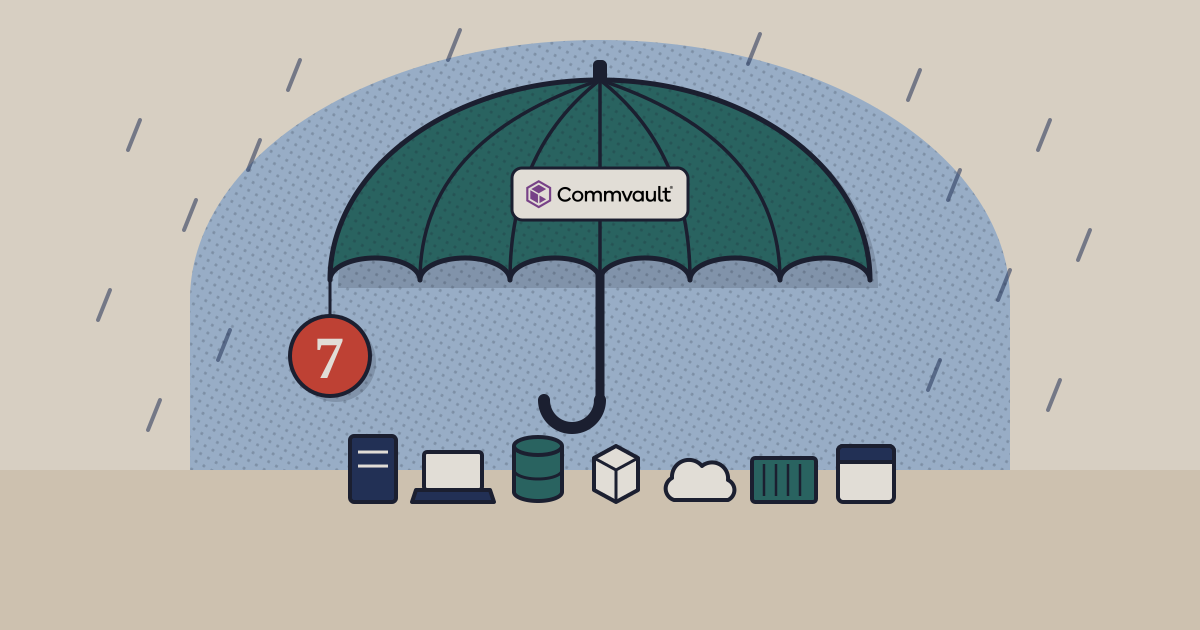
The product the 2024 version of this piece described, Commvault Complete, is no longer sold under that name; Commvault’s backup, SaaS, recovery and cloud products now sit under one platform, Commvault Cloud.2 The buyer’s question has not changed: if your data is spread across VMware, a database cluster, AWS, Azure and a few hundred laptops, is one vendor’s platform the simplest answer, and what does that breadth cost? TechBag’s Backup & Recovery guide documents 18 products from 11 vendors against the same fields, which lets us answer with counts rather than adjectives. TechBag sells Commvault in India, as it does most vendors in that guide; the counts below come from vendor documentation, not from Commvault.
01Breadth: one product covers all seven workload types
The guide records, for each product, which of seven workload types its documentation says it protects: physical servers, virtual machines, public-cloud workloads, Kubernetes, databases, NAS and file shares, and endpoints.1 Commvault Cloud Backup & Recovery is the only product with all seven. Cohesity DataProtect, NetBackup (now Cohesity’s) and Rubrik’s Enterprise Edition cover six; none of the three documents laptop backup. Eight of the 18 cover one or two types, by design: Kasten does Kubernetes, Druva’s inSync does laptops.
Only Commvault's core product is documented for all seven workload types; three rivals stop at six
Number of workload types each product documents protecting (of 7), the ten broadest of 18 products, September 2026
Source: TechBag Backup & Recovery guide, vendor documentation verified 22 August 2026, TechBag count · as of 30 September 2026 · eight narrower products, covering one or two types, are not shown
“Multi-cloud” at Commvault is three products, not one. The core product protects cloud workloads in the same catalogue as the data centre. Clumio, acquired in October 2024, protects AWS only, outside your own account, on a published meter of US$0.012 per GiB-month, with restores at US$0.08 per GiB plus AWS transfer.3 Cloud Rewind, from the 2024 Appranix acquisition, rebuilds whole applications, infrastructure, networking and configuration included, in AWS, Azure or Google Cloud.4
02Hypervisors: three products follow you off VMware
“Multi-cloud” in most Indian estates starts on premises, and for many of them the platform under the virtual machines is moving; leaving VMware is one of the eight buying scenarios the guide is organised around. Data spread across VMware today may be spread across VMware, Nutanix AHV and Proxmox next year, mid-migration, with the backup product the one thing that should not change at the same time. The guide records which of four hypervisors each product documents protecting.1
VMware and Hyper-V are table stakes; only 4 of 18 document Proxmox and 3 document all four
Backup products documenting protection for each hypervisor, count of 18 products in TechBag's Backup & Recovery guide, September 2026
- Documented
- Not documented
Table view
| Documented | Not documented | |
|---|---|---|
| VMware | 10 | 8 |
| Hyper-V | 10 | 8 |
| Nutanix AHV | 7 | 11 |
| Proxmox | 4 | 14 |
| All four | 3 | 15 |
Source: TechBag Backup & Recovery guide, vendor documentation verified 22 August 2026, TechBag count · as of 30 September 2026 · Proxmox: Veeam Data Platform, Commvault, both Acronis products; all four: Commvault, Veeam Data Platform, Acronis Cyber Protect Cloud; eight products protect no hypervisor by design
The drop-off is the point. Cohesity DataProtect, NetBackup and Rubrik, three of the four broadest products in section 01, document AHV but not Proxmox; so does Druva Hybrid Workloads. Commvault is one of only three products that covers all four, alongside Veeam Data Platform and Acronis Cyber Protect Cloud.1 The guide’s own caution applies to all of them: Proxmox support is newer everywhere, so test a restore onto the new hypervisor, not just a backup from the old one, before the cut-over.
Where the copies sit is the other filter, and it splits Commvault in two: its core SaaS documents an India region, Clumio does not.2 3 Our note on DPDP Rule 6 counts that column across all 18 products.
03Price: seven units for eighteen products
Commvault’s SaaS list is US$58.50 to US$90 per TB a month, from virtual machines and Kubernetes at the low end to databases at the high end; the on-premises software is priced per front-end TB on quote.1 That is one of seven licensing units in the guide, and the units do not convert into one another.
Per-TB pricing is the most common unit, but 13 of 18 products bill on something else
Products by licensing unit, of 18 in TechBag's Backup & Recovery guide, September 2026
Source: TechBag Backup & Recovery guide, vendor documentation and price pages, TechBag count · as of 30 September 2026
Even inside the per-TB group the meters differ: Commvault’s SaaS list is per TB a month, Rubrik’s reported figure of about US$130 is per back-end TB a month on three-year terms, and NetBackup’s reported US$400 to US$900 is per front-end TB a year. The guide’s note is blunt: the same estate can cost three times more or less depending only on which unit the vendor chose, and every line excludes the storage the backups sit on, which is often larger than the licence.1
04What to settle before the contract
The 2024 post praised Commvault’s compliance reports and called its interface intuitive. Neither is measurable from documentation, and the guide’s own limitation line, that breadth is also the learning curve, cuts against the second. What can be measured is restore speed, and no datasheet in the category prints it. Nine of the 18 products document instant recovery, booting or mounting a machine straight from the backup, Commvault’s core product among them.1 The guide’s point is that the number that matters, how many virtual machines per hour come back over your network from your repository, is a proof-of-concept figure, not a brochure one.
Four checks turn Commvault's breadth into a price you can compare with anyone else's
The order TechBag applies to a multi-workload backup shortlist, from the guide's reference notes, September 2026
- 01
Count your workload types
Map the estate to the seven types. Four or more in production is where one platform starts to pay.
- 02
Get residency in writing
Per product, not per vendor: Commvault’s SaaS documents India; Clumio does not.
- 03
Price one estate document
VM count, front-end TB, three-year growth, restores a year, and storage priced separately.
- 04
Time a restore
Run a proof of concept with a timed restore of your largest workload as the pass mark.
Source: TechBag Backup & Recovery guide, reference notes on restore speed, immutability, licensing units and storage · as of 30 September 2026
Immutability is the other question to settle on paper. The guide sorts the 18 products into three patterns: enforced on a target you configure, enforced on the vendor’s storage, or enforced by the platform’s own software. Commvault’s core product is in the first group, so its copies are as tamper-proof as the object lock or hardened repository you point it at. That is a design task for your team or your partner, and it belongs in the statement of work, not in a later change request.1
Sources
- TechBag, Backup & Recovery guide (18 products: workload coverage, India residency, licensing unit, price) — version committed 30 September 2026; vendor documentation verified 22 August 2026
- TechBag, Commvault vendor hub (Commvault Cloud platform; Azure regions including India; Air Gap Protect) — version committed 30 September 2026
- TechBag, Commvault Clumio intel page (acquired October 2024; AWS only) — version committed 30 September 2026
- TechBag, Commvault Cloud Rewind intel page (from the 2024 Appranix acquisition) — version committed 30 September 2026
- DPDP Rules, 2025, Rule 6 (reasonable security safeguards: data-backups; one-year retention of logs) — notified 13 November 2025
- MeitY, Digital Personal Data Protection Act, 2023 and DPDP Rules, 2025 (substantive duties from 13 May 2027) — 13 November 2025
- CERT-In, Directions under section 70B(6) of the IT Act (six-hour reporting; 180-day logs within India) — 28 April 2022
- RBI, Cybersecurity, Technology Risk and Resilience Framework Directions, 2026, via practitioner summary — 31 July 2026 RBI PDF not fetched.
- SEBI, Cybersecurity and Cyber Resilience Framework (CSCRF) for SEBI Regulated Entities — 20 August 2024; in force 31 August 2025
Disclosure. TechBag is a software reseller: it earns a margin when a reader buys through it, including from vendors named here. The analysis is TechBag’s own; no vendor paid for or saw this piece before publication. Facts are labelled reported, TechBag count or our view.
Keep reading