Urban Company opens a ₹2,500 crore share sale; InstaHelp lost ₹306 crore in six months
Urban Company’s placement of 16 November and its July–September results: a ₹161.03 floor, ₹600 crore for InstaHelp, and where the house-help service’s loss comes from.

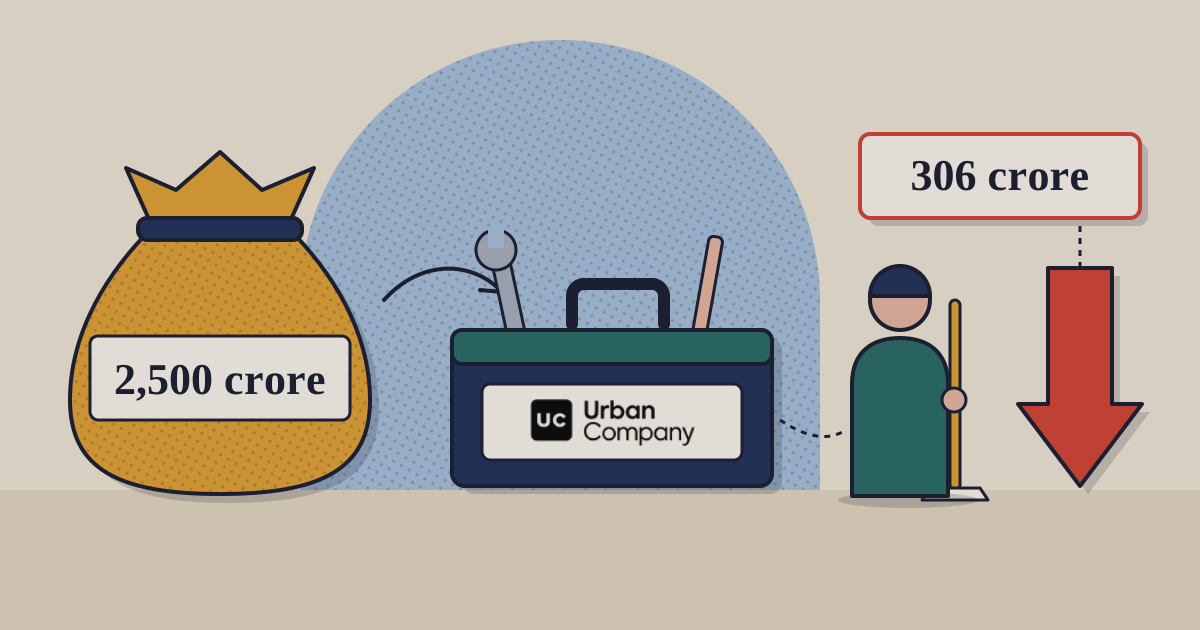
Urban Company opened a sale of new shares to institutional investors on 16 November to raise up to ₹2,500 crore, at a floor price of ₹161.03 a share, with the option to price up to 5% below it.1 The largest single use it names is up to ₹600 crore “to grow InstaHelp business”.2 InstaHelp, the house-help service it sells as “instant” and its results describe as covering households’ daily cleaning and housekeeping, lost ₹306 crore in April–September on Urban Company’s adjusted EBITDA measure, more than the ₹235 crore it lost in the whole year to March 2026. Everything else Urban Company runs earned ₹97 crore on the same measure in the half.3
₹2,500 cr
share sale to institutions, opened 16 November at a ₹161.03 floor
NSE filing
₹600 cr
of it earmarked to grow InstaHelp, the largest named use
NSE filing
−₹306 cr
InstaHelp’s adjusted EBITDA, April–September; −₹235 crore in all of FY26
Urban Company
₹97 cr
adjusted EBITDA of everything else, April–September
Urban Company
01What is on sale, and what for
A qualified institutions placement sells new shares only to institutional buyers such as mutual funds and insurers, without a public offer, at no less than a floor that SEBI’s pricing formula sets from recent trading prices.1 The board approved the raise on 16 October and shareholders passed it by postal ballot on 15 November, with 99.29% of votes cast in favour.4 Morgan Stanley, Emkay Global and Kotak Mahindra Capital are the bankers. Besides InstaHelp, the filing names up to ₹540 crore for marketing, ₹200 crore for technology and cloud infrastructure, ₹85 crore for office rent and ₹50 crore for research on Native, its water purifiers and smart locks; the rest goes to acquisitions and general corporate purposes, the second capped at 25% of the proceeds.2 Inc42, reading the placement document, reports the InstaHelp money spread as ₹150 crore this year, ₹300 crore in FY28 and ₹150 crore in FY29.6 At the floor price, ₹2,500 crore buys about 15.5 crore new shares, about a tenth of the 154.2 crore in issue.
Urban Company held ₹1,901 crore of cash and treasury investments at 30 September.3 On the results call, chief executive Abhiraj Singh Bhal said that for the existing businesses and InstaHelp “the current balance sheet is more than sufficient”, and that the new money is “to provide strategic cushion, and definitely to look at any interesting inorganic opportunities”.5
02Where InstaHelp’s loss comes from
InstaHelp delivered 6.2 million orders in July–September, 63% more than in April–June, but the net value of each order fell to ₹114 from ₹138 the quarter before and ₹170 a year earlier. Over the half it averaged about ₹123, against about ₹165 a year earlier. Urban Company puts the fall down to “competitive intensity and introductory pricing for new users”. The loss on each order narrowed to ₹279 from ₹346, which it attributes to density: more orders in each neighbourhood mean shorter travel between jobs and lower support cost per order. More orders at a lower price still widened the quarter’s loss to ₹174 crore from ₹132 crore.3
InstaHelp’s loss grew every quarter, to ₹174 crore in July–September
Urban Company: InstaHelp adjusted EBITDA loss by quarter, ₹ crore, April 2025 to September 2026
Source: Urban Company, Q2 FY27 shareholders’ letter, InstaHelp financial metrics · as of 16 October 2026 · Adjusted EBITDA is Urban Company’s measure; losses shown as positive bars
The company expects losses “to remain elevated for a few more quarters”, keeps its target of adjusted EBITDA breakeven for the whole group by October–December 2027 and ₹1,000 crore of it by FY31, and says that where InstaHelp runs beside its other services, about 45% of new users now arrive through it.3 Bhal put InstaHelp’s own breakeven target “as far out as FY31”.5
03The first day of trading
On 17 November, the first session after the issue opened, the shares fell 5.9% on NSE to ₹161.63, sixty paise above the floor, after touching ₹160.50; about 28.8 million shares changed hands, against 2.9 million the day before.7 On BSE they closed 5.80% lower at ₹161.65.6 What to watch: the issue price and the number of shares allotted, which Urban Company must file with the exchanges when the placement closes. For how another listed Indian company’s cash ran down in the same quarter, see Kaynes Technology’s results.
Sources
- Urban Company, outcome of Fund Raise Committee meeting: opening of the qualified institutions placement, floor price ₹161.03 (NSE) — 16 November 2026
- Urban Company, in-principle QIP filing: issue size, lead managers and objects of the issue (NSE, XBRL) — 16 November 2026
- Urban Company, Q2 FY27 shareholders’ letter and unaudited results (NSE) — 16 October 2026
- Urban Company, voting results and scrutiniser’s report of the postal ballot (NSE) — 15 November 2026
- Urban Company, Q2 FY27 earnings conference call transcript (NSE) — 16 October 2026
- Inc42, Urban Company To Use ₹600 Cr From QIP To Expand InstaHelp (reading the preliminary placement document; BSE close) — 17 November 2026
- Yahoo Finance, URBANCO.NS daily prices, 16 and 17 November 2026 (quote data, not a primary source) — 17 November 2026
Disclosure. TechBag is a software reseller: it earns when companies buy through it, including from vendors named here. The analysis is TechBag’s own; no vendor paid for or saw this piece before publication. Facts are labelled reported, TechBag count or our view.
Keep reading