Markets & the AI economyAnalysis
Alibaba’s AI labs lost RMB10.5bn, more than its cloud made; net income tripled
Alibaba’s results for July to September: AI cloud revenue up 53%, a RMB10.5bn loss at its AI labs, RMB50.5bn of capex, and net income lifted by investment gains.

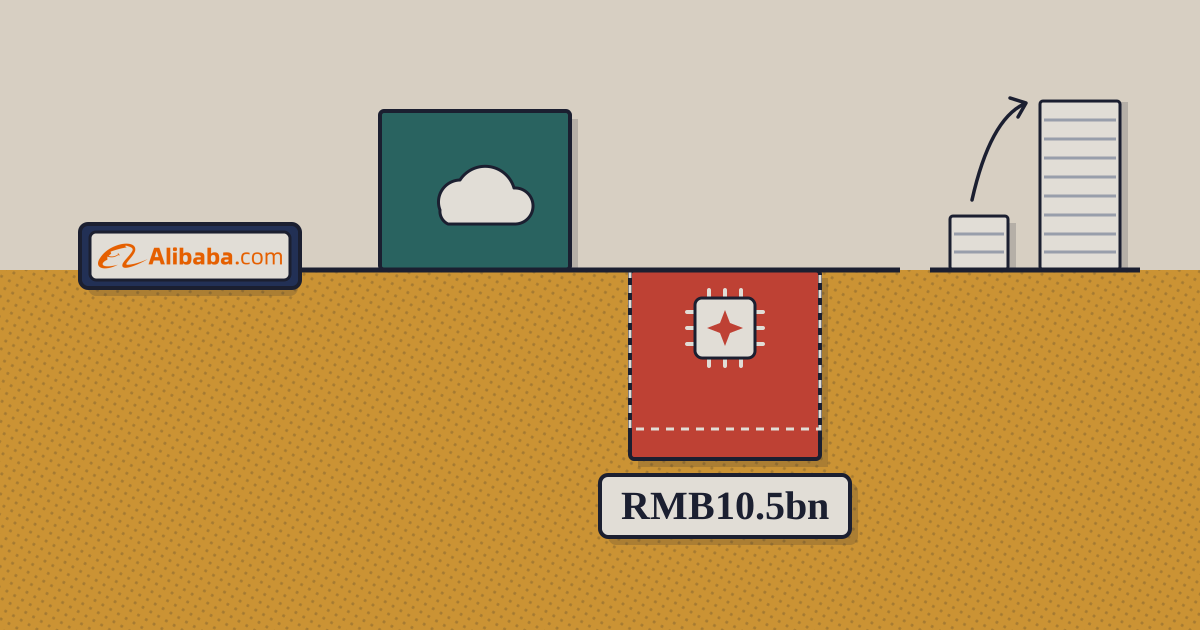
Alibaba split its AI business in two in the April–June quarter: a cloud unit that rents out computing, and a unit that builds models and the apps on top of them. This is the second quarter of the new reporting, and the first in which the split shows what each half earns or costs over a year. We read the 47-page results announcement Alibaba filed with the Hong Kong exchange on 19 November to answer four questions: what kind of revenue the cloud is adding, what the models and apps cost, how the spending on data centres is paid for, and why net income tripled.
01Cloud revenue up 53%, most of it from outside customers
Revenue from AI Cloud and Compute Services, which combines Alibaba Cloud with its chip designer T-Head, was RMB60,973m in the three months to 30 September, up 53% from RMB39,914m. Revenue from external customers rose 64%. Within that, “recurring revenue”, which Alibaba defines as pay-as-you-go or subscription revenue, mainly public cloud and licence renewals, rose 67%; sales of compute equipment rose 55%. Revenue from Alibaba’s own businesses rose 23%.1 On the six-month figures, the unit’s growth in April–June was about 45%, so it sped up.1
Recurring revenue from outside customers rose 67%, to RMB37bn of the cloud unit's RMB61bn
AI Cloud and Compute Services revenue by source, RMB bn, July–September 2025 and July–September 2026
- External: recurring
- External: compute equipment
- Alibaba's own businesses
Show tableHide table
| External: recurring | External: compute equipment | Alibaba's own businesses | |
|---|---|---|---|
| Jul–Sep 2025 | 22 | 7 | 11 |
| Jul–Sep 2026 | 37 | 10 | 14 |
Source: Alibaba Group, September quarter 2026 results announcement (HKEX) · as of 19 November 2026 · Alibaba rounds this table to whole billions
Alibaba also reports “AI-related product revenue” of RMB17,918m, its thirteenth straight quarter of triple-digit growth; the announcement gives neither a definition nor the year-earlier figure. The unit’s adjusted EBITA rose 121% to RMB8,838m, a margin of 14.5% against 10.0% a year earlier.1
For scale: in the same quarter Google Cloud’s revenue grew 103%, Azure 48% and AWS 39%, on our quarterly cloud line.6 In China, Tencent’s cloud revenue rose 35% and Baidu’s AI Cloud Infra 94%.78 Each company draws its cloud line differently; Alibaba’s includes chips and hardware sold.
02The AI labs lost RMB10.5bn, more than the cloud made
AI Labs and Applications brings together Alibaba’s model labs, the Qwen consumer business and QwenWork, its agent platform for companies. Its revenue rose 51% to RMB4,435m. Its adjusted EBITA, Alibaba’s profit measure before share-based pay, amortisation and impairments, was a loss of RMB10,503m, against RMB3,435m a year earlier, “primarily due to our increased investment in AI capabilities, and higher inference cost related to Qwen app.”1 The loss was 2.4 times the unit’s revenue.
AI Labs lost RMB10.5bn, RMB1.7bn more than the cloud unit earned
Adjusted EBITA by segment, RMB bn, July–September 2026 (profit or loss, shown as its size)
Source: Alibaba Group, September quarter 2026 results announcement (HKEX) · as of 19 November 2026 · Losses are drawn as positive bars and labelled; unallocated costs and eliminations of RMB1.2bn not shown
The products behind the loss are named in the announcement: Qwen4-Max, a model with 2.4 trillion “backbone parameters”; the Qwen app, which Alibaba says now handles tasks across more than 20 service categories; Qwen Go!, an agent inside the app launched in October; and QwenWork.1
Commerce paid for it. The E-commerce Group’s adjusted EBITA rose 243% to RMB38,851m, mainly because losses at Taobao Instant Commerce, its quick-delivery business, narrowed. Group adjusted EBITA rose 260% to RMB32,636m.1
04Why net income tripled: RMB73.3bn of investment income
Net income was RMB64,420m, up 213% from RMB20,612m. Alibaba attributes the rise “primarily” to higher net investment income and income from operations. Interest and investment income, net, was RMB73,305m, up 265%, “primarily attributable to the increase in net gain from mark-to-market changes of our equity investments”, partly offset by larger impairments of investments.1 That line equalled about 73% of the quarter’s RMB100,570m of pre-tax income. Income tax rose to RMB37,126m from RMB5,550m.1
Investment income rose to RMB73.3bn, more than twice operating income
Selected profit lines, RMB bn, July–September 2025 and July–September 2026
- Jul–Sep 2025
- Jul–Sep 2026
RMB bn
Show tableHide table
| Jul–Sep 2025 | Jul–Sep 2026 | |
|---|---|---|
| Income from operations | 5.4 | 29.1 |
| Investment income, net | 20.1 | 73.3 |
| Net income | 20.6 | 64.4 |
| Non-GAAP net income | 10.4 | 19.9 |
Source: Alibaba Group, September quarter 2026 results announcement (HKEX) · as of 19 November 2026 · Non-GAAP net income is Alibaba's measure; it excludes investment gains and losses, share-based pay and impairments
Alibaba’s reconciliation shows the parts: RMB87,068m of gains on disposals and revaluations of investments, RMB18,446m of impairments of goodwill, investments and other items, and RMB20,591m of related tax. Without them and share-based pay, non-GAAP net income was RMB19,909m, up 92%. Income from operations rose 443% to RMB29,116m. For the six months, non-GAAP net income fell 7%, after a goodwill impairment of RMB4,458m and a provision for the EUR550m fine the European Commission imposed under the Digital Services Act.1
The results came out after the Hong Kong close. Alibaba’s Hong Kong shares had ended the day at HK$80.55, down 5.5%, and 28.5% below the August placing price.3 In New York, the ADSs traded at about US$85.40 at 1pm, up 1.2% on the previous close, after reaching US$88.15 in the morning.2 Alibaba gave no reason for either move, and we give none.
The figures to watch in the next announcement are the AI labs’ loss against the cloud’s profit, capex against free cash flow, and what Alibaba says the US rule costs it.
Sources
- Alibaba Group Holding, Announcement of the September quarter 2026 results and interim results for the six months ended September 30, 2026 (HKEX) — 19 November 2026
- Yahoo Finance, BABA (NYSE) intraday quote, 19 November 2026 (quote data, not a primary source) — 19 November 2026, 1pm ET
- Yahoo Finance, 9988.HK (Hong Kong) closing quote, 19 November 2026 (quote data, not a primary source) — 19 November 2026
- BIS, US Department of Commerce, Addressing Remote Access to Advanced Semiconductors, interim final rule (RIN 0694-AK50) — 16 November 2026
- The TechBag Journal, US AI chip rule: a licence for Malaysia, Singapore, Thailand, Indonesia and Brazil — 16 November 2026
- The TechBag Journal, Google Cloud revenue doubled in a year; Azure grew 48%, AWS 39% — 2 November 2026
- The TechBag Journal, Tencent’s capex rose 527% to RMB81.4bn as its net cash turned to net debt — 18 November 2026
- The TechBag Journal, Baidu’s ads fell to 48% of its core revenue as AI cloud revenue grew 94% — 16 November 2026
- Federal Reserve, H.10 Foreign Exchange Rates (noon buying rates, 9–13 November 2026) — 16 November 2026
- Press Information Bureau, Cabinet approves ambitious IndiaAI Mission to strengthen the AI innovation ecosystem — 7 March 2024
Disclosure. TechBag is a software reseller: it earns when companies buy through it, including from vendors named here. The analysis is TechBag’s own; no vendor paid for or saw this piece before publication. Facts are labelled reported, TechBag count or our view.
Keep reading