Markets & the AI economyAnalysis
Anthropic raises US$81bn at US$83 a share; its stock opens at US$111.50
Anthropic’s final prospectus of 19 November and its first trades: 980m shares at US$83, US$26.0bn more from seven suppliers, a US$104.0bn nine-month net loss, and who holds the votes.

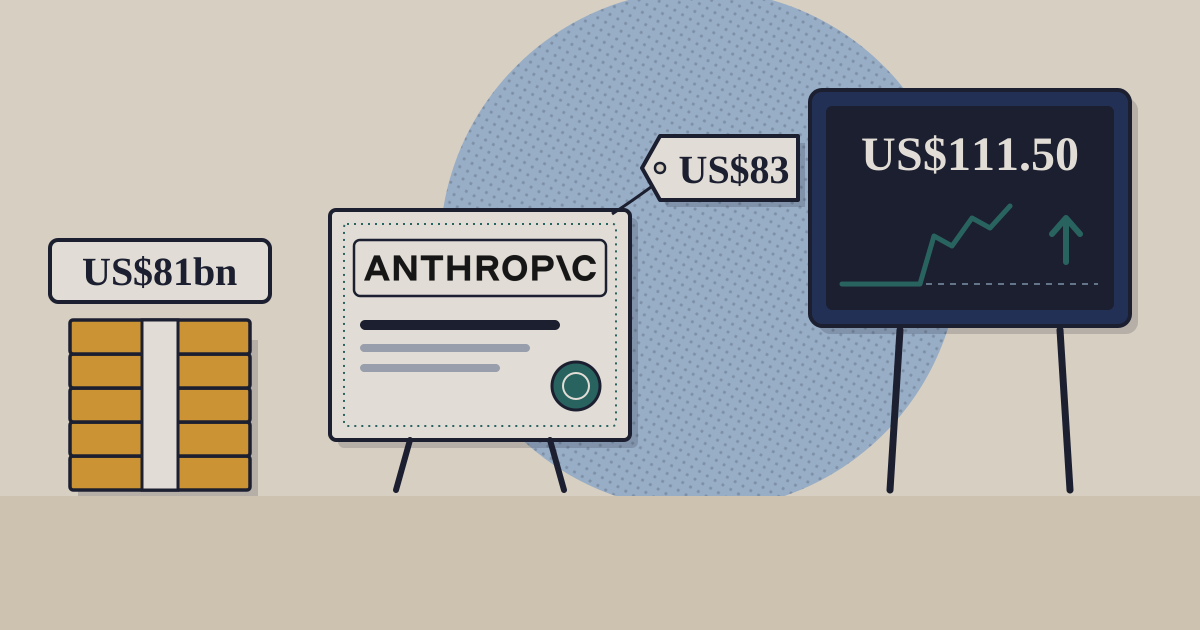
Anthropic, the company behind the Claude models, began trading on the Nasdaq Global Select Market as ANT on 19 November, a day after it priced the offer.2 Its final prospectus, filed that morning, fixes what the 10 November amendment left open: the price, the number of shares and the money raised.1 We read it for four things: what the offer raised and from whom, how US$33bn of revenue ends in a US$104bn loss, what the money has to meet, and who holds the votes. We take no view on the shares.
US$81.34bn
raised by Anthropic’s IPO: 980m Class A shares at US$83.00
Before the underwriters’ option on 147m more shares; the US$26.0bn supplier placement comes on top. Source: Anthropic 424B4, 19 November 2026.
01US$5 above the range, and a first trade at US$111.50
The price is US$5 above the top of the US$70–78 range filed on 10 November, and the offer grew from 825m shares to 980m. Anthropic sells 956,351,354 of them; the seven co-founders sell the other 23,648,646, about US$1.96bn. The underwriters, led by Goldman Sachs and Morgan Stanley, take US$550m, or 0.68%, and have 30 days to buy up to 147m more shares from the company. Settlement is due on or about 20 November.124 The US$81.34bn is more than the US$75.0bn SpaceX raised from its base offering in June, the two companies’ final prospectuses show.15
The first trade was 34% above the offer price; by 1pm the gain was 17%
ANT share price, US$, Nasdaq, 19 November 2026, from the first trade to 1pm New York time (11:30pm IST)
- ANT
- Offer price
US$
Show tableHide table
| ANT | Offer price | |
|---|---|---|
| 11:48 | 111.5 | 83 |
| 12:00 | 105.05 | 83 |
| 12:15 | 98.05 | 83 |
| 12:30 | 101.23 | 83 |
| 12:45 | 97.73 | 83 |
| 13:00 | 96.89 | 83 |
Source: Yahoo Finance one-minute data (not a primary source); offer price from Anthropic's 424B4 · as of 19 November 2026, 1:00pm ET · Intraday; the session closes at 4pm ET
Trading opened at about 11:48am New York time. The shares touched US$114.99 within two minutes and US$95.05 by 12:19pm, and 536m shares had changed hands by 1pm, more than half the number sold in the offer.3
02Where the US$107bn comes from
Before the option, the money comes from three places. Anthropic’s own 956m shares bring in US$79.38bn gross. The co-founders’ US$1.96bn goes to them, not to the company. The third part is a private placement: Google, NVIDIA, AMD, Broadcom, Micron, Microsoft and TSMC Partners will buy 313,253,007 Class N shares for US$26.0bn, immediately after the offer and subject to conditions, with no underwriting fee. Google’s US$10.0bn funds part of an investment it had already committed to.1
A quarter of the US$107.3bn comes from seven suppliers, not the public
Gross money raised at US$83 a share, by source, US$ billion, before the underwriters' option
- IPO shares sold by AnthropicUS$79.38 74%
- Placement to seven suppliersUS$26 24%
- Shares sold by the co-foundersUS$1.96 2%
Show tableHide table
| Value (US$) | Share | |
|---|---|---|
| IPO shares sold by Anthropic | 79.38 | 74% |
| Placement to seven suppliers | 26 | 24% |
| Shares sold by the co-founders | 1.96 | 2% |
Source: Anthropic 424B4; split by source is TechBag arithmetic on the prospectus's share counts · as of 19 November 2026
The seven buyers, as the prospectus lists them at the final price:
Show tableHide table
| Buyer | Class N shares at US$83 | Amount |
|---|---|---|
| 120,481,927 | US$10.0bn | |
| NVIDIA | 120,481,927 | US$10.0bn |
| AMD | 30,120,481 | US$2.5bn |
| Broadcom | 12,048,192 | US$1.0bn |
| Micron | 12,048,192 | US$1.0bn |
| Microsoft | 12,048,192 | US$1.0bn |
| TSMC Partners | 6,024,096 | US$0.5bn |
Class N shares carry no vote and are not covered by the lock-up agreements with the underwriters, though they are restricted securities that can be resold only under a registration or an exemption. After expenses, Anthropic expects about US$104.8bn, or US$117.0bn if the option is taken up in full. The money is for general corporate purposes, including compute and infrastructure, and part goes to tax withholding on employee stock units that settle with the listing; the company says it has no agreements for any material acquisition. The public’s 980m shares are 7.4% of the Class A and Class N shares outstanding.1
03Revenue 13 times a year earlier; a US$104bn loss that is mostly a paper charge
Revenue in the nine months to 30 September was US$33.24bn against US$2.55bn a year earlier, up 1,206%. Consumption-based revenue rose US$24.2bn and subscriptions US$6.5bn. More than 11,900 customers paid US$100,000 or more over the trailing 12 months, against more than 950 a year earlier, and they supplied 74% of revenue. Run-rate revenue was about US$81bn on 31 October, up US$10bn in a month; it annualises 28 days of usage fees and one month of subscriptions, and the prospectus says it is not a forecast.1
The US$104.0bn net loss is mostly paper: US$94.3bn came from notes rising in value
Nine months to 30 September 2026, US$ billion; losses shown as amounts
Source: Anthropic 424B4; nine-month figures summed from the quarterly results · as of 19 November 2026 · The fair-value change is part of the net loss, not in addition to it
The operating business lost US$1.26bn over the nine months: a US$974m profit in the June quarter, then a US$567m loss in September, when compute and infrastructure cost US$9.86bn, 58% of revenue. Operations brought in US$6.6bn of cash, against an outflow of US$2.0bn a year earlier.1
The rest is convertible notes. Amazon’s US$2.19bn of 2023 notes, for example, convert into up to 1.04bn Class N shares, subject to an ownership cap, at the lower of US$2.0928 or the IPO price. At US$83, those shares are worth about US$86.7bn. As Anthropic’s value rose, so did what it owes in shares, and the accounts record each rise as an expense; no cash leaves. Of the US$156.2bn accumulated deficit at 30 September, US$135.1bn is such fair-value changes “driven by increases in our enterprise valuation”, US$94.3bn of it this year. The largest single charge, US$59.6bn, fell in the June quarter.1
The prospectus is plain about the growth rate: “We do not expect our revenue will continue to grow at comparable rates, and we cannot assure you that it will continue to grow at all.” It adds that the company has “struggled to accurately forecast” revenue in the past.1
04What the money meets: two named rivals and US$900.9bn of commitments
The filing names its primary competitors among model makers: Google and OpenAI. “Many have substantially greater financial, technical, and marketing resources than we do,” it says, and they compete for customers, staff, compute and partners. Google is also buying US$10.0bn of the placement, and the filing says Amazon, Google and Microsoft “simultaneously serve as our investors, customers, distribution partners, and competitors”. The five largest customers were about 25% of nine-month revenue, and many can cut spending at any time.1
The commitments run to US$900.9bn, with US$70.7bn due within a year
Compute and infrastructure obligations, US$, as of and after 30 September 2026
US$900.9bn
Purchase commitments and leases, substantially all compute
424B4
US$70.7bn
Due in the 12 months after 30 September
424B4
US$161.2bn
Rent on TPU hardware leased from Broadcom and financing entities
424B4
US$34.9bn
Lambda agreement now terminable by either side
424B4
Source: Anthropic 424B4, Liquidity and Capital Resources and Risk Factors · as of 19 November 2026
About US$451.6bn of the commitments falls before the end of 2030, and arrangements with no fixed dollar figure add an estimated US$150bn to US$175bn. The Broadcom leases are finance leases, with rent of about US$161.2bn over their life, excluding interest. Of US$41.3bn agreed with Lambda, the August agreement, about US$34.9bn, can be ended by either side because Lambda did not secure a facility lease in time; neither has given notice, and Anthropic says it does not intend to. Against this, the company held US$95.6bn of cash and US$36.3bn of short-term investments at 30 September, before the offering, and US$14.8bn of undrawn credit.1
Sources
- Anthropic, PBC: prospectus filed under Rule 424(b)(4) — filed 19 November 2026
- Anthropic: Anthropic prices initial public offering — 18 November 2026
- Yahoo Finance: Anthropic, PBC (ANT), one-minute price and volume data — 19 November 2026, to 1:00pm ET quote service, not a primary source
- Anthropic, PBC: Form S-1/A, Amendment No. 2 — filed 10 November 2026
- Space Exploration Technologies Corp.: prospectus filed under Rule 424(b)(4) — filed 12 June 2026
- Reserve Bank of India: Master Direction, Liberalised Remittance Scheme — updated 6 September 2024
Disclosure. TechBag is a software reseller: it earns when companies buy through it, including from vendors named here. The analysis is TechBag’s own; no vendor paid for or saw this piece before publication. Facts are labelled reported, TechBag count or our view.
Keep reading