Markets & the AI economyAnalysis
Dell’s revenue doubled to US$54.9bn; its AI backlog reached US$132.3bn
Dell’s results for August to October: where the 103% growth came from, what a US$132.3bn AI backlog is, how much servers earn, why PC profit fell, and the raised outlook.

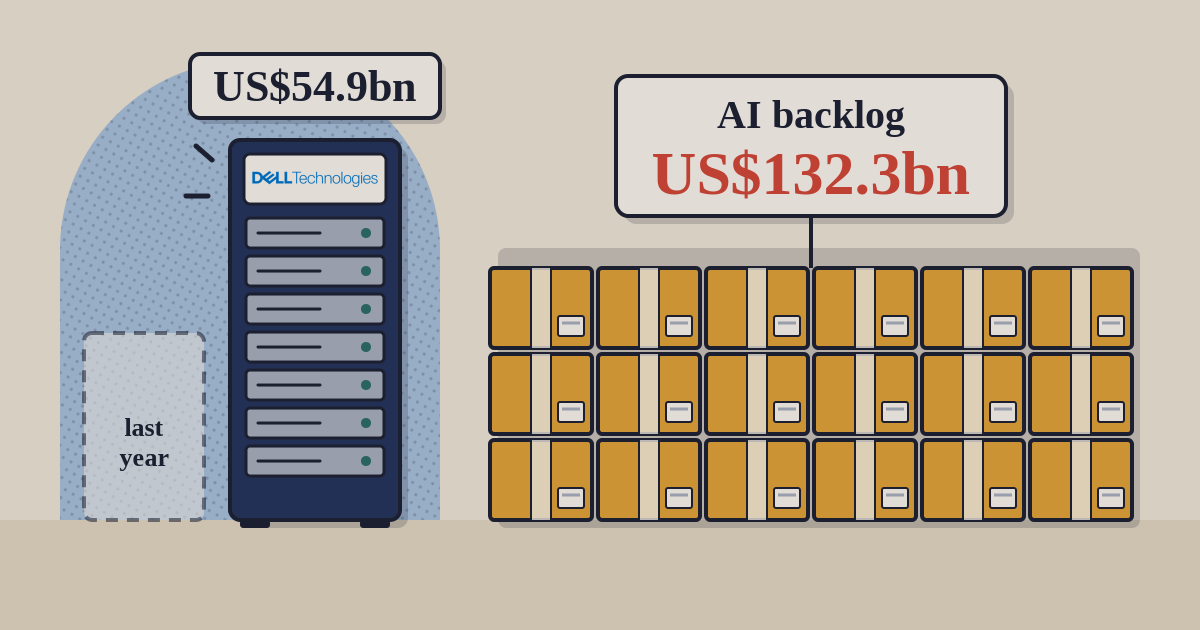
Dell Technologies’ revenue more than doubled, to US$54.94bn from US$27.01bn, in its fiscal third quarter, the three months to 30 October. Diluted earnings per share rose 287% to US$8.82.1 Jeff Clarke, its vice chairman and chief operating officer, said it “ended the quarter with a record $132.3 billion AI backlog after booking $60.2 billion of orders”.1 The quarter is the headline; the backlog is the story. This piece explains what a backlog is and how fast Dell turns it into sales, how much of the new revenue becomes profit, why the PC business earned less, and what Dell now expects.
+103%
revenue: US$54.94bn, from US$27.01bn a year earlier
Dell
+291%
AI-optimised server revenue: US$22.03bn, from US$5.64bn
Dell
US$132.3bn
AI backlog at 30 October, after US$60.2bn of orders
Dell
US$202bn
full-year revenue guide, from US$192bn
Dell
01Servers added US$26.9bn of the US$27.9bn
Dell reports two businesses. The Infrastructure Solutions Group (ISG) sells servers, networking and storage to companies and data-centre operators; the Client Solutions Group (CSG) sells PCs. ISG’s revenue rose 198% to US$41.97bn. Inside it, AI-optimised servers, the machines built around accelerator chips for training and running AI models, rose 291% to US$22.03bn; traditional servers and networking rose 235% to US$15.01bn; storage rose 24% to US$4.93bn.1
CSG grew 3%, to US$12.89bn. Its commercial PCs rose 6% to US$11.30bn while consumer PCs fell 15% to US$1.59bn.1 So of the US$27.93bn Dell added to quarterly revenue in a year, AI servers supplied US$16.39bn and traditional servers and networking US$10.53bn: 96% between them. Storage added US$0.95bn and PCs US$0.41bn. ISG is now 76% of revenue, against 52% a year earlier.1
Traditional servers are not a side line. Dell’s prepared remarks say customers are buying more ordinary compute for growing workloads and to replace ageing machines, and that it is seeing “increased demand for CPU-based compute to support AI and inference workloads”. Dell also guided the quarter at US$49.0bn in September; it reported US$5.9bn more.2 3
AI servers nearly quadrupled and traditional servers more than tripled; PCs barely moved
Dell net revenue by line, US$ million, three months to 30 October 2026 against three months to 31 October 2025
- Aug–Oct 2025
- Aug–Oct 2026
US$ million
Show tableHide table
| Aug–Oct 2025 | Aug–Oct 2026 | |
|---|---|---|
| AI-optimised servers | 5,641 | 22,031 |
| Traditional servers & networking | 4,484 | 15,013 |
| Storage | 3,982 | 4,930 |
| PCs (CSG) | 12,478 | 12,886 |
Source: Dell earnings release (Exhibit 99.1 to Form 8-K), segment information · as of 24 November 2026 · not shown: Corporate and other, mainly VMware resale (US$77m, from US$420m)
02What a backlog is, and why it matters more than the quarter
A backlog is the value of orders a customer has signed but Dell has not yet delivered, so it has not yet counted them as revenue. Orders flow in, shipped racks flow out as revenue, and what is left is the backlog. At the end of July Dell’s AI backlog was “$95 billion”, after a record US$60.9bn of orders that quarter.3 In the three months to October it booked US$60.2bn more and recognised US$22.0bn of AI-server revenue, and the backlog closed at US$132.3bn.1 2
Orders of US$60.2bn against shipments of US$22.0bn lifted Dell’s AI backlog to US$132.3bn
Dell AI-server orders, revenue and backlog, US$ billion, three months to 30 October 2026
- 01
Backlog, end of July
about US$95bn of AI-server orders not yet delivered - 02
New orders
US$60.2bn booked in August to October, the second quarter above US$60bn - 03
Shipped as revenue
US$22.0bn recognised as AI-server revenue, a record - 04
Backlog, end of October
US$132.3bn, a record
Source: Dell earnings releases of 1 September and 24 November 2026; prepared remarks, 24 November 2026 · as of 24 November 2026 · July backlog as Dell stated it, rounded
That is why the backlog matters more than the quarter: it is revenue already contracted for well into Dell’s next fiscal year, and it moves the guidance. The risk sits in whether customers can pay and build. Dell says every AI order is vetted “for access to capital, end-customer quality, trade and export compliance, and access to land and power”, checked once at the purchase order and again before production; where its own finance arm lends, the loan is “selective and short-term, bridging the customer from purchase order to cluster go-live”.2 The balance sheet shows the cost of carrying the queue: inventories were US$29.44bn on 30 October, against US$10.44bn at the end of January, and short-term financing receivables rose to US$13.18bn from US$8.46bn.1
03How much of the revenue becomes profit
ISG made an operating profit of US$7.12bn, 17.0% of its revenue, against 12.4% a year earlier and 15.0% in the quarter to July.1 3 It earned 91% of the two segments’ operating income, against 70% a year earlier.1 Dell does not report the profit on AI servers alone. What the tables show is that the mix did not sink the margin: AI servers were 52% of ISG’s revenue, and the group’s margin still rose. Dell’s chief financial officer, David Kennedy, put the 4.6-point rise down “primarily” to scale, with storage of Dell’s own design adding profit, and said rates will “sequentially moderate” as the benefit of a stronger North American sales mix fades.2
For the company as a whole, gross margin, what is left of revenue after the cost of the goods and services sold, was 21.0%, against 20.7%. The gain came below that line: operating expenses fell to 7.5% of revenue from 12.9%, so operating income rose to 13.5% of revenue from 7.8%.1 On Dell’s adjusted measure, operating expenses were 7.0% of revenue, which it calls the lowest in its 42-year history.1
PCs went the other way. CSG’s operating income fell 6% to US$704m, 5.5% of its revenue, against 6.0% a year earlier and 7.6% in the quarter to July.1 3 Dell’s explanation is about demand and price, not a named component: revenue grew “in a softer PC unit market as the industry adjusts to higher price points”, customers are “electing to defer some PC-related refresh”, and “within a supply constrained environment, we continue to prioritize ISG”. The release and the remarks do not mention memory prices. The PC market around Dell is in our Trend on PC shipments and memory.2
Dell’s server group widened its margin to 17.0% while its PC group’s narrowed to 5.5%
Operating income as % of revenue, three months to 31 October 2025 against three months to 30 October 2026
- Aug–Oct 2025
- Aug–Oct 2026
Show tableHide table
| Aug–Oct 2025 | Aug–Oct 2026 | Change | |
|---|---|---|---|
| Servers, storage, networking (ISG) | 12.4 | 17 | 4.6 pts |
| Dell, adjusted | 9.3 | 14.2 | 4.9 pts |
| PCs (CSG) | 6 | 5.5 | -0.5 pts |
Source: Dell earnings release (Exhibit 99.1 to Form 8-K), segment information and non-GAAP tables · as of 24 November 2026 · Dell total is the adjusted (non-GAAP) operating margin; on GAAP it was 13.5% against 7.8%
Other hardware sellers have grown on thinner margins: see our Trend on who keeps the margin in AI hardware and our Note on HPE’s quarter, reported a day earlier.
04The third raise of the year, and US$25bn more for buybacks
Dell now expects US$202.0bn of revenue for the year to 29 January 2027, up 78%, from US$192.0bn in September and US$167.0bn before that. Its AI-server forecast rose to US$78bn from US$74bn, and from US$60bn before September.1 3 For the quarter to January it guides revenue of US$56.3bn, up 69%, and adjusted earnings of US$8.40 a share.1
Dell has raised its full-year revenue forecast from US$167bn to US$202bn and its AI-server forecast from US$60bn to US$78bn
Dell full-year fiscal 2027 guidance, US$ billion, as stated before 1 September, on 1 September and on 24 November 2026
- Total revenue
- AI-optimised servers
US$bn
Show tableHide table
| Total revenue | AI-optimised servers | |
|---|---|---|
| Previous | 167 | 60 |
| 1 Sep | 192 | 74 |
| 24 Nov | 202 | 78 |
Source: Dell earnings releases (Exhibit 99.1 to Form 8-K), guidance tables · as of 24 November 2026 · the earliest point is the guide Dell's 1 September release lists as “previous”
Show tableHide table
| Quarter to 29 January 2027, guidance | Amount | Change on a year earlier |
|---|---|---|
| Revenue | US$56.3bn | +69% |
| AI-optimised server revenue (prepared remarks) | about US$23.5bn | not given |
| Diluted earnings per share | US$7.90 | +134% |
| Adjusted diluted earnings per share | US$8.40 | +116% |
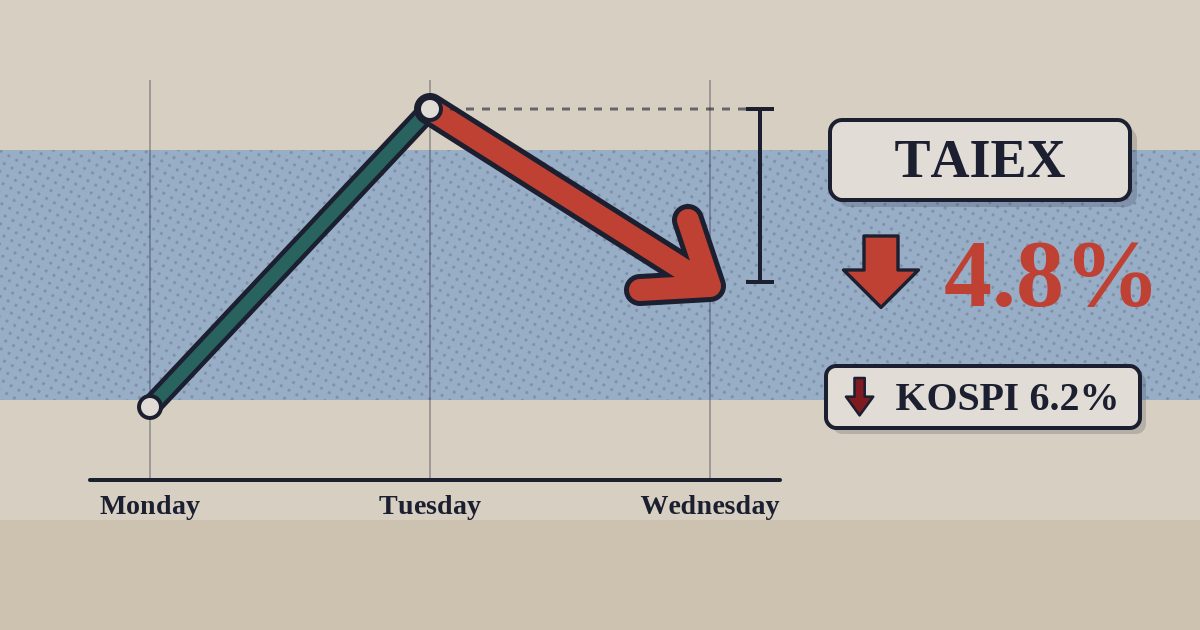
Dell returned a record US$4.9bn to shareholders in the quarter and the board added US$25bn to the buyback authorisation.1 It bought 9.0m shares at an average of US$488 each.2 The results were filed at 4:09pm in New York on Tuesday 24 November, after the market closed.4 In Tuesday’s session the shares had fallen 11.8%, to US$295.28, after rising 20.5% on Monday; that close is 39.5% below the average price Dell paid in the quarter.5 At 8:45am in New York on Wednesday, before the market opened, they were quoted at US$276.48, 6.4% below Tuesday’s close.6
Sources
- Dell Technologies, Dell Technologies Delivers Third Quarter Fiscal 2027 Financial Results (Exhibit 99.1 to Form 8-K), SEC — 24 November 2026
- Dell Technologies, Q3 FY27 earnings call prepared remarks — 24 November 2026
- Dell Technologies, Dell Technologies Delivers Second Quarter Fiscal 2027 Financial Results (Exhibit 99.1 to Form 8-K), SEC — 1 September 2026
- Dell Technologies, Form 8-K filing index (accepted by EDGAR at 4:09pm ET), SEC — 24 November 2026
- Nasdaq, DELL historical prices: closes of 20, 23 and 24 November 2026 — 24 November 2026 quote data, not a primary source
- Nasdaq, DELL pre-market quote, 25 November 2026 — 25 November 2026, 8:45am ET pre-market quote, not a primary source
- Redington, Earnings Presentation Q2 FY27 — 4 November 2026
Disclosure. TechBag is a software reseller: it earns when companies buy through it, including from vendors named here. The analysis is TechBag’s own; no vendor paid for or saw this piece before publication. Facts are labelled reported, TechBag count or our view. How the Journal works.
Keep reading