PC shipments fell a fifth while DRAM contract prices rose 5× in a year
Worldwide PC shipments by quarter from IDC, Gartner and Counterpoint, and TrendForce's DRAM contract-price changes, July 2025 to September 2026: what they mean for a laptop refresh.

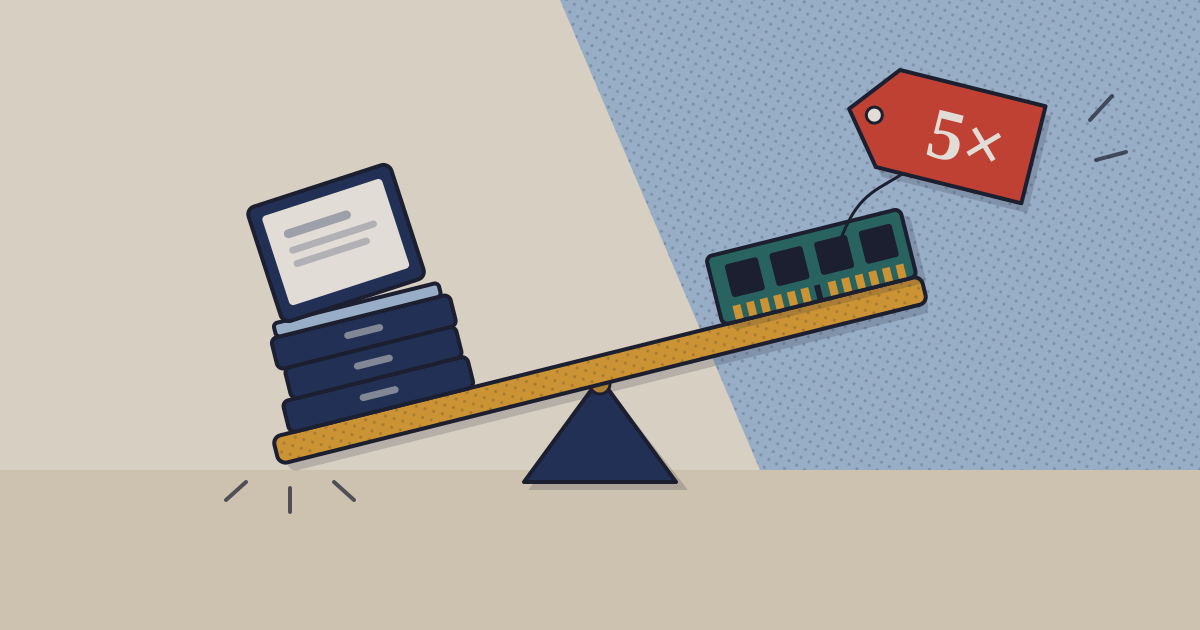
Two lines crossed in 2026. PC shipments, which grew by double digits at the end of 2025, turned down in the second quarter and fell sharply in the third. Memory prices did the opposite: the contract price PC makers pay for DRAM, the working memory in every laptop, roughly doubled in a single quarter at the start of the year and has kept rising since. This piece sets the two series side by side, reports who says what connects them, and asks what that means for a company planning to replace its laptops.
01The line: a fifth fewer PCs, in a quarter that is normally bigger
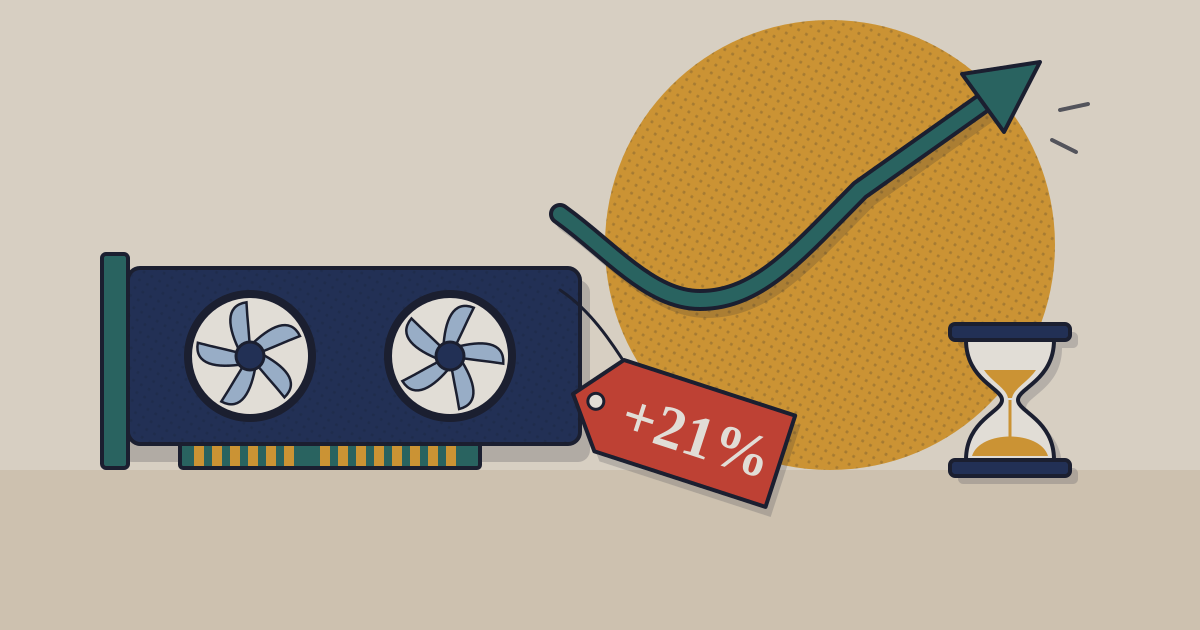
IDC counted 62.7 million desktops, notebooks and workstations shipped worldwide in the third quarter of 2026, 20.1% fewer than a year earlier and 9.1% fewer than in the second quarter. IDC notes that the third quarter is normally larger than the second.1 Gartner’s preliminary count is 55.4 million, down 22.4% from 71.3 million.2 Counterpoint’s, published on 22 October, is 57 million, down 21% year on year and 13.8% on the quarter.3 The three firms count differently, so their totals differ; their rates of decline sit within 2.3 points of each other.
IDC's count fell from 80.5 million PCs at the end of 2025 to 62.7 million in the third quarter of 2026, the lowest of the five quarters
Worldwide PC shipments (desktops, notebooks, workstations), millions of units, by quarter, Q3 2025 to Q3 2026
million units
Table view
| Worldwide PC shipments | |
|---|---|
| Q3 2025 | 78.5 |
| Q4 2025 | 80.5 |
| Q1 2026 | 67.9 |
| Q2 2026 | 69 |
| Q3 2026 | 62.7 |
Source: IDC Quarterly Personal Computing Device Tracker, release of 8 October 2026 (Figure 1) · as of 8 October 2026 · Q3 2026 is preliminary. IDC's year-on-year changes: +10.5%, +12.4%, +3.0%, −3.8%, −20.1%.
The fall was uneven. In IDC’s table HP shipped 30.9% fewer PCs, Dell 25.0% and Lenovo 22.6%; Apple fell 11.3% and ASUS 8.6%. The three largest makers gave up 4.2 points of share between them.1 Gartner, as reported by VARINDIA, linked HP’s fall to its exposure to price-sensitive consumer and mainstream business buyers.2
02What drives it: memory prices, in the analysts' reading
TrendForce, which tracks the contract prices memory makers charge PC, phone and server makers, put the rise in conventional DRAM at 10–15% in the third quarter of 2025,4 then 45–50% in the last quarter of 2025, 93–98% in the first quarter of 2026 and 58–63% in the second.567 PC memory alone was forecast to rise 105–110% in the first quarter.5 The rises have slowed, not stopped: 13–18% in the third quarter and a forecast 10–15% in the fourth.8
DRAM contract prices rose every quarter, by almost 96% at the start of 2026; the rises are smaller now but have not reversed
Change in conventional DRAM contract prices on the previous quarter, midpoint of TrendForce's range, %, Q3 2025 to Q4 2026
% change on previous quarter
Table view
| Conventional DRAM contract price | |
|---|---|
| Q3 2025 | 12.5 |
| Q4 2025 | 47.5 |
| Q1 2026 | 95.5 |
| Q2 2026 | 60.5 |
| Q3 2026 | 15.5 |
| Q4 2026 (f) | 12.5 |
Source: TrendForce press releases of 24 September 2025, 2 February, 31 March, 3 July and 30 September 2026 · as of 30 September 2026 · Each quarter from the latest TrendForce table that reports it. Q3 2025 and Q3 2026 are estimates; Q4 2026 is a forecast. Ranges: 10–15, 45–50, 93–98, 58–63, 13–18, 10–15.
Why memory is short is the analysts’ reading, not a measured fact. IDC lists “higher price points driven by AI data center build out” among the causes of the decline.1 TrendForce says memory makers are moving capacity toward HBM, the stacked memory in AI accelerators, and toward server DRAM,6 and that PC memory supply “could decline in 2027 as more capacity shifts to server applications”.8
The firms weigh the other causes differently. IDC puts the inventory pull-in first: PC makers and distributors bought early in the year to beat price rises, which left the third quarter with little demand.1 Counterpoint points to a high comparison base, because the third quarter of 2025 was inflated by purchases ahead of the Windows 10 end-of-support deadline.3 Gartner’s Banerjee said the higher memory and storage costs are “now fully reflected in PC pricing”.2
03What it means for a laptop refresh
Prices. In March TrendForce modelled a mainstream notebook listed at US$900 and found that keeping makers’ and resellers’ margins intact would need a price rise approaching 40% once memory and processor costs were passed on.9 By the third quarter, processor, DRAM and SSD made up about 68% of that notebook’s bill of materials.10 IDC expects promotions in the near term as distributors clear stock, but says prices “will remain elevated” and well above last year’s.1
Specifications and supply. TrendForce lists cutting memory capacity as one of the ways makers may hold a price.10 It also warns that circuit boards, capacitors and power chips could see higher prices or longer lead times in 2027.10 Gartner, as reported, saw vendors reprioritise scarce components and shift toward higher-priced configurations.2
The outlook. Counterpoint expects fourth-quarter shipments to fall 27% and 2027 to be broadly flat; its David Naranjo says “stabilization should not be mistaken for recovery”.3 TrendForce expects 2027 notebook shipments to fall by a low single-digit percentage, or a high single-digit one if makers pass all their costs on.10
The Windows 10 clock. Waiting for prices to fall has its own cost. The second year of Windows 10 Extended Security Updates starts in November at US$122 a device, double the first year.11 Our piece of 14 October sets out which Windows 10 PCs to upgrade, pay for or retire.
What to watch. IDC, Gartner and Counterpoint published their third-quarter counts between 8 and 22 October, so their fourth-quarter counts should follow in January; Counterpoint’s 27% forecast is the number to test.3 TrendForce’s next contract-price call, for the first quarter of 2027, should come around the turn of the year; its call for the first quarter of 2026 came on 5 January. A fourth-quarter rise near the 10–15% forecast would mean the price is still climbing.8
Sources
- IDC, PC Market Woes Continue: Shipments Fall 20.1% in Q3 2026 as Pull-In Hangover and Supply Constraints Bite — 8 October 2026
- Gartner, worldwide PC shipments declined 22.4% in Q3 2026, as reported by VARINDIA — Gartner release 12 October 2026; VARINDIA 13 October 2026
- Counterpoint Research, Global PC Shipments Plunge 21% in Q3 2026; Q4 Decline to Deepen to 27% — 22 October 2026
- TrendForce, DRAM Prices to Continue Rising in 4Q25 (3Q25 estimate) — 24 September 2025
- TrendForce, Memory Price Outlook for 1Q26 Sharply Upgraded (4Q25 table; PC DRAM) — 2 February 2026
- TrendForce, AI Server Demand to Drive Memory Contract Price Increases in 2Q26 — 31 March 2026
- TrendForce, AI Server Demand Continues to Support Memory Prices in 3Q26 — 3 July 2026
- TrendForce, AI Server Demand Sustains Memory Contract Price Increases in 4Q26 — 30 September 2026
- TrendForce, Rising Memory and CPU Prices Could Push Mainstream Notebook Prices Up by Nearly 40% — 10 March 2026
- TrendForce, Rising Costs Threaten Notebook Demand in 2027 — 8 October 2026
- Microsoft Learn, Extended Security Updates program for Windows 10 — page dated 17 November 2025
- Statcounter Global Stats, desktop Windows version market share, India and worldwide — September 2026
Disclosure. TechBag is a software reseller: it earns a margin when a reader buys through it, including from vendors named here. The analysis is TechBag’s own; no vendor paid for or saw this piece before publication. Facts are labelled reported, TechBag count or our view.
Keep reading