Entra MFA texts and calls end from 1 February; SMS-only users must register a passkey
Microsoft’s Entra guidance to 23 November: who loses Microsoft-sent SMS and voice codes from 1 February 2027 and 1 July 2027, what breaks, and what an admin does first.

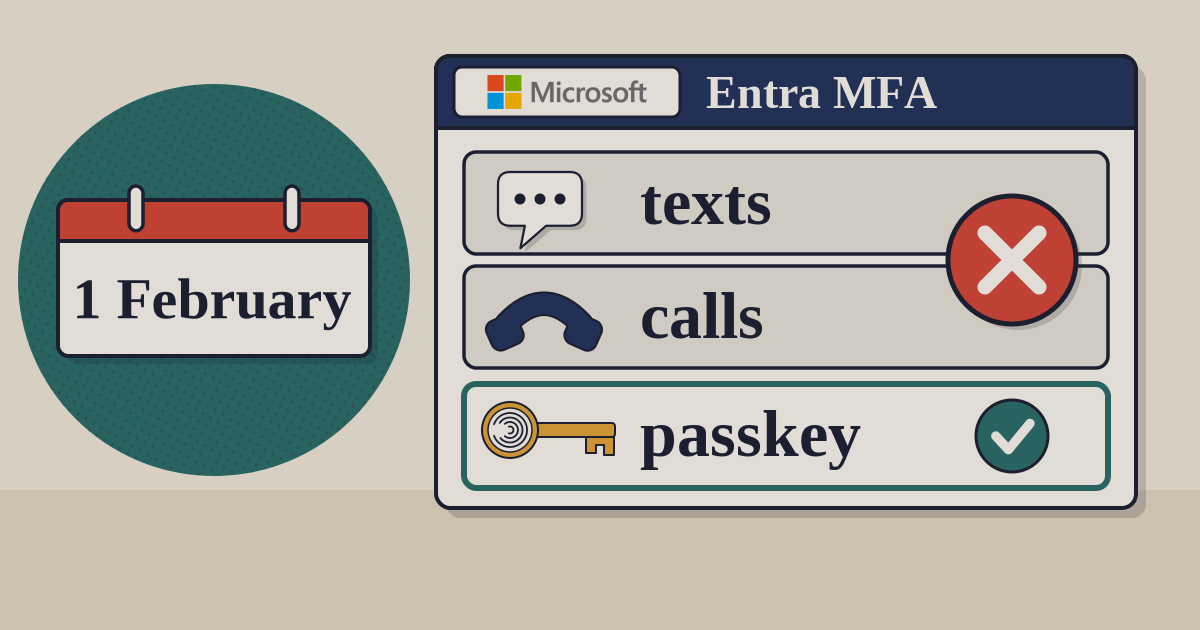
From 1 February 2027 Microsoft will stop delivering the text messages and voice calls that Entra ID uses for multifactor authentication, for every user except Global Administrators and external users, whose date is 1 July 2027. A user whose only registered method is SMS or voice will then have to register a passkey during sign-in. Microsoft’s guidance is blunt: “This prompt is blocking”, and “There is no opt out”.1 The plan was announced on 13 July.9 What is new came in the past week: on 23 November bringing your own telephony provider became generally available,2 and a 20 November warning covers the sign-ins where a passkey cannot be registered at all.5
Microsoft's MFA texts and calls end from 1 February 2027 for most users, and from 1 July for Global Administrators and external users
Retirement of Microsoft-provided SMS and voice authentication in Entra ID, July 2026 to July 2027
Show tableHide table
| Date | Event | Detail |
|---|---|---|
| 13 Jul 2026 | Retirement announced | Message-centre post MC1426371 |
| 1 Sept 2026 | Passkeys on by default | SMS and voice users are enabled for passkeys and nudged to register; the nudge can be skipped |
| 30 Oct 2026 | Providers in Security Store | Tenants can buy SMS and voice delivery from a listed telephony provider |
| 23 Nov 2026 | Own-provider option available | Bring Your Own Telephony, set up through APIs, is generally available |
| 1 Feb 2027 | Texts and calls end for most users | Rollout begins; internal guest users are included |
| 22 Mar 2027 | Act-by date for password reset | SMS and voice stop counting for self-service reset 50 days after the rollout reaches a tenant |
| 1 Jul 2027 | Global Administrators, external users | Their separate rollout begins |
Source: Microsoft Learn; Microsoft 365 message-centre posts MC1426371, MC1519855 and MC1536049, read via mc.merill.net · as of 24 November 2026, 7:45pm IST · 1 February and 1 July are rollout start dates, not one cutoff for every tenant
01What is ending, and what breaks
What retires is Microsoft’s delivery of the code, not the method. Entra still generates and checks the one-time passcode; a tenant that wants texts after the date pays a carrier to send them. It can buy from Soprano, Telesign or Infobip through Microsoft Security Store, billed to its Azure subscription, or bring another provider and configure it through APIs. Either way an Azure Function in the tenant’s own subscription passes each request to the provider.3 4 Providers set the price; Microsoft’s pages give none. And the option covers SMS and voice “as verification methods, not as primary sign-in”.4
For everyone else, the passkey prompt is the easy case. The 20 November warning is about sign-ins that cannot use a passkey: embedded browsers, unsupported browser and operating-system pairs, native apps without a supported authentication broker. There the user sees Text and Call disabled, and Microsoft adds: “Registering a passkey on another browser or device doesn’t make the original session support passkeys.”5 6 Open the table for each group:
Show tableHide table
| Who | From | What happens |
|---|---|---|
| Users with only SMS or voice registered | 1 February 2027 | SMS or voice verifies identity once more, then a blocking prompt to register a passkey before sign-in continues |
| Users with another registered method that works for that sign-in | 1 February 2027 | They sign in with that method; no passkey is required |
| SMS-only users in a session that cannot use passkeys | 1 February 2027 | Text and Call are shown disabled; blocked until another method is registered through My Sign-Ins |
| VPN and Remote Desktop Gateway users behind the NPS extension | 1 February 2027 | SMS and voice no longer complete MFA; NPS does not support passkeys |
| Self-service password reset | 50 days after the rollout reaches the tenant | Microsoft-provided SMS and voice stop counting as recovery methods |
| Global Administrators with the role active, and external users | 1 July 2027 | The same changes, on a separate rollout |
| Users migrated to the tenant's own telephony provider | No change | SMS and voice continue as verification methods |
Both dates start a phased rollout. Microsoft says it “can’t provide each tenant with the specific date”, so 1 February is the date to be ready by.5
02What to do, in order
- Count the users. In the Entra admin centre, go to Entra ID > Authentication methods > Activity. The Registration tab shows users registered by method, and the registration details list every method each user holds. It needs an Entra ID P1 or P2 licence.8 Microsoft’s PowerShell scanner on GitHub reads which groups the SMS and voice policies target; its own notes say it is not a user inventory.11
- Move them to passkeys. A registration campaign (Entra ID > Authentication methods > Registration campaign) prompts users at their next MFA sign-in.1 Passkeys are included in every Entra plan.9
- Cover the sessions passkeys cannot reach. Microsoft names Authenticator push notifications, passwordless phone sign-in and authenticator codes (TOTP). For Azure VPN Gateway over RADIUS and for Remote Desktop Gateway, only push works: neither accepts a typed code.5 6
- Check password reset separately. A passkey does not make a user eligible for self-service reset; they need enough other recovery methods.10
- Buy telephony only where SMS must stay. It needs an Azure subscription; start in evaluation mode and move traffic in stages.2
The temporary opt-out, the Graph property passkeyDynamicMigration, delays only the passkey nudges that began on 1 September. It does not exempt a tenant from the retirement.1 6
Sources
- Microsoft Learn: Passkeys by default and retirement of Microsoft-provided SMS and voice authentication — dated 23 September 2026; republished 23 November 2026
- Microsoft 365 message centre, MC1519855: Microsoft Entra: Choose your own telephony provider now generally available (read via mc.merill.net) — 21 October 2026, updated 23 November 2026
- Microsoft Learn: Choose your own telephony provider for SMS and voice authentication — 30 October 2026
- Microsoft Learn: Frequently asked questions, Choose Your Own Telephony Provider and Bring Your Own Telephony — 23 November 2026
- Microsoft 365 message centre, MC1540327: Action required: Prepare users who can't use passkeys for SMS and voice retirement (read via mc.merill.net) — 5 November 2026, updated 20 November 2026
- Microsoft Learn: What happens when Microsoft-provided SMS and voice retire — 16 November 2026
- Microsoft Learn: Frequently asked questions about SMS and voice retirement — 2 November 2026
- Microsoft Learn: Authentication Methods Activity — 9 November 2026
- Microsoft 365 message centre, MC1426371: Microsoft Entra: Passkeys by default and retirement of Microsoft-provided SMS and voice authentication (read via mc.merill.net) — 13 July 2026, updated 15 September 2026
- Microsoft 365 message centre, MC1536049: Microsoft-provided SMS and voice authentication to retire for self-service password reset (read via mc.merill.net) — 3 November 2026
- Microsoft on GitHub: Entra SMS/Voice Policy Scanner (entra-sms-voice-usage-analyzer), README — undated page
- Reserve Bank of India (Authentication mechanisms for digital payment transactions) Directions, 2025, RBI/2025-26/79 — 25 September 2025
Disclosure. TechBag is a software reseller: it earns when companies buy through it, including from vendors named here. The analysis is TechBag’s own; no vendor paid for or saw this piece before publication. Facts are labelled reported, TechBag count or our view. How the Journal works.
Keep reading