Identity & accessAnalysis
5 billion passkeys, yet 57% of firms still sign staff in with a phishable factor
What the FIDO Alliance’s survey of 1,400 organisations and 11,000 consumers in ten countries found in April 2026, and what passkey sign-in costs at five identity providers.

World Passkey Day, 7 May, brought the FIDO Alliance’s annual count: an estimated 5 billion passkeys in use worldwide.1 Your phone, your email provider and probably your bank already offer one. The question for whoever runs sign-in at a company is narrower. If passkeys are this common, why do most workforces still rely on codes and pushes, which kind of passkey should staff get, and what does the switch cost at the identity provider you already pay?
01Consumers took passkeys; offices kept the password
FIDO’s survey, run by Sapio Research in April 2026, asked 11,000 consumers and 1,400 workforce decision-makers in the US, the UK, France, Germany, Australia, Singapore, Japan, South Korea, China and India. 90% of consumers know what a passkey is, 75% have enabled one on at least some accounts, and 49% use one “whenever possible” or “most of the time”. The 5 billion figure is FIDO’s own estimate, built from public data and its members’ deployment data.12
Organisations look busy too: 68% have deployed, are deploying or are piloting passkeys for staff, and 82% call a fully passwordless workforce a goal they have reached or are pursuing. Deployment is not use. Only 30% say a passkey is the method employees sign in with most often, and 28% say most of their workforce is already fully passwordless. FIDO’s report puts it in a heading: “Deploying Passkeys and Eliminating Passwords Are Not the Same Thing.”2
Three in four consumers have switched a passkey on; fewer than one organisation in three signs staff in with one
Share of consumers (11,000) and of organisations with 500+ staff (1,400) in ten countries, survey fielded April 2026
75%
Consumers who have enabled a passkey on at least some accounts
68%
Organisations deploying, rolling out or piloting workforce passkeys
30%
Organisations where a passkey is the main daily sign-in
28%
Organisations that say most of the workforce is fully passwordless
US 37%, Europe 21%, Asia-Pacific 32%
Source: FIDO Alliance, The State of Passkeys 2026 (Sapio Research), questions 1, 6, 7 and 10 · as of 7 May 2026
The US is furthest along at finishing the job, with 37% of its organisations fully passwordless against 21% in Europe. Yet even in the US, 56% still sign staff in primarily with a password.2
02What 57% means: three sign-ins a fake page can collect
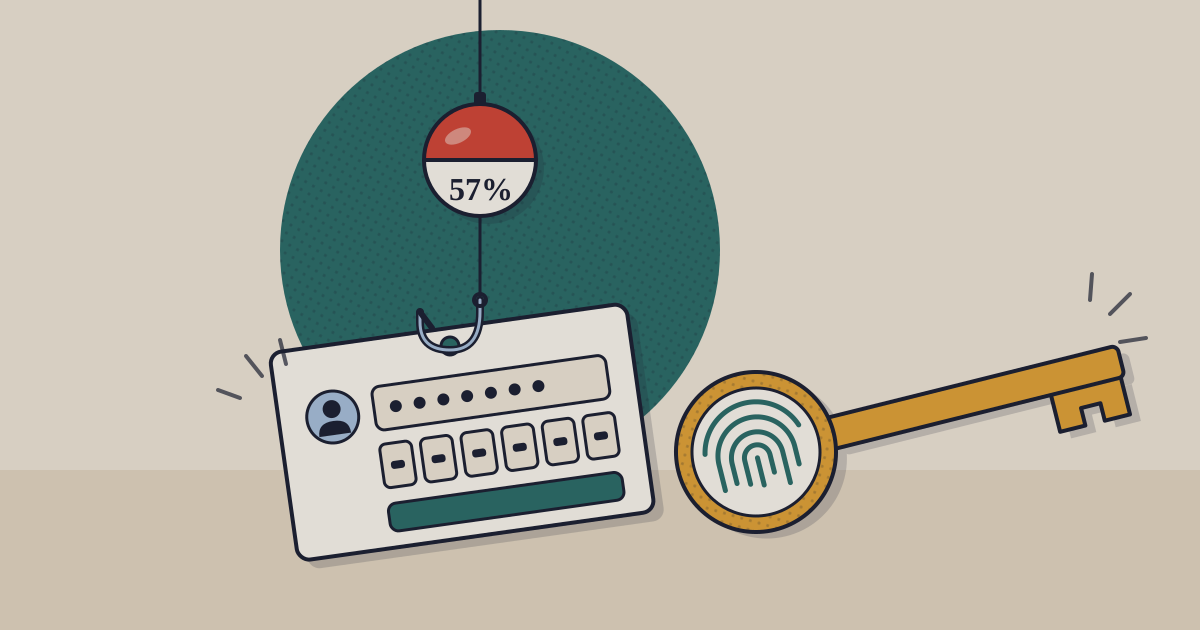
FIDO asked which method employees use most often today. The phishable 57% is made of a password plus an authenticator app’s push or six-digit code (28%), a password plus an SMS or email code (18%), and a password alone (11%). The rest use passkeys (30%) or a smart card or certificate (12%). The password-led share barely moves by region: 56% in the US, 59% in Europe, 57% in Asia-Pacific.2
57% of organisations still sign staff in with something a fake login page can collect
Sign-in method employees use most often, share of 1,400 organisations with 500+ staff in ten countries, April 2026
- Password + authenticator app (push or code)28% 28%
- Password + SMS or email code18% 18%
- Password only11% 11%
- Passkey30% 30%
- Smart card or certificate12% 12%
Table view
| Value (%) | Share | |
|---|---|---|
| Password + authenticator app (push or code) | 28 | 28% |
| Password + SMS or email code | 18 | 18% |
| Password only | 11 | 11% |
| Passkey | 30 | 30% |
| Smart card or certificate | 12 | 12% |
Source: FIDO Alliance, The State of Passkeys 2026, question 10 · as of 7 May 2026 · shares as published; they sum to 99% because of rounding
Why the phishable methods stay: among organisations not yet fully passwordless, 16% say password plus MFA is sufficient for now, and the same share point to legacy systems or account recovery. Among those with no passkey plans for two years, 21% believe their push or one-time-code MFA is good enough for their risk.2 FIDO’s report calls that belief “a risk that the data on ongoing account compromise does not support”; a third of its consumers had an account compromised or received a breach notice in the past year.2
03Why a code or a push can be relayed and a passkey cannot
CISA’s guidance ranks the forms of MFA from strongest to weakest. SMS and voice codes are “vulnerable to phishing, SS7, and SIM swap attacks” and should be a last resort. App codes, and push with number matching, remain “vulnerable to phishing attacks”. Plain push adds push bombing, in which an attacker fires prompts until a tired user taps Accept. Only FIDO/WebAuthn and PKI-based methods are listed as “resistant to phishing”.3
The reason is in the protocol. NIST’s revised authentication guideline, SP 800-63B-4 of August 2025, defines phishing resistance as preventing the disclosure of authenticator outputs “to an impostor verifier”, and says authenticators that involve manual entry of an output, such as one-time codes, “SHALL NOT be considered phishing-resistant”.4 A code is a secret the user carries across, and whoever runs the page receives it. A passkey answers a challenge with a signature bound to the site’s domain, so a lookalike page gets nothing it can replay.
A relay page passes on the password and the code; a passkey signs only for the real site
How an adversary-in-the-middle phishing page defeats code and push MFA, and where a passkey stops it, per CISA and NIST guidance
- 01
The lure
An email sends the employee to a copy of the company’s sign-in page, on a domain the attacker owns.
- 02
The relay
The page passes the password and the six-digit code to the real portal as they are typed; a push prompt reaches the real phone and gets approved.
- 03
The session
The real portal sees a valid sign-in and hands its session to the attacker. Number matching does not help: the user is reading the real numbers.
- 04
Where a passkey stops it
The browser asks the passkey to sign only for the domain it was created on. The copy page’s domain gets no valid answer, and there is no code to type.
Source: CISA, Implementing Phishing-Resistant MFA (October 2022); NIST SP 800-63B-4 (August 2025) · as of 7 May 2026
Passkeys come in two kinds, and choosing between them is the real decision. A device-bound passkey lives on one security key or one phone and cannot be copied. A synced passkey is held by a provider such as Apple iCloud Keychain or Google Password Manager and follows the user to every device.5 NIST allows syncable authenticators up to its middle assurance level, AAL2, but says they “SHALL NOT be used at AAL3”, because syncing requires the private key to be exportable. Certificate-based sign-in is phishing-resistant too, but in CISA’s words it “requires highly mature identity management practices”.43
04Passkeys sit in the cheap tiers; the risk engine does not
We read the published plans of five identity providers as their pages stood before 7 May. Cisco Duo’s Free edition, for up to 10 users, does not list phishing-resistant MFA; Essentials, at US$3 a user a month, lists it along with passwordless sign-in through Duo Mobile and FIDO2, and risk-based authentication starts in Advantage at US$6.9 Microsoft lists Entra ID P1 at US$6 and P2 at US$9. P1 brings Conditional Access, whose authentication strengths let an administrator require a phishing-resistant method for an app; risk-based Conditional Access is a P2 feature. Device-bound passkeys on security keys and in Microsoft Authenticator are generally available, and synced passkeys were in preview.1011126
Okta’s Starter suite, at US$6, includes MFA, and Okta documents its FIDO2 (WebAuthn) authenticator as meeting the “device-bound, phishing-resistant” requirements; Adaptive MFA, which weighs device and network context, comes in Core Essentials at US$14 or Essentials at US$17, against a US$1,500 annual minimum.78 miniOrange puts FIDO2 and WebAuthn passwordless sign-in, and its adaptive rules, in Premium at US$3; its US$2 tier lists neither.13 JumpCloud sells JumpCloud Go, which its documentation calls phishing-resistant, device-bound and hardware-protected, à la carte at US$5 a user a month billed annually, with Conditional Access a separate US$3.1415
Phishing-resistant sign-in starts at US$3 to US$6 a user a month; risk-based policy adds up to US$8 more
US$ list price per user per month, billed annually: entry tier with passkey or FIDO2 sign-in, and first tier with risk-based or adaptive policy, pricing pages December 2025 to April 2026
- Passkey or FIDO2 sign-in
- Risk-based or adaptive policy
Table view
| Passkey or FIDO2 sign-in | Risk-based or adaptive policy | Change | |
|---|---|---|---|
| Cisco Duo (Essentials, Advantage) | 3 | 6 | 100% |
| miniOrange (Premium, both in one tier) | 3 | 3 | 0% |
| Microsoft Entra ID (P1, P2) | 6 | 9 | 50% |
| Okta (Starter, Core Essentials) | 6 | 14 | 133% |
Source: Pricing pages of Cisco Duo (30 Apr 2026), Microsoft (30 Apr 2026), Okta (12 Apr 2026) and miniOrange (13 Dec 2025), as preserved by the Internet Archive; TechBag reading · as of 30 April 2026 · for Microsoft the entry tier is P1, the first that can require a phishing-resistant method by policy; JumpCloud is sold à la carte and is left out
The survey agrees that money is rarely the blocker on its own. The barriers rated highest are compatibility with legacy internal systems (38%), budget approval (35%) and device recovery (33%). Among technical concerns, the exportability of synced passkeys and shared devices such as kiosks and frontline terminals tie at 39%, and 26% say their current identity provider lacks support.2
Sources
- FIDO Alliance: FIDO Alliance reports accelerating global passkey adoption on World Passkey Day 2026 — 7 May 2026
- FIDO Alliance and Sapio Research: The State of Passkeys 2026, Global Consumer and Workforce Report (47 pages; fieldwork April 2026) — 7 May 2026
- CISA: Implementing Phishing-Resistant MFA (fact sheet) — October 2022
- NIST SP 800-63B-4, Digital Identity Guidelines: Authentication and Authenticator Management (phishing resistance, syncable authenticators, AAL3) — August 2025
- Microsoft Learn: How to enable synced passkeys (FIDO2) in Microsoft Entra ID (preview) — page as of 16 March 2026 (Internet Archive)
- Microsoft Learn: How to enable passkeys (FIDO2) in Microsoft Entra ID (device-bound support; synced in preview) — page as of 11 March 2026 (Internet Archive)
- Okta Help Center: Configure the FIDO2 (WebAuthn) authenticator — page as of 16 February 2026 (Internet Archive)
- Okta: Pricing, Workforce Identity suites (Starter, Core Essentials, Essentials; US$1,500 annual minimum) — page as of 12 April 2026 (Internet Archive)
- Cisco Duo: Editions and Pricing (Free, Essentials, Advantage, Premier) — page as of 30 April 2026 (Internet Archive)
- Microsoft: Microsoft Entra plans and pricing (US) — page as of 30 April 2026 (Internet Archive)
- Microsoft Learn: Conditional Access authentication strengths (P1 prerequisite; phishing-resistant MFA strength) — page as of 8 April 2026 (Internet Archive)
- Microsoft Learn: Microsoft Entra licensing (risk-based Conditional Access in P2) — page as of 21 April 2026 (Internet Archive)
- miniOrange: IAM and CIAM pricing (Employee IAM: Essential, Premium, IAM Suite) — page as of 13 December 2025 (Internet Archive)
- JumpCloud: Pricing (à la carte products, billed annually) — page as of 10 April 2026 (Internet Archive)
- JumpCloud Support: Get started with JumpCloud Go — page as of 3 January 2026 (Internet Archive)
- RBI: Reserve Bank of India (Authentication mechanisms for digital payment transactions) Directions, 2025, RBI/2025-26/79, paras 1, 3, 5, 6, 9 and 10 — 25 September 2025
- Microsoft: Microsoft Entra plans and pricing (India, ₹) — page as of 4 January 2026 (Internet Archive)
Related on TechBag: our note on what Entra ID P1 covers maps the wider identity checklist onto Microsoft’s tiers; our piece on phishing training shows why the fix cannot rest on staff spotting the fake page.
Disclosure. TechBag is a software reseller: it earns a margin when a reader buys through it, including from vendors named here. The analysis is TechBag’s own; no vendor paid for or saw this piece before publication. Facts are labelled reported, TechBag count or our view.
Keep reading