Indeed’s US revenue rose 33% as hiring stalled; revenue per job posting rose 37%
Recruit’s results for April to September: how Indeed made 37% more per US job posting while hiring stalled, what employers pay for, and why its margin reached 47.5%.

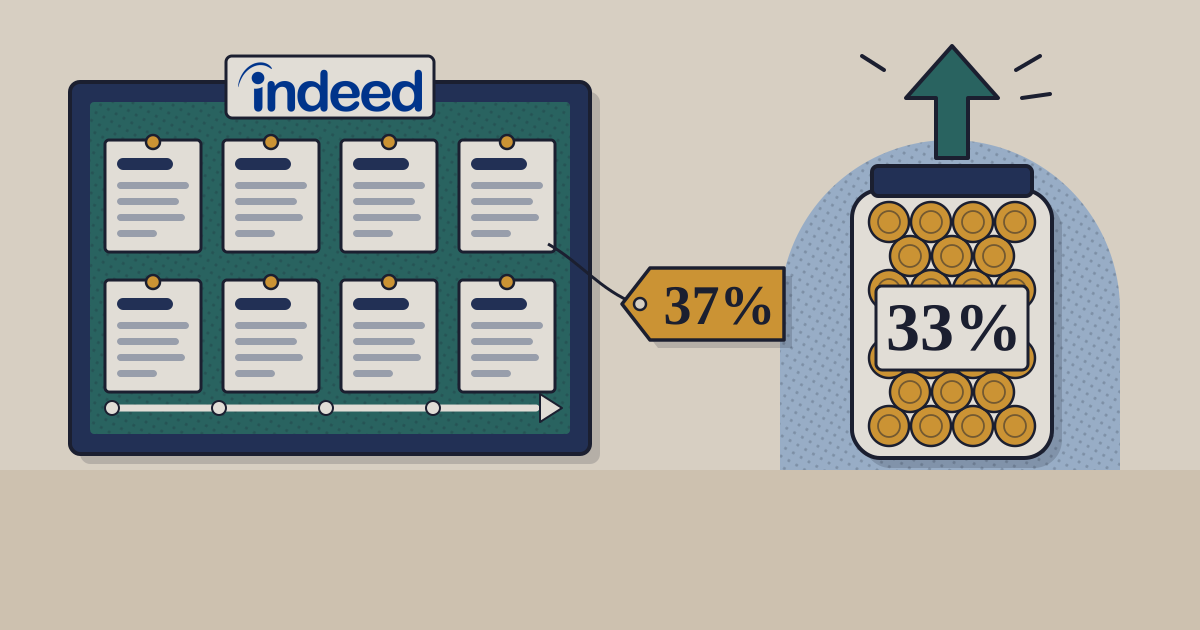
Indeed’s owner earned US$3.46bn in the United States in April–September, 33.4% more in dollars than a year earlier, and said it did so “despite stagnant hiring demand”. Recruit Holdings, the Tokyo company that owns the job site, credits “monetization improvements”: its US revenue per job posting on Indeed rose 37%.1 In July–September alone, US revenue rose 36.6% to a quarterly record of US$1.82bn while the count of US job postings on Indeed stood 2% below a year earlier.23 These are Recruit’s first-half figures, published on 11 November.
US$3.46bn
US revenue, April–September, up 33.4% in dollars
Recruit release
+37%
US revenue per job posting on Indeed, year on year
Recruit release
47.5%
HR Technology EBITDA+S margin, against 36.5% a year earlier
Release, data workbook
+63.9%
group operating income, to ¥513.7bn
Recruit release
01How a job site makes more from fewer jobs
Recruit’s measure, US ARPJ, is US revenue divided by the average daily number of US job postings on Indeed, as counted by the Indeed Hiring Lab.3 The count includes free listings and jobs Indeed collects from employers’ career sites, so the company stresses it is “not the average unit price per sponsored job ad”.4 The revenue comes mostly from Sponsored Jobs, paid ads sold as Standard and Premium packages, plus tools such as Smart Sourcing, Smart Screening and Employer Branding. Premium Sponsored Jobs is, in Recruit’s words, “the primary driver of US revenue growth” this year.4 The company says the model has moved from a search engine selling pay-per-click job ads to AI matching that does part of a recruiter’s sourcing and screening.4
In August its chief executive, Hisayuki Idekoba, split the rise for small and mid-sized employers into roughly equal thirds: more paying clients, more sponsored jobs per client, and a higher price per job.4
Revenue per US job posting has grown faster in each of the last six quarters, to 39%
Recruit’s HR Technology revenue in the US by quarter (US$m), and US revenue per Indeed job posting, change on a year earlier (%), April 2025 to September 2026
- US revenue (US$m)
- Revenue per job posting, change on a year earlier (%)
Show tableHide table
| US revenue (US$m) | Revenue per job posting, change on a year earlier (%) | |
|---|---|---|
| Apr–Jun 25 | 1,263 | 11 |
| Jul–Sep 25 | 1,333 | 15 |
| Oct–Dec 25 | 1,303 | 19 |
| Jan–Mar 26 | 1,414 | 25 |
| Apr–Jun 26 | 1,641 | 35 |
| Jul–Sep 26 | 1,821 | 39 |
Source: Recruit Holdings, financial data workbook and results presentation (slide 19), 11 November 2026 · as of 11 November 2026 · Recruit’s fiscal year starts in April. Revenue per posting divides all US revenue by all US postings, paid or free.
02Where the margin came from
The HR Technology segment, Indeed’s business, turned 47.5% of its revenue into EBITDA+S, Recruit’s profit measure before depreciation and share-based pay, up from 36.5% a year earlier; EBITDA+S rose 76.7% to ¥449.2bn. Recruit credits “revenue growth and appropriate control of personnel expenses”.15 Its summary puts it more plainly: personnel expenses were flat.2 In April–June, pay and outsourcing together were about 37% of the segment’s revenue, against about 48% a year earlier, its finance chief said in August.4
03What to watch
Recruit now expects HR Technology revenue of US$11.92bn for the year to March, up 23.2%, against US$11.48bn in August, and US revenue up 31.2% with revenue per posting up 33%. It kept the group’s guidance unchanged, saying the effect is limited.12 The outlook has US growth slowing to 29.1% in October–March.1
The risk is the client’s bill. “Average spend per client has risen rapidly over a short period,” Idekoba said in August, adding that Recruit would “monitor client satisfaction very closely”.4 For an employer, the figures mean the same vacancy costs more to advertise on Indeed than it did a year ago, and the company is selling its AI tools as a substitute for recruiter hours: one healthcare client, Idekoba said, found they did the work of “several full-time recruiters”.4 Whether AI is changing hiring itself is the question PhysicsWallah’s falling headcount raised in India this week.
Sources
- Recruit Holdings, Earnings Release for Q2 FY2026: consolidated results for the six months ended 30 September 2026 — 11 November 2026
- Recruit Holdings, Recruit Holdings Announces Q2 FY2026 (summary) — 11 November 2026
- Recruit Holdings, FY2026 Q2 consolidated results presentation (slide 19 and footnotes) — 11 November 2026
- Recruit Holdings, Q1 FY2026 earnings call transcript (edited English translation) — 7 August 2026
- Recruit Holdings, Q2 FY2026 financial data workbook (quarterly segment revenue and EBITDA+S margin) — 11 November 2026
Disclosure. TechBag is a software reseller: it earns a margin when a reader buys through it, including from vendors named here. The analysis is TechBag’s own; no vendor paid for or saw this piece before publication. Facts are labelled reported, TechBag count or our view.
Keep reading