Markets & the AI economyAnalysis
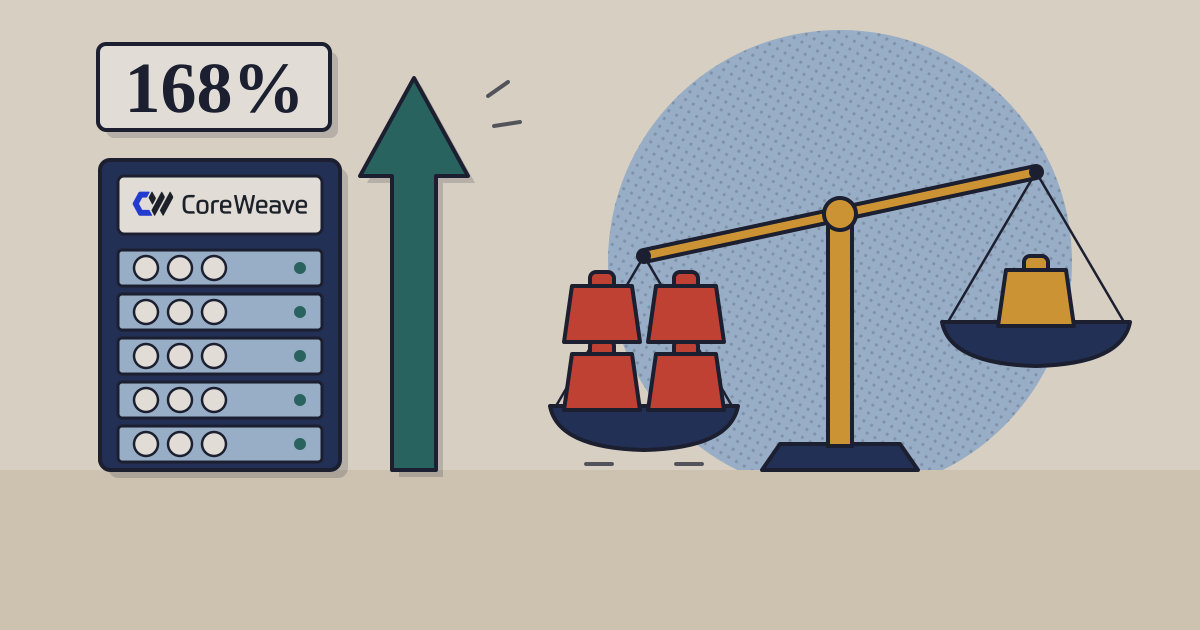
CoreWeave’s revenue rose 168%; its interest bill was four times its operating profit
CoreWeave’s results and filings for July to September: how a GPU cloud earns and spends, why US$846m of interest outran US$207m of operating income, and what a US$132.5bn backlog promises.

CoreWeave rents out Nvidia GPUs by the hour, on multi-year contracts, to AI labs, hyperscalers and other companies. It reported its third quarter on 10 November after the US close, and its shares were up 15.3% in premarket trading at 8:30am New York time the next morning.111 This piece reads the release and CoreWeave’s filings to answer three questions: how a GPU cloud makes and spends money, why its interest bill is now larger than its operating profit, and what a US$132.5bn backlog does and does not guarantee.
01The fastest quarter of growth this year
Revenue was US$3,661m against US$1,365m a year earlier, and US$1,086m more than in April–June.12 Growth on a year earlier had settled at 110–112% for three quarters; this quarter it reached 168%.34910
Almost all of it is contracted. CoreWeave sells capacity on committed contracts, which are take-or-pay: the customer pays for the capacity whether it uses it or not. Those contracts were 98% of revenue in April–June. They usually run one to six years, and revenue is recognised evenly over the term once the capacity is delivered. The rest is on-demand, pay-as-you-go use.23
CoreWeave's growth sped up again: revenue rose 168% on a year earlier, after three quarters near 110%
Quarterly revenue, US$bn, and growth on the same quarter a year earlier, %, April 2025 to September 2026
- Revenue (US$bn)
- Growth on a year earlier (%)
Show tableHide table
| Revenue (US$bn) | Growth on a year earlier (%) | |
|---|---|---|
| Q2 25 | 1.21 | 207 |
| Q3 25 | 1.36 | 134 |
| Q4 25 | 1.57 | 110 |
| Q1 26 | 2.08 | 112 |
| Q2 26 | 2.58 | 112 |
| Q3 26 | 3.66 | 168 |
Source: CoreWeave results release (10 Nov 2026); 10-Qs and 10-K for earlier quarters · as of 10 November 2026 · Quarters not reported on their own are derived from year-to-date totals
CoreWeave raised its 2026 revenue guidance to US$13.0–13.3bn and expects to leave the year at an annualised run rate of US$20–21bn, which it defines as the last month’s revenue times 12. It added more than 200 MW of active power in the quarter, to over 1.7 GW, and expects more than 1.85 GW at year-end.1
02Where each dollar of revenue goes
At CoreWeave the largest cost is the GPU itself, and it arrives as depreciation. CoreWeave writes its computing equipment off over six years, a period it lengthened from five in 2023.3 Depreciation and amortisation were US$1,889m in the quarter, 52% of revenue. Depreciation of servers, networking gear and software sits in the line CoreWeave calls technology and infrastructure; the cost of revenue line holds data-centre rent and power, along with the depreciation of power installations.12
Of every US$100 CoreWeave billed, about US$6 was left as operating income and US$23 went on interest
Lines of the income statement per US$100 of revenue, July to September 2026
Source: CoreWeave results release, consolidated statement of operations (10 Nov 2026) · as of 10 November 2026 · Depreciation and amortisation, US$51.6 of every US$100, is spread across the cost lines; tax and other income omitted
Adjusted EBITDA, the first of CoreWeave’s non-GAAP measures, adds depreciation, interest, tax and share-based pay back to the result: US$2,256m, a 62% margin. Its adjusted operating income, which keeps depreciation in, was US$379m, or 10%; a year earlier that margin was 16%. Operating income under US accounting rules was US$207m, 6% of revenue.1 The gap between 62% and 6% is mostly the price of the hardware, spread over its life. If GPUs earn for fewer than six years, each year’s real cost is higher than the books show; CoreWeave’s filing lists the useful life of its GPUs among the estimates that “could significantly affect” its results.2
03Why interest is larger than operating profit
4.1×
net interest expense as a multiple of operating income, July to September
US$846m against US$207m. A year earlier it was US$310m against US$52m, about six times.
The interest comes from how the GPUs are paid for. In the quarter CoreWeave spent US$9,441m on property and equipment and its operations brought in US$1,975m. Net new borrowing of US$7,957m covered the gap.1 Total debt, recourse and non-recourse, was about US$46.9bn on 30 September, from US$21.4bn on 31 December and US$14.0bn a year earlier.19 Recourse debt can be claimed from the parent company; non-recourse debt only from the assets of the subsidiary that borrowed it. Against that debt sat shareholders’ equity of US$4.0bn, and the company also carries US$18.7bn of operating lease liabilities, the category that holds its data-centre leases.13
Interest rose every quarter; operating income has been positive in only three of the last six
Operating income and net interest expense, US$m, April 2025 to September 2026
- Interest expense
- Operating income
US$m
Show tableHide table
| Interest expense | Operating income | |
|---|---|---|
| Q2 25 | 267 | 19 |
| Q3 25 | 310 | 52 |
| Q4 25 | 388 | -90 |
| Q1 26 | 536 | -144 |
| Q2 26 | 640 | -49 |
| Q3 26 | 846 | 207 |
Source: CoreWeave results release (10 Nov 2026); 10-Qs and 10-K for earlier quarters · as of 10 November 2026 · Q4 2025 and Q1 2026 derived from year-to-date totals
The price of the money is high. On 30 June CoreWeave’s term loans carried effective rates of 7% to 15%, its senior notes 9–10% and its equipment financing 9–11%; only its convertible notes, which can turn into shares, cost about 2%.2 In the quarter it raised about US$4.2bn of convertible notes, set up a programme to sell up to 35 million new shares on the market, and closed a US$2.6bn delayed-draw loan priced at the SOFR benchmark plus 5.5 percentage points.12 Interest guided at US$1.05–1.15bn for October–December is 24–36% above this quarter’s.1
04What the backlog promises, and what it does not
Backlog was about US$132.5bn on 30 September, from about US$104bn on 30 June, US$99.4bn on 31 March, US$66.8bn at the end of 2025 and US$55.6bn a year earlier.15678 The June release had said that more than US$25bn of new commitments signed early in the third quarter were not yet in its figure.5 At the midpoint of guidance, the backlog is about ten times 2026 revenue.
Backlog turns into revenue only after CoreWeave builds, delivers and keeps the capacity running
How a committed contract moves through CoreWeave's accounts, as its filings describe it, 2025 to 2026
- 01
Sign
A take-or-pay contract, usually one to six years. Its value enters the backlog, net of estimated credits.
- 02
Prepay and borrow
Customers prepaid 15–25% of contract value on average at end-2025. Term loans are secured on contract cash flows and the GPUs.
- 03
Build and deliver
GPUs bought, a powered data centre leased. Revenue starts when capacity is delivered and available.
- 04
Earn
Revenue booked evenly over the term. Service credits are paid if availability falls short.
Source: CoreWeave 10-K for 2025; 10-Q for April to June 2026; Q3 2026 results release · as of 10 November 2026
The definition carries the limits. Backlog counts committed contracts “subject to the satisfaction of delivery and availability of service requirements”.1 The part reported in its financial statements, remaining performance obligations, is net of expected credits, of revenue lost to delivery delays, and of capacity CoreWeave has the right to resell. Of the US$103.7bn on that measure at 30 June, 41% was expected within 24 months, 39% in months 25 to 48 and the rest up to month 78.2 Timing depends on others: in November 2025 CoreWeave announced delays by a third-party data-centre provider in delivering sites.2 CEO Michael Intrator said about US$9bn of customer prepayments and deposits are expected in the next three months.1
05The bill for the next quarter
CoreWeave’s guidance spells out the next three months. Revenue of US$13.0–13.3bn for the year leaves US$4.69–4.99bn for October–December. Adjusted operating income of US$1.275–1.375bn for the year, after US$528m in the first nine months, leaves US$747–847m for the quarter, below the US$1.05–1.15bn of interest CoreWeave expects in it. Capital expenditure for the year is now US$37–39bn; the low end rose from US$35bn because, the company says, it expects to deliver infrastructure to customers sooner than planned.1
CoreWeave's own guidance has interest above adjusted operating income again in October to December
2026 guidance and capacity, as stated in the third-quarter results release
US$13.0–13.3bn
Revenue for 2026, raised
Guidance
US$37–39bn
Capital expenditure for 2026
Guidance
US$1.05–1.15bn
Interest expense, Oct–Dec 2026
Guidance
4.6 GW
Contracted power; 1.7 GW active
30 September
Source: CoreWeave results release (10 Nov 2026) · as of 10 November 2026
Contracted power, the electricity CoreWeave has secured for future sites, grew by more than 900 MW in the quarter to over 4.6 GW, about 2.7 times what it runs today.1 Turning that power into revenue takes GPUs, and this quarter’s were paid for mostly with debt. The same strain shows at another financier of US AI data centres: SoftBank, in its quarter to September, wrote off power equipment bought for those sites while its finance cost rose.
Sources
- CoreWeave: Third Quarter 2026 results release (Form 8-K, Exhibit 99.1) — 10 November 2026
- CoreWeave: Form 10-Q for the quarter ended 30 June 2026 — 12 August 2026
- CoreWeave: Form 10-K for the year ended 31 December 2025 — 2 March 2026
- CoreWeave: Form 10-Q for the quarter ended 31 March 2026 — 8 May 2026
- CoreWeave: Second Quarter 2026 results release — 11 August 2026
- CoreWeave: First Quarter 2026 results release — 7 May 2026
- CoreWeave: Fourth Quarter and Fiscal Year 2025 results release — 26 February 2026
- CoreWeave: Third Quarter 2025 results release — 10 November 2025
- CoreWeave: Form 10-Q for the quarter ended 30 September 2025 — 13 November 2025
- CoreWeave: Form 10-Q for the quarter ended 30 June 2025 — 13 August 2025
- CNBC: CoreWeave stock pops 11% after outlook raise eases AI slowdown concerns — 11 November 2026 Premarket move as of 8:30am ET.
- CNBC: CoreWeave earnings put debt-fueled AI build-out under scrutiny — 10 November 2026
Disclosure. TechBag is a software reseller: it earns a margin when a reader buys through it, including from vendors named here. The analysis is TechBag’s own; no vendor paid for or saw this piece before publication. Facts are labelled reported, TechBag count or our view.
Keep reading