Cloud & DevOpsNote
Microsoft 365 outage final report: a Teams fault in US East; only newer servers failed
Microsoft’s final post-incident report of 20 November: a routing fault in US East, a worldwide Teams failover, a defect only newer servers hit, and 13 next steps, 9 of them dated.

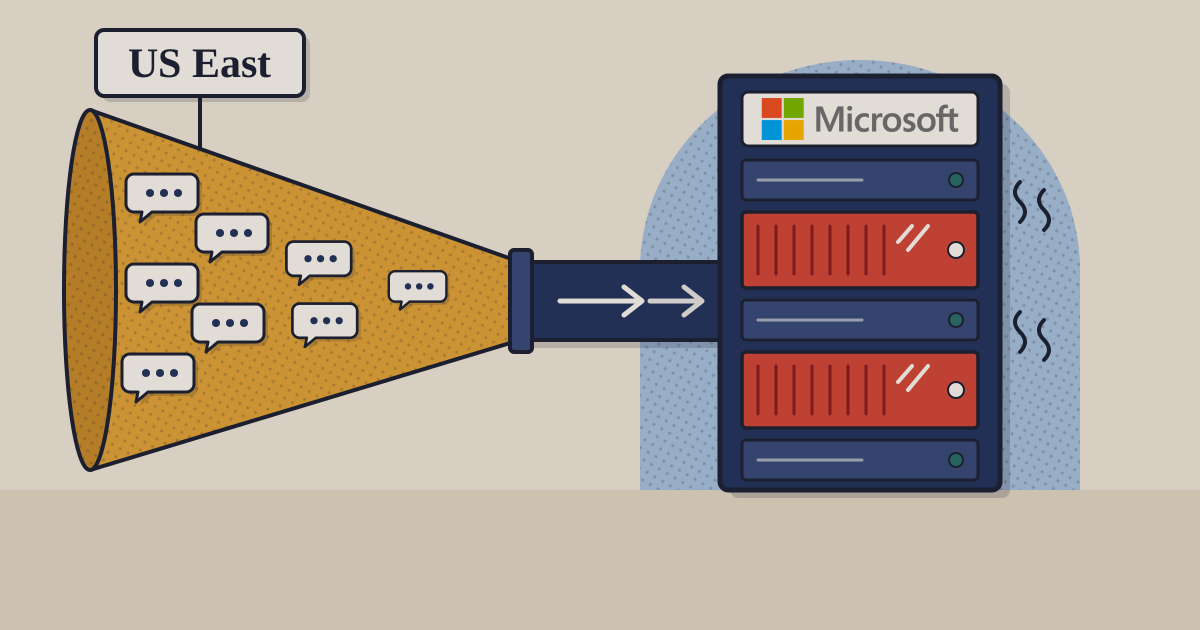
Microsoft’s final report on the 12 November Microsoft 365 outage starts the chain in one region. At 00:25 UTC (5:55am IST) Teams users in US East began timing out on Teams’ own networking gateway; at 01:07 an automated failover moved Teams traffic onto the gateway that Exchange Online uses. In the report’s own findings: “A routing issue in one region moved all Teams traffic worldwide to the primary network gateway.”1 The report is dated 20 November and replaces the preliminary one we read on 16 November.2
00:25 UTC
Teams users in US East begin timing out
Microsoft
4
causes in the final report; the preliminary gave three
Microsoft
~2 hours
from broad failures in North America to every region
Microsoft
13
next steps, nine of them with a due date
Microsoft
01What the final report changes
The latent July defect is still the first cause. The 14% of gateway capacity that was out of service is now “part of routine operations when we deploy the latest version of the service”, where the preliminary report said “an unrelated issue from the previous day”. The new fourth cause is North America’s daily peak: broad failures began at about 16:00 UTC as US traffic approached it, some 16 hours after the failover.12
The spread is told differently too. “More than 80%” of servers unresponsive at the low point now describes the North American fleet, reached in under two hours. When a region runs short of healthy capacity, traffic management sends its traffic to other regions; they carried the same defect, and within about two hours servers in every region were affected. The preliminary report had said bulkheads between regions failed “due to a separate issue”; the final one does not mention that.12
02Why only newer servers failed
The defect “impacted our newer SKU hardware, but not the older generation SKUs”: newer machines have more cores, take more concurrent requests and so hit more lock contention. Microsoft’s load testing “used older SKU hardware with fewer cores”. Each server took five steps to fix: out of service, restart from its hung state, patch, restart again, back into service. The fix is now in the Windows image for new and existing servers.1
Microsoft names three things that stretched recovery: tracing a defect introduced months earlier, the two restarts per server, and the time to deploy the update across so many machines. Servers returned to service were swamped by queued client traffic and went down again. Recovery finished in parts of Asia Pacific at 11:00 UTC on 13 November and in Europe at 11:35; customers stopped seeing active impact at 16:10, and the incident was declared resolved at 04:15 UTC on 14 November.1
The report’s impact list is longer than the preliminary one: most users could not launch the Microsoft 365 Copilot desktop apps or load the web apps, and Purview policy alerts and Defender’s post-delivery mail clean-up ran late. Microsoft extended its mail retry window from 24 to 48 hours before a bounce and found no enterprise message permanently lost, but some delayed mail to consumer mailboxes inactive for more than 30 days expired. It says the incident was not a cyberattack and “was not caused by AI tooling”, and that its first customer notice came “about 20 minutes after broad impact”.1
03Thirteen next steps, four due this quarter
Microsoft dated nine of its 13 fixes; four are due by the end of December
Next steps in Microsoft's final post-incident report, by completion date given, 20 November 2026
Show tableHide table
| Due | Microsoft's tag | Action |
|---|---|---|
| CY26 Q4 | Blast radius | Stop traffic distribution cascading failures to other regions |
| CY26 Q4 | Failover design | Teams fails over only for the affected region, not worldwide |
| CY26 Q4 | Capacity design | Detect extended capacity loss before headroom runs out |
| CY26 Q4 | Customer communications | Faster detection and automated notification |
| CY27 Q1 | Blast radius | Split gateway capacity into pools for different workloads |
| CY27 Q1 | Diagnosis | Better diagnostics and change auditing for Windows changes |
| CY27 Q1 | Recovery | Procedures for fleet-wide failures |
| CY27 Q1 | Testing | Load tests on the newest, highest-core hardware at peak limits |
| CY27 Q1 | Capacity design | More capacity for headroom |
| TBD | Blast radius | Smaller fault zones |
| TBD | Failover drills | Failover tests covering peak conditions |
| TBD | Recovery | Gradual ramp-up as servers rejoin; retry and back-off |
| TBD | Blast radius | Retry and back-off with other services |
Source: Microsoft, final post-incident report EX1550543/MO1550821; TechBag count · as of 21 November 2026
The Teams change is in the first group, due by 31 December: a regional fault should move only that region’s traffic. So is faster customer notification. Load tests on the newest hardware follow by March; smaller fault zones and gradual ramp-up for returning servers carry no date.1 How the outage reached Parliament is in our Note of 17 November; how it unfolded, in our Note of 13 November.
Sources
- Microsoft: Post Incident Report for Microsoft 365, EX1550543/MO1550821 (final; copy hosted by 365Fanatic) — report date 20 November 2026; copy 21 November
- Microsoft: Preliminary Post Incident Report, EX1550543/MO1550821 (copy hosted by next.ink) — report date 15 November 2026; copy 16 November
Disclosure. TechBag is a software reseller: it earns when companies buy through it, including from vendors named here. The analysis is TechBag’s own; no vendor paid for or saw this piece before publication. Facts are labelled reported, TechBag count or our view.
Keep reading