Paytm to pay about ₹162 crore for 19.1% of Singapore’s CardUp
Paytm’s filing of 19 November: SGD21.8m for 19.1% of CardUp, a Singapore card-payments company owned by Funding Societies, what CardUp does, its turnover, and a five-year technology deal.

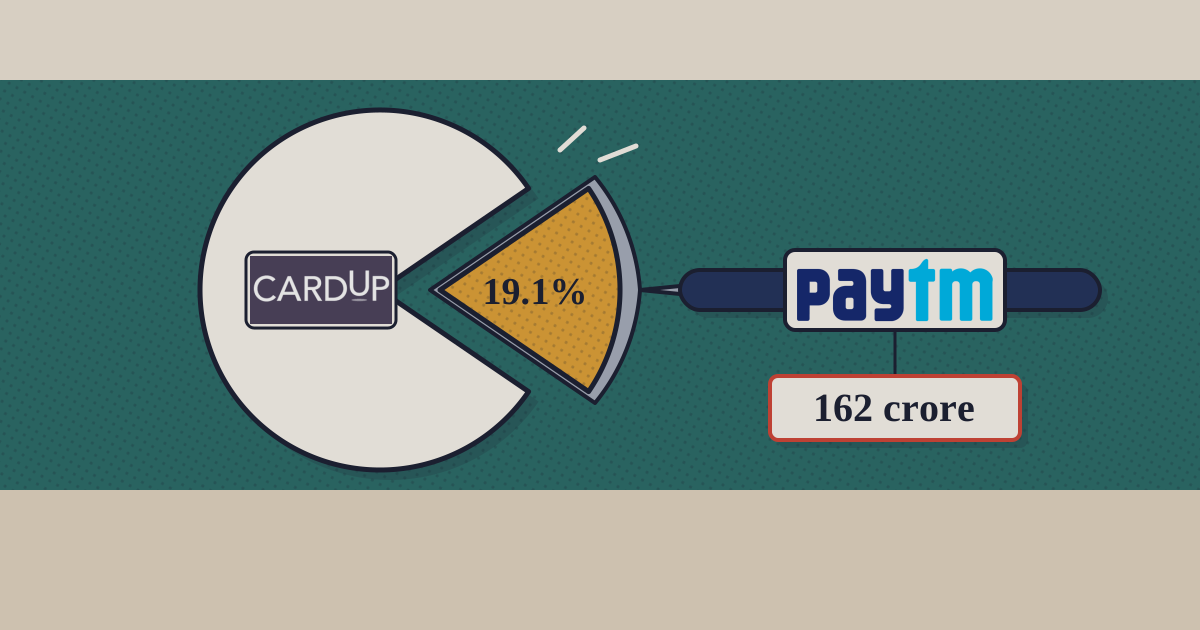
Paytm’s Singapore subsidiary will pay up to SGD21.8m, about ₹162 crore, for 19.1% of CardUp, a Singapore payments company owned by the small-business lender Funding Societies. The board of Paytm Singapore approved it on 19 November and told its Indian parent, One 97 Communications, at 6:22pm.1 CardUp will issue new shares to Paytm Singapore for cash, and Paytm will also supply CardUp with payments and lending technology for five years, for fees and a share of revenue. Completion is expected by 20 May 2027, subject to confirmatory due diligence, definitive documents and approvals.1
Paytm values CardUp at about SGD114m, 2.8 times last year’s turnover
Paytm Singapore’s proposed investment in CardUp Pte. Ltd., as disclosed on 19 November 2026; CardUp turnover for calendar 2025
19.1%
of CardUp, for up to SGD21.8m, about ₹162 crore
Paytm filing
SGD114m
what that price implies for all of CardUp, about ₹848 crore
price ÷ stake
₹299.2 cr
CardUp’s turnover in 2025, up 54% from ₹194.4 crore
Paytm filing
5 years
technology agreement: Paytm earns fees and a revenue share
Paytm filing
Source: One 97 Communications, Regulation 30 disclosure, 19 November 2026; TechBag arithmetic for the implied value · as of 19 November 2026 · Implied value is the price divided by the stake, after the new shares
01What CardUp does
CardUp lets businesses and households pay bills by credit card where the payee does not take cards (rent, suppliers, payroll, corporate tax and GST among them), and collect payments from their own customers.2 Paying by card lets a business take up to two months longer to pay its suppliers, CardUp says.2 Funding Societies, which describes itself as Southeast Asia’s largest digital financing platform for small businesses, agreed to buy CardUp in 2022, to add payments to its loans.3
Paytm’s filing puts CardUp’s turnover at ₹299.20 crore for calendar 2025, against ₹194.38 crore in 2024 and ₹104.16 crore in 2023: almost three times in two years.1 It gives no profit figure. The investment is part of up to ₹200 crore that Paytm Singapore will put into Funding Societies’ subsidiaries; the other ₹38 crore or so may go into one of its affiliates, not yet named.1
Sources
- One 97 Communications (Paytm), disclosure under Regulation 30 of SEBI LODR: Paytm Singapore board approves partnership with Funding Societies, with Annexures I and II — 19 November 2026
- CardUp, home page: what CardUp is, payment types and working capital — as published on 19 November 2026
- CardUp and Funding Societies, Funding Societies to acquire CardUp, drives payments expansion — 2022 (editor’s note of December 2022: acquisition complete)
- NSE, security-wise full bhavcopy, 19 November 2026 (PAYTM, EQ) — 19 November 2026
- NSE, security-wise full bhavcopy, 31 December 2025 (PAYTM, EQ) — 31 December 2025
Disclosure. TechBag is a software reseller: it earns when companies buy through it, including from vendors named here. The analysis is TechBag’s own; no vendor paid for or saw this piece before publication. Facts are labelled reported, TechBag count or our view.
Keep reading