Project Zero cuts its bug deadline from 90+30 days to 90, then 60, then 30
Project Zero’s policy of 13 November and its own tracker: when the deadline falls to 60 and 30 days, what was dropped, and how many of this year’s bugs vendors fixed within 30.

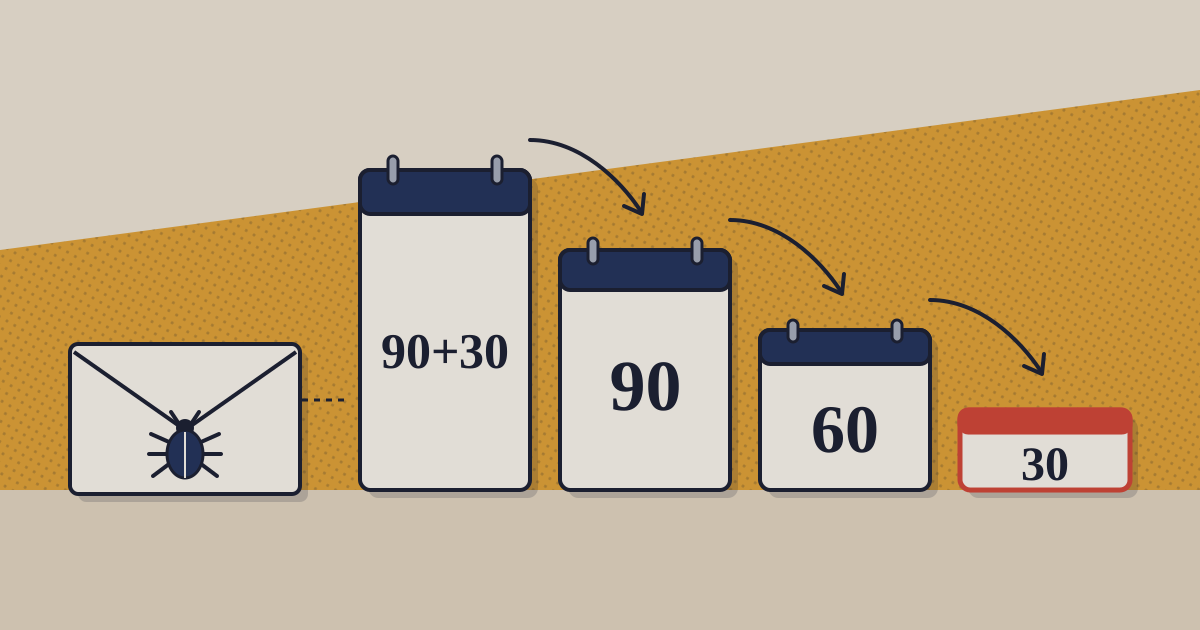
Google’s Project Zero, the team that finds flaws in other companies’ software and publishes them after a deadline, dropped its “90 + 30” policy on 13 November. Bugs it reports are now made public 90 days after the vendor is told, fixed or not. On 2 February 2027 the window falls to 60 days, and on 3 January 2028 to 30.1 Under the old rule, in place since 2021, a vendor had up to 90 days to fix a bug and then 30 days of “soak time” for users to install the patch before details came out.1 The grace period and the variant policy go too.1
90 days
from report to publication, fixed or not, from 13 November
Project Zero
60 days
from 2 February 2027
Project Zero
30 days
from 3 January 2028
Project Zero
7 days
for a flaw being exploited in the wild, unchanged
Project Zero
01Why the clock is shorter
Project Zero’s reason is language models. They have sped up how fast attackers find and exploit flaws and raised the chance that several parties, malicious ones included, find the same bug. They have also cut the time needed to turn a patch back into an exploit, so far that it now treats “zero patch-to-exploitation time” as a reasonable model of attackers. That, it says, makes soak time meaningless.1
We are finding several vulnerabilities a week in targets where we once found a few vulnerabilities a year.
At that volume, the parts of the old policy that needed negotiation, such as agreeing whether a bug was fixed and whether a grace period applied, were “quickly becoming unmanageable”. Project Zero will still track fixes but they no longer move the date. The steps are gradual because vendors it consulted warned that an immediate cut could expose unfixed bugs, push Project Zero’s reports ahead of more severe ones, or lead vendors to stop trying to meet a deadline they could not hit. Severity does not change the clock: it affects the harm a bug does, Project Zero argues, not the odds attackers find it.1 Exceptions remain: 7 days for a flaw exploited in the wild, immediate release if details are already public or the vendor asks, and rare delays such as Spectre and Meltdown; it has granted five in 12 years.2
02How vendors would fare today
Project Zero lists every report and its fix time on a public tracker. Of the 61 bugs reported this year and marked fixed by its 10 November update, 19 were fixed within 30 days and 37 within 60. Five more reports are past the 90-day deadline and unfixed, all of them in Google’s own Pixel and Android. Of 49 still open, 13 are already older than 60 days.3
Vendors fixed 19 of 61 Project Zero bugs from this year within 30 days
Bugs reported in 2026 and marked fixed, by days from report to fix; tracker updated 10 November 2026
Source: Project Zero Reporting Transparency page; TechBag count · as of 17 November 2026, 10:30pm IST
Sources
- Project Zero (Natalie Silvanovich), Policy and Disclosure: 2026 Edition — 13 November 2026
- Project Zero, Vulnerability Disclosure Policy — page as of 17 November 2026
- Project Zero, Reporting Transparency (open, fixed and past-deadline reports) — updated 10 November 2026
- Ittiam Systems, Contact (headquarters, Bengaluru) — page as of 17 November 2026
- Google, Application security: Google’s vulnerability disclosure policy — page as of 17 November 2026
- Project Zero (Natalie Silvanovich), How to fix a bug in a fix — 6 October 2026
Disclosure. TechBag is a software reseller: it earns when companies buy through it, including from vendors named here. The analysis is TechBag’s own; no vendor paid for or saw this piece before publication. Facts are labelled reported, TechBag count or our view.
Keep reading