Rashi Peripherals faces ₹34.62 crore customs demand: ₹17.32 crore duty, an equal penalty
Rashi Peripherals’ filing of 24 November: a ₹17.32 crore duty demand doubled by a Section 114A penalty, how a tariff code sets the duty, and what an appeal costs.

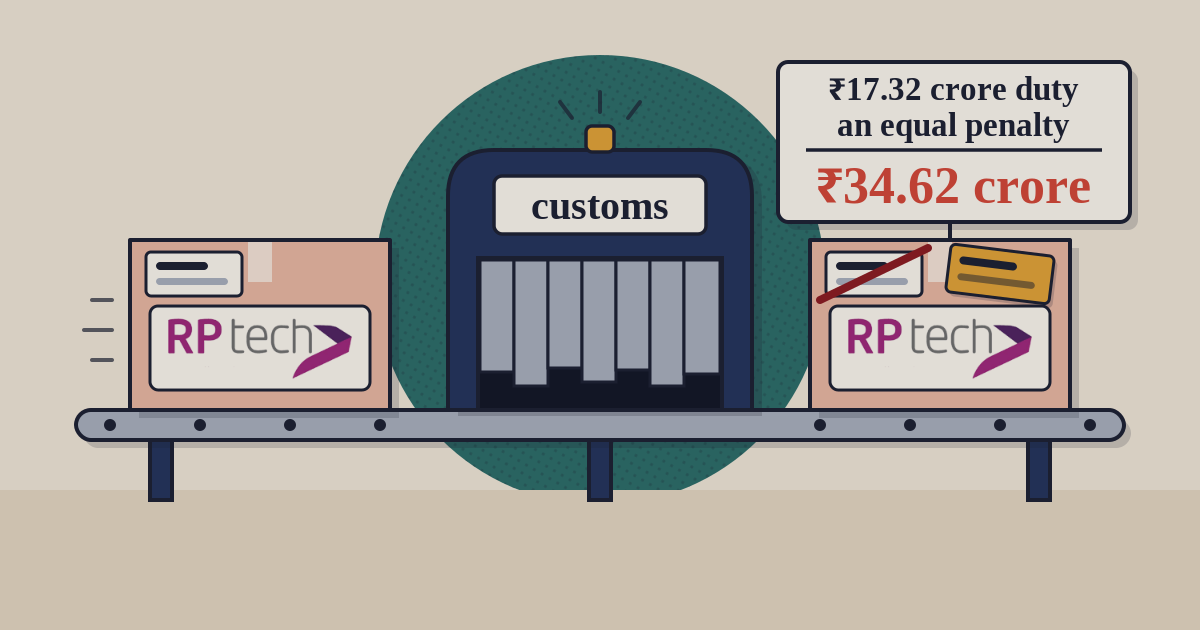
The Commissioner of Customs (NS-V) at Jawaharlal Nehru Custom House, Nhava Sheva, has confirmed a demand of ₹34,62,17,701 on Rashi Peripherals, the Mumbai IT distributor that trades as RP Tech. The order is dated 12 November and reached the company at 10:00 on 24 November. It consists of ₹17,31,70,772 of differential duty and a penalty of exactly the same amount under Section 114A of the Customs Act, less ₹1,23,843 already paid. Interest is extra.1 It is Rashi’s second customs order this month: on 3 November the Air Cargo Complex in Mumbai confirmed ₹2.15 crore, also for wrong classification.2
₹17.32 cr
differential customs duty confirmed by the order of 12 November
Rashi Peripherals filing
100%
the Section 114A penalty as a share of that duty: another ₹17.32 crore
Rashi Peripherals filing
12.3%
the net demand as a share of Rashi’s ₹282.35 crore profit for the year to March 2026
TechBag, from Rashi’s results
3 months
the time to appeal to the customs tribunal, from the day the order is communicated
Customs Act, s. 129A
01How a tariff code becomes a demand
Every imported product is entered under an eight-digit tariff item, and the duty rate belongs to the item. The importer chooses the item: Section 17 of the Customs Act has the importer “self-assess the duty”, and customs may verify it afterwards.3 For IT hardware the choice can move the rate a long way. A World Trade Organization panel recorded in April 2023 that inside one Indian tariff item, 8517 62 90, routers were exempt, most other goods paid 10% and a listed group paid 20%.4 That shows the mechanism only. Rashi’s filing names neither the goods nor the tariff items in dispute.1
If customs decides the wrong item was used, Section 28 lets it claim the shortfall within two years. It has five years where it alleges “collusion”, “wilful mis-statement” or “suppression of facts”, and Rashi’s notice of 13 January 2026 was issued under that limb, Section 28(4).13 The limb matters because Section 114A covers the same three grounds, and makes the importer “liable to pay a penalty equal to the duty”. The penalty falls to 25% of the duty if the duty, the interest and the reduced penalty are all paid within thirty days of the order being communicated.3
A classification dispute doubles on the way: the duty, then a penalty equal to it
The steps from an importer’s own declaration to an appeal, under the Customs Act, 1962
- 01
Declaration
The importer picks the tariff item and assesses its own duty. - 02
Notice
Customs claims a shortfall: two years, or five if it alleges wilful mis-statement. - 03
Order
Duty and interest are confirmed, with a penalty equal to the duty. - 04
Appeal
Three months to reach the tribunal, after depositing 7.5% of the duty.
Source: Customs Act, 1962, sections 17, 28, 114A, 129A and 129E, on CBIC’s tax information portal · as of 24 November 2026
02The size, and the next three months
Rashi “believes it has strong grounds on merits”, will carry the sum as a contingent liability and is “in discussion with its tax experts regarding filing of appeal before CESTAT”, the customs tribunal.1 An appeal must be filed within three months of the order being communicated, which by our count is 24 February 2027, and the tribunal will not hear it without a deposit of 7.5% of the duty, about ₹1.30 crore here. The thirty days for the reduced penalty end on 24 December.3
Rashi distributes 89 technology brands to 10,289 channel partners, on thin margins. It earned ₹282.35 crore on revenue of ₹15,827 crore in the year to March 2026, and ₹130.74 crore on ₹6,185 crore in July–September.56 The net demand is 12.3% of last year’s profit, 26.5% of the latest quarter’s and 1.5% of shareholders’ equity of ₹2,248.94 crore. The shares closed at ₹647.05 on Monday 23 November, before the order arrived. Indian markets were shut on Tuesday for Guru Nanak Jayanti, so the first trading after the filing is on Wednesday.7
Sources
- Rashi Peripherals, intimation under Regulation 30: order of the Commissioner of Customs (NS-V), Nhava Sheva, dated 12 November 2026 (NSE) — 24 November 2026
- Rashi Peripherals, intimation under Regulation 30: order of the Principal Commissioner of Customs (Import), Air Cargo Complex, Mumbai, dated 3 November 2026 (NSE) — 4 November 2026
- Customs Act, 1962: sections 17, 28, 28AA, 114A, 129A and 129E (Central Board of Indirect Taxes and Customs, tax information portal) — As in force on 24 November 2026
- World Trade Organization, India – Tariff Treatment on Certain Goods in the Information and Communications Technology Sector, report of the panel, WT/DS582/R, paragraphs 7.340 to 7.345 — 17 April 2023
- Rashi Peripherals, outcome of board meeting: unaudited standalone and consolidated results for the quarter and half year to 30 September 2026 (NSE) — 5 November 2026
- Rashi Peripherals, press release on results for July to September 2026 (NSE) — 5 November 2026
- National Stock Exchange of India, daily price file for the cash market (RPTECH, series EQ) — 23 November 2026
Disclosure. TechBag is a software reseller: it earns when companies buy through it, including from vendors named here. The analysis is TechBag’s own; no vendor paid for or saw this piece before publication. Facts are labelled reported, TechBag count or our view. How the Journal works.
Keep reading