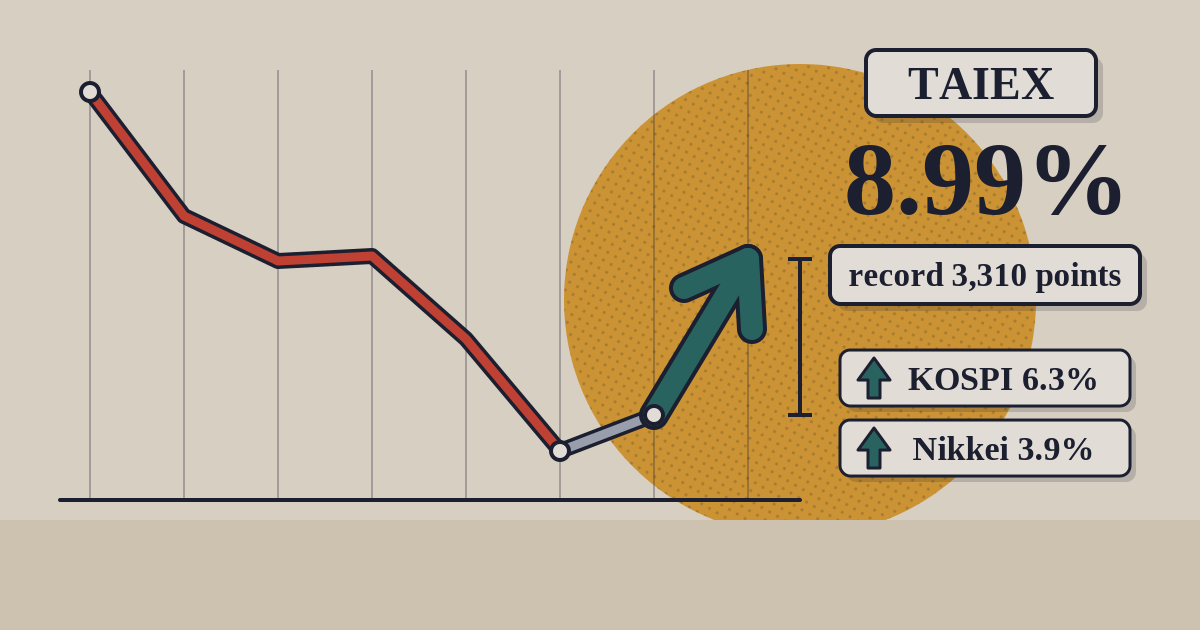
Taiwan’s TAIEX rose 8.99%, a record 3,310 points; KOSPI up 6.3%, Nikkei 3.9%
Exchange closes for Tuesday 24 November: how much of the fall Taipei, Seoul and Tokyo won back in a day, how far each still sits below its 2026 high, and who sold in Taipei.

On Monday our Trend on the AI rout by country measured how far four Asian markets had fallen from their highs for the year. A day later three of them rose sharply. The session came after Monday in New York, where the Nasdaq Composite rose 6.51%, the S&P 500 rose 4.73% and Nvidia’s shares rose 31.48% to US$165.05, the day Nvidia reinstated Jensen Huang as chief executive.67 Dealers quoted by CNA and the Korea Herald’s market report tied Tuesday’s gains to that.413 We report the moves and assert no cause. The measure is Monday’s: each index as a share of its own 2026 closing high.
01One day against the whole fall
The TAIEX peaked at 49,822.55 on 6 October and closed as low as 36,033.29 on Friday 20 November. Monday’s and Tuesday’s gains have taken back 30% of that fall.1 The KOSPI peaked at 9,114.55 on 22 June and closed at 4,708.54 on Monday; Tuesday took back 6.8% of the fall.3 The Nikkei 225, shut on Monday for Labor Thanksgiving Day, recovered 13.9% of its fall from 72,366.34 on 25 June to 56,436.65 on Friday.515
After Tuesday's rebound the KOSPI is still 45% below its June high; Taiwan and Japan are 19% below theirs
KOSPI, TAIEX, Nikkei 225 and Nifty 50, weekly closes as a share of each index's 2026 closing high (high = 100), 2 January to 24 November 2026
- KOSPI
- TAIEX
- Nikkei 225
- Nifty 50
Show tableHide table
| KOSPI | TAIEX | Nikkei 225 | Nifty 50 | |
|---|---|---|---|---|
| 2 Jan | 47.3 | 58.9 | 69.6 | 100 |
| 9 Jan | 50.3 | 60.8 | 71.8 | 97.5 |
| 16 Jan | 53.1 | 63 | 74.5 | 97.6 |
| 23 Jan | 54.7 | 64.2 | 74.4 | 95.1 |
| 30 Jan | 57.3 | 64.4 | 73.7 | 96.2 |
| 6 Feb | 55.8 | 63.8 | 75 | 97.6 |
| 13 Feb | 60.4 | 67.5 | 78.7 | 96.7 |
| 20 Feb | 63.7 | 67.5 | 78.5 | 97.1 |
| 27 Feb | 68.5 | 71.1 | 81.3 | 95.6 |
| 6 Mar | 61.3 | 67.4 | 76.9 | 92.9 |
| 13 Mar | 60.2 | 67 | 74.4 | 87.9 |
| 20 Mar | 63.4 | 67.3 | 73.8 | 87.8 |
| 27 Mar | 59.7 | 66.5 | 73.8 | 86.7 |
| 3 Apr | 59 | 65.4 | 73.4 | 86.3 |
| 10 Apr | 64.3 | 71.1 | 78.7 | 91.3 |
| 17 Apr | 67.9 | 73.9 | 80.8 | 92.5 |
| 24 Apr | 71 | 78.1 | 82.5 | 90.8 |
| 1 May | 72.4 | 78.1 | 82.2 | 91.1 |
| 8 May | 82.3 | 83.5 | 86.7 | 91.8 |
| 15 May | 82.2 | 82.6 | 84.9 | 89.8 |
| 22 May | 86.1 | 84.8 | 87.5 | 90.1 |
| 29 May | 93 | 89.8 | 91.7 | 89.4 |
| 5 Jun | 89.5 | 90.5 | 92 | 88.8 |
| 12 Jun | 89.1 | 88.7 | 91.2 | 89.7 |
| 19 Jun | 99.3 | 93.3 | 98.5 | 91.2 |
| 26 Jun | 92.3 | 89.5 | 95.8 | 91.4 |
| 3 Jul | 88.7 | 93.9 | 96.4 | 92.2 |
| 10 Jul | 82 | 91 | 94.7 | 91.9 |
| 17 Jul | 74.8 | 85.6 | 88.6 | 92.4 |
| 24 Jul | 73.4 | 87.6 | 89.3 | 90.3 |
| 31 Jul | 72.4 | 86.5 | 88.9 | 92.6 |
| 7 Aug | 68.7 | 88.8 | 90.7 | 93.3 |
| 14 Aug | 76.6 | 91.9 | 95 | 92.5 |
| 21 Aug | 75.8 | 90.8 | 91.2 | 92.1 |
| 28 Aug | 74.5 | 93 | 91.8 | 91.8 |
| 4 Sep | 73.4 | 93.4 | 89.8 | 90.8 |
| 11 Sep | 75.8 | 92.7 | 88.5 | 88.9 |
| 18 Sep | 75.6 | 94.7 | 89.8 | 88.7 |
| 25 Sep | 77.7 | 96.4 | 91.7 | 87.9 |
| 2 Oct | 76.8 | 97.3 | 94.4 | 85.2 |
| 9 Oct | 72.7 | 99 | 95.4 | 85.5 |
| 16 Oct | 62.2 | 94.6 | 90.3 | 87.9 |
| 23 Oct | 60.9 | 92.4 | 86.6 | 85.8 |
| 30 Oct | 62.9 | 90.7 | 87.5 | 87.6 |
| 6 Nov | 55.5 | 79.7 | 79.4 | 95.1 |
| 13 Nov | 58 | 87.7 | 84.5 | 95.5 |
| 20 Nov | 53.4 | 72.3 | 78 | 98 |
| 23 Nov | 51.7 | 73.9 | 78 | 96.3 |
| 24 Nov | 54.9 | 80.5 | 81 | 96.3 |
Source: Naver Finance (KRX-derived KOSPI series); Taiwan Stock Exchange; Nikkei Inc.; NSE · as of 24 November 2026 · last close of each week, then Monday 23 and Tuesday 24 November; Tokyo was shut on 23 November and Mumbai on 24 November, so each carries its previous close that day. Peaks reached mid-week show just under 100
A fall and the rise that undoes it are not the same size. The KOSPI lost 48.3% between its high and Monday; from there it needed to rise 93.6% to get back, and after Tuesday’s 6.32% it still needs 82.1%.
02Taipei: a record gain on thin trading
The TAIEX opened at 39,148.91, 6.3% above Monday’s close, and never traded lower. The previous largest point gain was 3,186.45 on 31 July, CNA reported.14 Of listed stocks, 1,053 rose, 335 of them by the 10% daily limit, and 26 fell.8 TSMC traded at one price all day: NT$2,230, its limit, 9.85% above Monday’s NT$2,030.9
A stock at its limit has buyers queuing and few sellers, so little of it trades. 13.2m TSMC shares changed hands, against 69.4m on Monday, and the market’s turnover fell 61% to NT$432.6bn, the lowest of any session in November.29 CNA, which put it at NT$419.41bn, called it the lowest this year.4 Foreign investors sold a net NT$50.39bn into the rise and dealers’ hedging accounts a net NT$82.61bn, while local investment trusts bought a net NT$9.76bn.12
It was the second session of the ban on short sales priced below the previous close, and the first with the exchange’s lower line for margin calls, collateral of 120% of the loan in place of 130%.19 Short sales with borrowed shares rose 86%, to 140.4m from 75.4m. Four-fifths of them were in exchange-traded funds. In everything else they fell 17% to 28.1m, a third of the 93.5m of Thursday, the last session before any price floor; in TSMC, 2,000 shares against 401,000 on Monday.10 The ban’s text names listed and over-the-counter stocks and Taiwan depositary receipts; it does not mention funds.17 Funds were also where much of the trading was: NT$140.1bn of the day’s turnover, 32%.8 Margin loans rose 4.5% in the day, to NT$453.5bn.11
03Seoul, Tokyo, and what to watch
Seoul. The KOSPI opened 3.64% up at 4,880.16 and closed above 5,000 for the first time since Thursday.3 At about 9:06am the Korea Exchange triggered a buy-side sidecar, which suspends program-trading buy orders for five minutes; on Monday it had triggered the sell-side one, for a second session running.18 Foreign investors bought a net ₩726.1bn and institutions ₩870.3bn, while individuals sold ₩2.04tn. Samsung Electronics rose 6.7% to ₩189,400 and SK hynix 6.73% to ₩1.158m, the Korea Herald reported.13 Tuesday was also the first day listed companies could buy back their own shares without the daily limit, which the Financial Services Commission lifted until 23 February 2027.14 Tokyo. The Nikkei 225 rose 2,207.98 points in its first session since Friday.5
What to watch.
- Wednesday in Taipei. Whether the 335 stocks that ended at the limit trade freely: turnover will show it. The short-sale ban has no end date.17
- New York on Tuesday. US markets had not closed when this was written.
- The KOSPI’s margin over last year. At 5,006.03 it is 18.8% above its 2025 close of 4,214.17.
- Buybacks in Seoul. Company disclosures will show whether the lifted limit is used.
Sources
- Taiwan Stock Exchange, TAIEX historical data (MI_5MINS_HIST), November 2026 (with the tables for December 2025, July and October 2026) — 24 November 2026
- Taiwan Stock Exchange, Highlights of Daily Trading (FMTQIK), November 2026 — 24 November 2026
- Naver Finance, KOSPI daily index series (KRX-derived), to 24 November 2026 — 24 November 2026 quote data, not a primary source
- Focus Taiwan (CNA), Taiex posts record single-day point gain on Huang's return to Nvidia — 24 November 2026, 5:05pm Taipei
- Nikkei Inc., Nikkei Stock Average daily data (CSV) — 24 November 2026
- Nasdaq, historical closes of the Nasdaq Composite and of Nvidia (NVDA), 20 and 23 November 2026 — 23 November 2026 quote data, not a primary source
- Yahoo Finance, S&P 500 (^GSPC) daily closes, 20 and 23 November 2026 — 23 November 2026 quote service, not a primary source
- Taiwan Stock Exchange, daily market report (MI_INDEX): market summary, advancers and decliners — 24 November 2026
- Taiwan Stock Exchange, daily trading of 2330 (TSMC), November 2026 — 24 November 2026
- Taiwan Stock Exchange, daily short sale balances, margin and borrowed shares (TWT93U), 19, 20, 23 and 24 November — 24 November 2026
- Taiwan Stock Exchange, margin transaction summary (MI_MARGN) — 24 November 2026
- Taiwan Stock Exchange, trading value of foreign and other investors (BFI82U), 24 November — 24 November 2026
- The Korea Herald, Kospi roars back above 5,000 on news of Huang's Nvidia comeback — 24 November 2026, 5:00pm KST
- Financial Services Commission (Korea), FSC eases rule on daily buying order limit on treasury stock buyback of listed companies for three months — 23 November 2026
- Japan Exchange Group, market holidays calendar — 2026
- NSE Indices, closing values of all indices, 23 November 2026; NSE trading holidays for 2026 (24 November: Prakash Gurpurb Sri Guru Nanak Dev) — 23 November 2026
- Financial Supervisory Commission (Taiwan), 為維護市場交易秩序,金管會宣布「全面禁止平盤以下放空」等5項措施 (five measures including a full ban on short selling below the previous close; Chinese) — 21 November 2026
- Yonhap News Agency, Bourse operator activates sell-side sidecar for KOSPI on sharp fall — 23 November 2026, 11:38am KST
- Taiwan Stock Exchange, 自115年11月24日起,信用交易擔保維持率最低標準由130%調降至120% (minimum margin maintenance ratio cut from 130% to 120% from 24 November; Chinese) — 23 November 2026, 2:50pm Taipei
Disclosure. TechBag is a software reseller: it earns when companies buy through it, including from vendors named here. The analysis is TechBag’s own; no vendor paid for or saw this piece before publication. Facts are labelled reported, TechBag count or our view. How the Journal works.
Keep reading