Sarvam’s Prism writes no text, so output is free; input costs ₹4 per million tokens
How Sarvam’s Prism decision model works, what a call costs and whose benchmarks rank it, from Sarvam’s release, API docs and model card of 3 November.

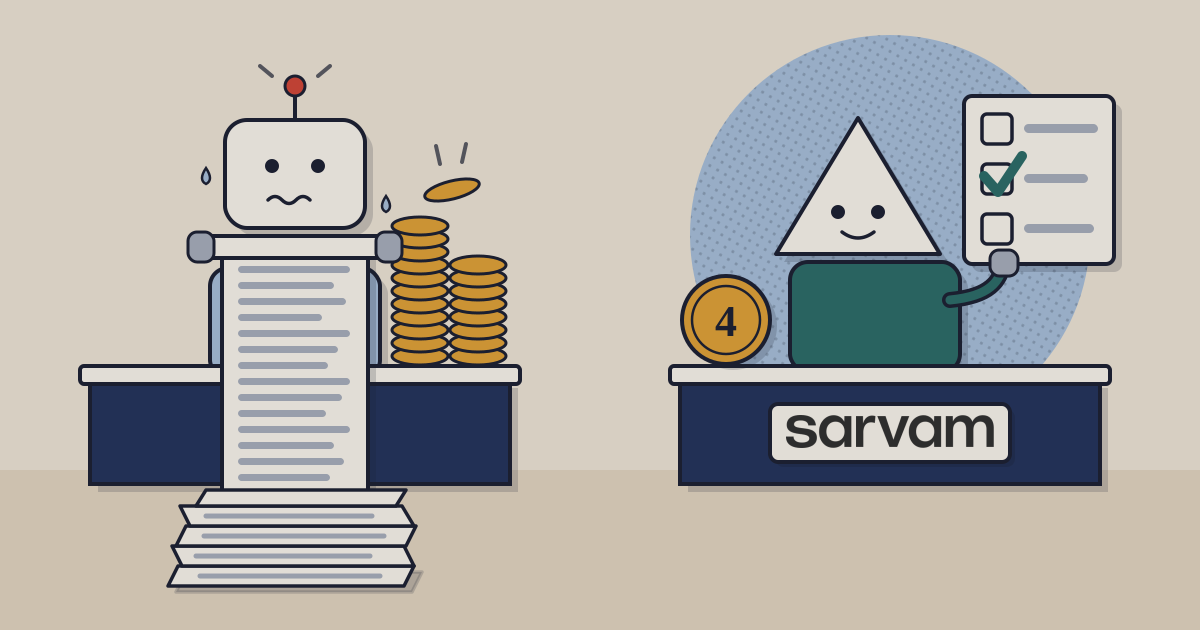
Bengaluru’s Sarvam released Prism on 3 November: a model that answers without writing. Given a text and a question with a fixed set of answers, it returns a probability for every answer “in a single forward pass”.14 Sarvam charges ₹4 per million input tokens and ₹0 for output, “on every plan”; by its own example, three short questions about a 1,000-token text cost about ₹0.004.2 Prices exclude GST.3 The weights are open, under the Apache 2.0 licence.4
₹4
per million input tokens, before GST
Sarvam price list
₹0
per million output tokens: it returns probabilities, not text
Sarvam API docs
44 ms
median per request on one Nvidia B200; 95th percentile 420 ms
Sarvam model card
₹0.004
three questions about a 1,000-token text, Sarvam's example
Sarvam API docs
01What a decision model does
Sarvam calls Prism a “System One” decision model, after Kahneman’s fast, intuitive mode of judgement, a category it says TypeSafe created a month earlier with its Jev model.1
Where a chat model is told to “reply with one of these labels” and its reply is parsed, Prism takes a state and typed questions: yes or no, pick one of 2–255 options, or a scale of 2–10 levels. It returns probabilities that sum to 1 for each question, and output_tokens is always 0, which is why output is free.2 Inside, a fine-tuned Sarvam 105B reads the text and the options, and a small decision head turns the end of each option into a probability; no option can see the others.4
In Sarvam’s worked example, a ticket saying all checkout payments are failing comes back urgent at 0.98 and routed to billing at 0.80, for 153 input tokens.2 Sarvam suggests acting automatically at a threshold such as 0.9 and sending the rest to a person: 68.5% of English answers clear that bar, and 38.4% in Indian languages.2
02Two limits: context length and serving
The hosted API takes 32,768 tokens per question, and one question over the limit fails the whole request.2 The open-weights code takes 131,072,4 the figure behind Sarvam’s claim that long agent traces fit “in one pass”.1 Self-hosting needs one FP8 GPU with about 120 GB free, such as a B200 or H200, and the weights are in a custom layout that “general-purpose inference servers” cannot serve. The API reads text only and does not stream.24
03Whose benchmark
Sarvam ran 25 decision models through three indices itself: the Jev Decision Index (37 public benchmarks), its own recreation of the Artificial Analysis Decision Index with curated hard questions in place of the private test, and an internal Indian-language benchmark.1 Its claim is the highest average “of any model that answers in under 100 ms”.
On Sarvam's own tests, Prism ranks third overall and first among models answering in under 100 ms
Average score across three indices, the 8 highest-scoring of 25 decision models, with median response time per request on one Nvidia B200
Source: Sarvam, Introducing Sarvam Prism (Sarvam's benchmark) · as of 3 November 2026 · Run by Sarvam; two of the three indices are Sarvam's construction
On Sarvam’s other tests, Prism judged 700 recorded agent runs with 78.5% accuracy against 70.7% for Claude Haiku 5.5, which Sarvam says took a median 2.5 seconds and US$0.64 per 1,000 runs. It scored 89.0% on Sarvam’s internal 5,517-question security set, which Sarvam says it will publish “in the coming weeks”.1 Until it does, and until others rerun the indices, every score here is Sarvam’s. How agent products are billed today is in our piece on AI agent pricing.
Sources
- Sarvam AI, Introducing Sarvam Prism — 3 November 2026
- Sarvam API docs, Sarvam Prism (System-1 Decision Model) — 3 November 2026
- Sarvam API docs, Pricing, Credits & Rate Limits — 3 November 2026 Undated page; Prism launched 3 November.
- Sarvam AI, sarvamai/prism model card, Hugging Face — 3 November 2026
Disclosure. TechBag is a software reseller: it earns a margin when a reader buys through it, including from vendors named here. The analysis is TechBag’s own; no vendor paid for or saw this piece before publication. Facts are labelled reported, TechBag count or our view.
Keep reading