AI in the enterpriseTrend
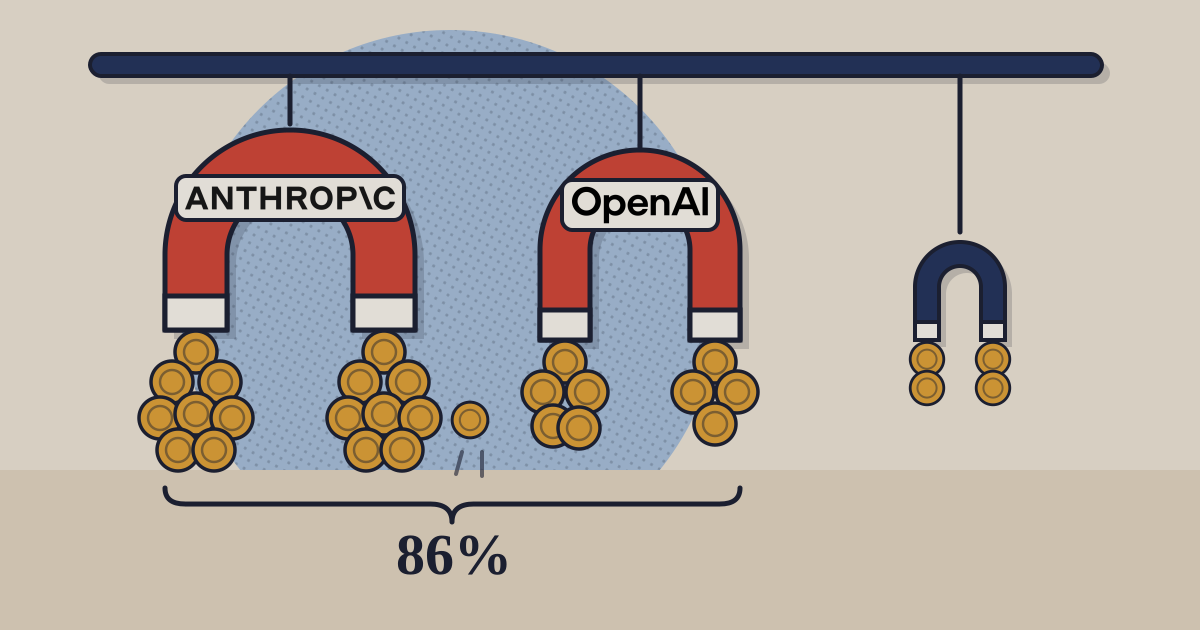
Enterprise AI hit a US$177bn run rate, Menlo estimates; Anthropic and OpenAI take 86%
Menlo Ventures’ estimates of enterprise AI spending, 2023 to September 2026, and of model API shares, checked against Anthropic’s own filing. Menlo is an Anthropic investor.

Who published this, and how. Menlo Ventures, a US venture firm, published the fourth edition of its enterprise AI report on 3 November. It marks Anthropic as a “Menlo Ventures portfolio company”, as it does OpenRouter, Fireworks and Modal, which the report also cites.1 Its survey covered nearly 400 US enterprise decision-makers responsible for more than US$4bn of AI spending, fielded by Morning Consult from 8 to 26 September 2026. The dollar figures are Menlo’s own estimates from a bottom-up model “informed by survey responses, public filings, and third-party reports”, shown as annualised run rates.1 This piece sets out what the report measures, where it says the money goes, how one company’s filing compares, and what the numbers cannot tell you.
01The line: US$1.7bn to US$177bn in three years
Menlo splits AI spending in two. Deployment, using AI, was US$176.8bn: US$99.5bn of infrastructure (model inference sold by the labs, inference platforms and agent infrastructure) and US$77.3bn of applications. Development, building models, was a further US$102.5bn: US$87.2bn of training compute and US$15.3bn of training data and services. The headline number is deployment only.1
Enterprise spending on using AI grew about 100-fold in three years, by Menlo's estimate
Enterprise generative AI deployment spend, US$bn, annualised run rate, 2023 to September 2026, Menlo's restated series
US$bn
Show tableHide table
| Deployment spend | |
|---|---|
| 2023 | 1.7 |
| 2024 | 8.5 |
| 2025 | 33 |
| Sep 2026 | 176.8 |
Source: Menlo Ventures, 2026: The State of Enterprise AI · as of 3 November 2026 · Menlo estimates, not reported revenue. Prior years reclassified to the 2026 taxonomy
Menlo’s explanation for the jump is agents: software that carries out multi-step work rather than answering one question. Spending averaged 4.7 times the previous year’s against a planned 1.9 times; the median company spent 2.2 times against a planned 1.8 times. The share of enterprises using AI rose from 55% to 65%, so most of the growth came from more spending per company, not more companies.1
02Where it goes: two labs, and coding
Menlo’s shares are “estimated dollars spent based on proportion of production API usage”: respondents reported which models ran their AI workloads, weighted by their AI spending.1 On that measure Anthropic went from 40% to 55%, which Menlo attributes to its Opus models in long-running tasks and coding; OpenAI from 27% to 31%; Google from 21% to 9%, its spending now skewed to cheaper Flash models.12
Anthropic and OpenAI went from 67% to 86% of enterprise API spend; Google's share fell by more than half
Share of enterprise LLM API spend by model provider, %, Menlo's 2025 and 2026 reports
- 2025 report
- 2026 report
Show tableHide table
| 2025 report | 2026 report | Change | |
|---|---|---|---|
| Anthropic | 40 | 55 | 15 pts |
| OpenAI | 27 | 31 | 4 pts |
| 21 | 9 | -12 pts | |
| Everyone else | 12 | 5 | -7 pts |
Source: Menlo Ventures, State of Generative AI in the Enterprise (9 December 2025) and State of Enterprise AI (3 November 2026) · as of 3 November 2026 · Everyone else = 100% minus the three, TechBag arithmetic. Survey-weighted estimates; Menlo is an Anthropic investor
Applications. Coding was US$34.0bn, up 7.7 times, and the labs’ own tools, Claude Code and Codex, took US$24.0bn of it (70%). Enterprise chatbots were US$25.0bn. The two make up 76% of the US$77.3bn application market; healthcare, third, was US$3.7bn.1
Open models. Open-weight models handled 19% of tokens but took about 4% of model spending, because their average price fell 3.3 times to US$0.13 per million tokens, against a blended US$0.70 for closed models, down 24%.1
03What the numbers cannot tell you, and what to watch
The limits. The survey is of US companies. The spending totals are modelled estimates, and annualised run rates are not a year’s revenue. Menlo restates its own past figures, so editions compare only on the newest basis. Some comparisons mix groups: agents are used by 74% of AI builders this year, against 27% of startup deployments in the 2025 survey. And the publisher holds stakes in the leading lab and in several infrastructure firms the report names.12
What to watch. Anthropic’s run-rate figure for 31 October is left blank in its 2 November amendment, so the number the company itself uses for its current pace is not yet public.3 Menlo’s next edition will show whether its 86% holds after the discounts on flagship models it says began “in recent weeks”.1 On the return side, our August analysis of McKinsey’s survey found 37% of firms reporting any profit from AI.4
Sources
- Menlo Ventures, 2026: The State of Enterprise AI (incl. Methodology) — 3 November 2026 Marks Anthropic, OpenRouter, Fireworks and Modal as Menlo Ventures portfolio companies.
- Menlo Ventures, 2025: The State of Generative AI in the Enterprise — 9 December 2025
- Anthropic, PBC, Form S-1/A (Amendment No. 1), registration statement — 2 November 2026 Quarterly results of operations, Note 2 (revenue by region and type), and the Run-Rate Revenue definition.
- The TechBag Journal: 37% of firms see any profit from AI, 6% a real one, as agents spread — 26 August 2026
Disclosure. TechBag is a software reseller: it earns a margin when a reader buys through it, including from vendors named here. The analysis is TechBag’s own; no vendor paid for or saw this piece before publication. Facts are labelled reported, TechBag count or our view.
Keep reading