SEBI fines KFin, Motilal Oswal ₹10 lakh each: an impostor took ₹11.19 crore of shares
SEBI’s order of 25 November: how an impostor had 54,000 Balkrishna Industries bonus shares dematerialised, the checks the registrar and broker missed, and what paper-share holders do.

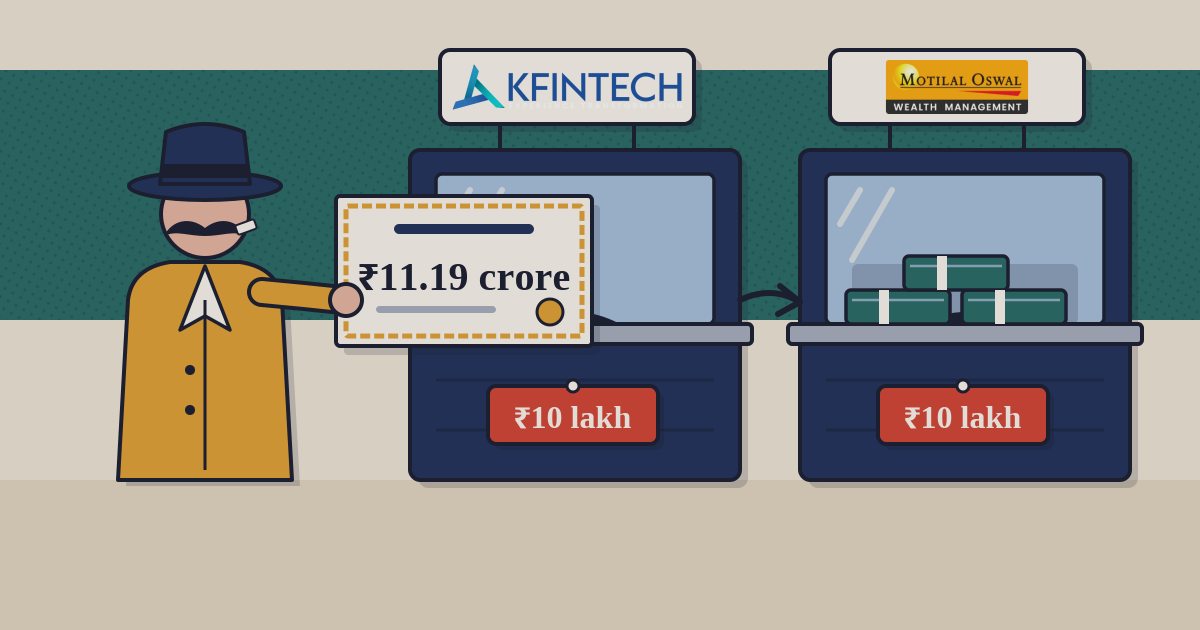
The Securities and Exchange Board of India has fined KFin Technologies, the share registrar, and Motilal Oswal Financial Services, the broker and depository participant, ₹10 lakh each under Section 15HB of the SEBI Act. A person impersonating a shareholder got 54,000 bonus shares of Balkrishna Industries, “approximately Rs. 11.19 crore” at the time, turned from a paper certificate into demat shares in January 2023, and sold 46,185 of them by the end of May.1 The Mumbai police’s Economic Offences Wing later identified the real holder, and the matter reached SEBI through her writ petition in the Bombay High Court.1
02The broker’s lapse: selling after a failed KYC
Motilal opened the account on 1 August 2022 and uploaded its KYC to CVL KRA, a KYC registration agency, the next day. The agency put it on hold on 20 September 2022 for “Proof of Address Not Legible and Aadhaar Number Should Be Blackout From Aadhaar Copy” and rejected it on 7 January 2023 on the same grounds. Under SEBI’s circular of 6 April 2022, a client whose KYC is not found valid may transact only once it is validated.1 Motilal argued the client sold through its automated online platform and that it had to release the shares to meet exchange pay-in. SEBI replied that the platform is the broker’s to control: “A broker cannot take shelter behind the automation of its own platform.” It also found Motilal never sent the client’s address change of 7 December 2022 to the agency.1
03The penalty, the market and what comes next
Section 15HB allows ₹1 lakh to ₹1 crore. SEBI found no record of past penalties on KFin; for Motilal it listed eight earlier SEBI penalties. Each fine is under 1% of the ₹11.19 crore at stake, and is due within 45 days, failing which SEBI may recover it by attaching property.1 KFin says the financial impact “had already been duly accounted for” in its 2025-26 accounts and that it is “considering appropriate legal remedies”; an appeal from a SEBI adjudicating officer goes to the Securities Appellate Tribunal. Motilal says the order has no material impact and that it has “strengthened its processes and controls”.2 3
On Thursday 26 November KFin, which filed during trading, closed at ₹995.00 on NSE, up 6.5% from ₹934.00. Motilal, which filed after the close, ended at ₹1,215.25, down 1.2%.5 Neither company linked its shares to the order.
For anyone holding old certificates, the order is a checklist: SEBI’s 2021 rules have holders register PAN and KYC on Form ISR-1 and a bank-confirmed signature on Form ISR-2 with the registrar. A folio without them is the kind SEBI says needs extra checks, and a current registered address is what makes the speed-post warning reach the real owner.1 4
Sources
- SEBI, adjudication order in respect of KFin Technologies Ltd and Motilal Oswal Financial Services Ltd (Order/JS/RJ/2026-27/32864-32865) — 25 November 2026
- KFin Technologies, disclosure under Regulation 30: action taken or order passed by SEBI (NSE, XBRL) — 26 November 2026
- Motilal Oswal Financial Services, disclosure under Regulation 30 on SEBI’s adjudication order (NSE) — 26 November 2026
- SEBI, circular: common and simplified norms for processing investor’s service requests by RTAs and norms for furnishing PAN, KYC details and nomination — 3 November 2021
- National Stock Exchange of India, daily price file for the cash market (KFINTECH and MOTILALOFS, series EQ) — 26 November 2026
Disclosure. TechBag is a software reseller: it earns when companies buy through it, including from vendors named here. The analysis is TechBag’s own; no vendor paid for or saw this piece before publication. Facts are labelled reported, TechBag count or our view. How the Journal works.
Keep reading