Anthropic closes below its US$83 IPO price; the first trade was US$111.50
Nasdaq’s closes for 19 to 25 November and the closing 8-K: US$81.905 and US$82.79, a US$73.85 low, and what the prospectus says about stabilising the price.

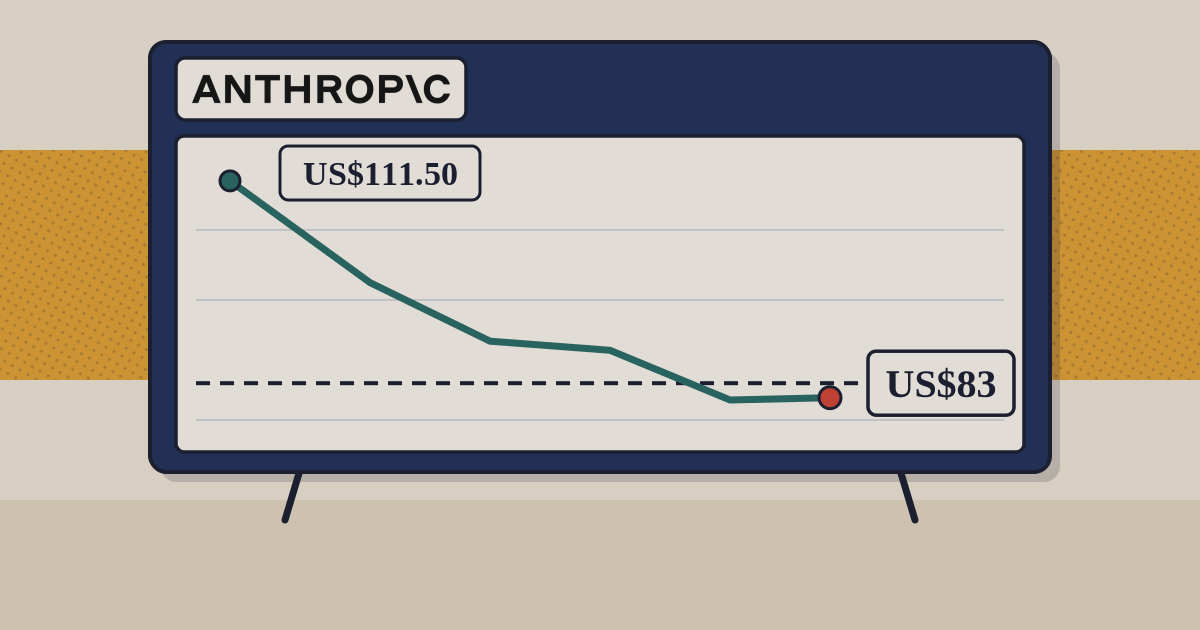
Anthropic’s shares closed at US$81.905 on Tuesday 24 November and at US$82.79 on Wednesday 25 November, below the US$83 at which they were sold in its initial public offering, according to Nasdaq’s daily data.1 On Wednesday they traded as low as US$73.85, 11.0% under the offer price, and closed 12.1% above that low. Five sessions earlier, on 19 November, the first trade was US$111.50. US markets were shut on Thursday 26 November for Thanksgiving, so Wednesday’s close is the latest price. No Anthropic filing we read comments on the share price, and we assign no cause to the move.
01Five sessions, from US$111.50 to US$82.79
On the first day the shares opened at US$111.50, reached US$115.10 and closed at US$97.17, with 857.3m shares traded. They closed at US$88.91 on 20 November and US$87.64 on 23 November. On 24 November they opened at US$83.40 and closed 6.5% lower on the day; on 25 November they opened at US$77.93 and ranged up to US$85.92 before the close.1 About 2.12bn shares changed hands in the five sessions, roughly 1.9 times the 1.127bn sold in the offer.
02What the closing 8-K puts on the record
The 8-K dated 25 November records the offer as completed on 20 November: 1,127,000,000 Class A shares at US$83, of which 1,103,351,354 were sold by the company and 23,648,646 by selling stockholders, the seven co-founders. The total includes all 147,000,000 extra shares of the underwriters’ option. Straight after the closing, Anthropic sold 313,253,007 non-voting Class N shares at the same price to AMD, Broadcom, Google, Micron, Microsoft, Nvidia and TSMC Partners, for about US$26.0bn and with no underwriting fee. Gross proceeds of the offer and the placement together were “approximately $119.5 billion”, before fees and expenses.2
The Class N shares are not part of the traded float. Each becomes a Class A share only when sold in a registered offering or on the open market, or transferred to someone who holds no Class N shares and would own no more than 9.99% of any class.2 How the offer was priced, and who holds the votes, is in our reading of the prospectus.
03Why US$83 matters to the underwriters
The prospectus names Morgan Stanley as stabilisation agent for the underwriters. It may sell more shares than the underwriters must buy, creating a short position. A short no larger than the option is “covered” and can be closed by exercising the option or by buying in the market, a choice made by comparing “the open market price” with the option price; anything beyond is a “naked short position” that must be bought back in the market. Morgan Stanley may also bid for shares “to stabilize the price”, activity that “may raise or maintain the market price ... or prevent or slow a decline”. It “is not required to engage in these activities and may end any of these activities at any time”.3
The option is already used: the 8-K counts its 147,000,000 shares in the offer that closed on 20 November.2 Under Rule 104 of the SEC’s Regulation M, no stabilising bid may be made above the offering price, so US$83 is the ceiling for any such bid.4 Neither the 8-K nor the prospectus says whether Morgan Stanley holds a short position or has bought shares since the listing. What to watch: Friday’s session, the first after the holiday, and the lock-up dates set out in the co-founders piece.
Sources
- Nasdaq: Anthropic, PBC (ANT), historical prices (open, high, low, close, volume), exchange data — sessions of 19 to 25 November 2026
- Anthropic, PBC: Form 8-K (Items 3.02, 3.03, 5.03, 7.01, 8.01) — dated 25 November 2026
- Anthropic, PBC: prospectus filed under Rule 424(b)(4), section on underwriting — dated 18 November 2026; filed 19 November 2026
- 17 CFR 242.104, Regulation M, Rule 104: stabilizing and other activities in connection with an offering (text via Cornell Law School's Legal Information Institute) — current text, read 26 November 2026
Disclosure. TechBag is a software reseller: it earns when companies buy through it, including from vendors named here. The analysis is TechBag’s own; no vendor paid for or saw this piece before publication. Facts are labelled reported, TechBag count or our view. How the Journal works.
Keep reading