Shein’s revenue fell 5.9% as the EU’s €3 parcel duty cut its European sales by 27.6%
Shein’s first results since listing, for July to September: how the end of the EU’s duty exemption for parcels under €150 cut European sales, and the one-off gain in its profit.

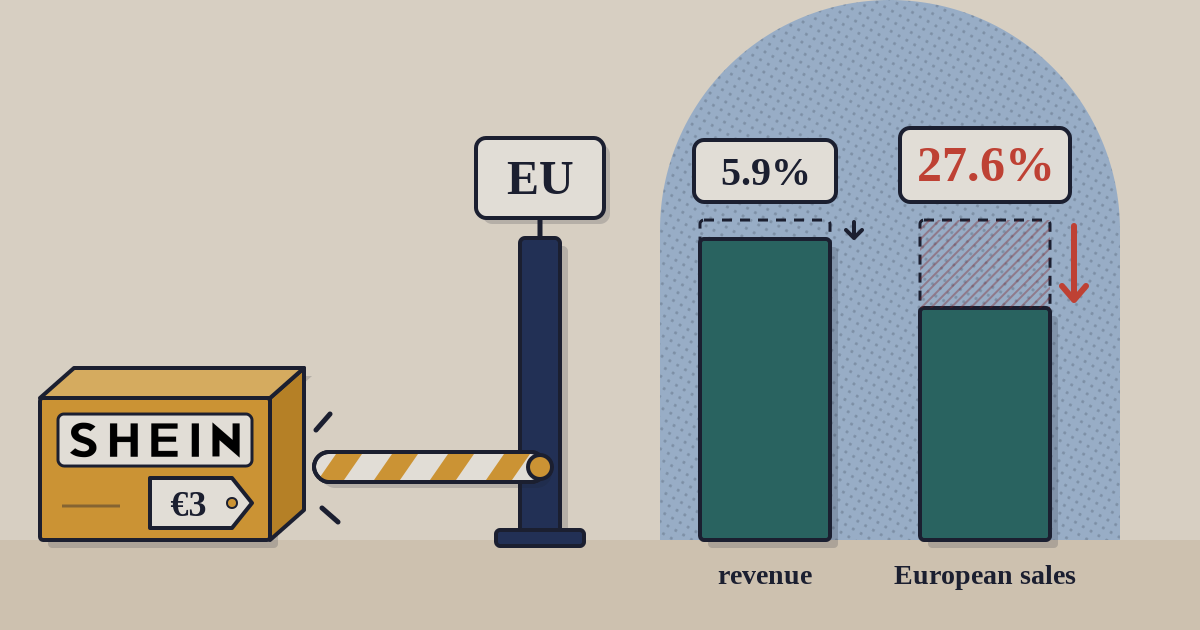
Shein, the online fashion retailer that listed in Hong Kong on 1 September, took in US$10.27bn of revenue in the three months to 30 September, 5.9% less than a year earlier, in what it calls “our first full set of results since our listing”. It puts the fall down to one cause: “the change in European trade policy: we raised prices to cover the additional cost, and demand softened accordingly.”1 The change was the EU’s end, on 1 July, of the customs-duty exemption for parcels worth up to €150 bought from outside the bloc.2
01What the EU changed on 1 July
Since 1 July the EU has charged a temporary €3 customs duty on goods in consignments worth up to €150 sold at a distance, such as online purchases from non-EU sellers, “abolishing the duty exemption applicable until 30 June 2026”. The duty is charged per item, defined by tariff classification, not quantity: five T-shirts in one parcel pay €3, a T-shirt and a watch pay €6. The seller or importer that declares the goods pays it, and it lasts until 1 July 2028, when normal duties take over.2 The Commission counted almost 5.9 billion such items shipped straight to EU consumers in 2025 without paying duty.2
The first quarter under the rule shows the effect. The Commission’s preliminary count is 555.33 million parcels imported in July–September, “a decrease by more than 60% on average in the EU, compared to the pre-duty trend”. Some low-value goods “seem to be now imported in bulk”, duty paid, and stored inside the EU before they are sent to buyers.3
02How it showed in Shein’s numbers
Revenue from Europe fell 27.6% to US$2,977m, “primarily due to a decline in sales volume as we raised prices and lowered online advertising spending”. Europe’s share of revenue fell to 29.0% from 37.7%. Marketing spending fell 41.5% to US$1,054m across all markets. Orders fulfilled fell to 264 million from 272 million, while active customers over twelve months rose to 291 million from 265 million.1 US revenue fell 9.4%, which Shein puts down to more orders going through its marketplace, where it books only a fraction of the sale price as revenue; revenue from the rest of the world, led by Latin America, rose 17.7% and is now 48.0% of the total.1
Shein’s European revenue fell 27.6% while the rest of the world grew 17.7%
Shein net revenues by region, July–September 2026 against July–September 2025, US$ million
Source: Shein Global Holdings, results for the three months ended 30 September 2026 (HKEX), 25 November 2026 · as of 25 November 2026
Shein’s answer is local stock. Its “Flash Forward-Deployed Inventory”, a local fulfilment model, now covers more than 40% of deliveries to European customers, more than double the level in April–June; Shein expects about 50% by the end of the year.1
03What the profit figures contain
Operating income rose 17.4% to US$743m. Reported net income was US$4,648m, but US$4,075m of it is a gain on the fair value of convertible redeemable preferred shares, booked when they converted into ordinary shares at the listing; Shein says that adjustment “will not be applicable in future periods”. Adjusted net income, which excludes it, rose 26.8% to US$790m. That still includes one-off items: Shein says that without them its adjusted net margin was 4.7%. Fulfilment costs were helped by “refunds of certain previously paid duties”.1 Hours before the results, Shein announced a US$100m payment under an agreement with the US Federal Trade Commission, pending court approval, which it says is not an admission of the FTC’s allegations.5
The shares fell 6.6% to HK$33.92 on 26 November, the first day of trading after the results, and closed on Friday at HK$35.34, 27.2% below the offer price of HK$48.56.6 7 What to watch: the €2 Union handling fee the EU has applied since 1 November, which Shein describes as charged “per distinct item category” and expects “to continue to weigh on performance in Europe in the near term”.4 1
Sources
- SHEIN Global Holdings, results announcement for the three months ended 30 September 2026 (HKEX) — 25 November 2026
- European Commission, DG Taxation and Customs Union: guidance and legal text on the temporary flat fee on low-value imports (last updated 20 July 2026) — 8 June 2026
- European Commission, Import of e-commerce parcels: situation for Q3 2026, preliminary assessment — 30 October 2026
- European Commission, EU Customs Reform: guidance on the €3 customs duty and Union handling fee (news item of 7 October 2026) — 7 October 2026
- SHEIN Global Holdings, inside information: update on the U.S. Federal Trade Commission investigation (HKEX) — 25 November 2026
- SHEIN Global Holdings, announcement of final offer price and allotment results (HKEX) — 31 August 2026
- Hong Kong Exchanges and Clearing, Daily Quotations, 26 and 27 November 2026 (SHEIN-W, 625) — 27 November 2026
Disclosure. TechBag is a software reseller: it earns when companies buy through it, including from vendors named here. The analysis is TechBag’s own; no vendor paid for or saw this piece before publication. Facts are labelled reported, TechBag count or our view. How the Journal works.
Keep reading