Data & privacyAnalysis
EU proposes Digital Fairness Act: 10 dark patterns banned, fines up to 6% of turnover
What the European Commission proposed on 11 November for checkouts, subscriptions, AI agents that buy and personalised ads, who can fine 6% of worldwide turnover, and what Indian sellers must watch.

EU law has banned misleading and aggressive selling since 2005, through a directive that each member state wrote into its own law. The proposal replaces that directive with a single regulation and adds rules written for screens: checkout pages, subscriptions, in-game currencies, influencers and software that shops on a person’s behalf. We read the proposal, its annex, the enforcement regulation that comes with it and the impact assessment to answer four questions: what a checkout or subscription page must do differently, what changes when an AI agent buys, who can fine whom and how much, and what an Indian company selling to Europeans should watch.
01Ten dark patterns banned outright, and drip pricing with them
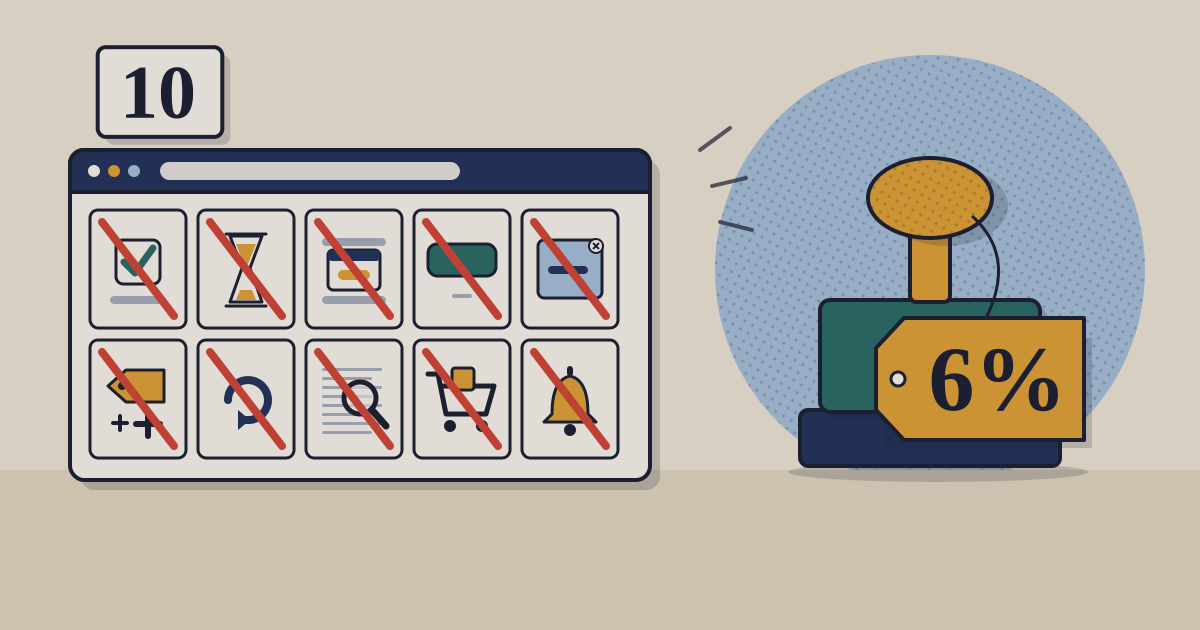
Article 10 bans designing, organising or operating an online interface “in a manner that is likely to deceive or manipulate consumers, or in a manner that is likely to otherwise materially distort” what they buy. Part III of Annex I then lists ten dark patterns that are unfair in all circumstances, which the proposal’s recitals define as unfair “without a case-by-case assessment”. The Commission can add to the list by delegated act, subject to objection by Parliament or Council.34 The Commission’s own examples are “Only 1 left”, “5 other customers are interested in this!”, “We’re sad to see you go” and a button reading “I don’t like good deals”.2
Elsewhere in the same annex, a price shown at the first step must include “all foreseeable fees, taxes, charges or other payments” the shopper cannot avoid, which ends drip pricing. A crossed-out price or a “save 40%” badge may no longer be measured against a manufacturer’s recommended price: the reference must be a current price of the same product charged by a clearly identified competitor (a shop’s own price cuts stay under the existing price-indication rules).34
What a checkout may no longer do, and what it shows instead
Practices listed as unfair in all circumstances in Annex I of the proposed Digital Fairness Act, 11 November 2026
Banned in all circumstances
- “Only 1 left” or “5 people are viewing this” when it is not true, or repeated through the order (points 53, 54)
- Pre-ticked insurance or extras the shopper must untick (point 55)
- A decline button worded as the wrong choice: “I don’t like good deals” (point 56)
- Fees that appear only at the last step (point 12)
- Price, duration or auto-renewal in smaller print than other terms (point 60)
- Asking again after the shopper has said no (point 58)
What the page shows instead
- Scarcity or popularity only when true, with its qualifications stated
- Empty boxes: extras added only by the shopper
- A neutral decline, worded as plainly as accept, with no double negatives (point 59)
- The full price at the first step, every unavoidable fee included
- Price and renewal terms as prominent as anything else on the page
- Refusing or changing a choice takes no more steps than needed (point 62)
Source: European Commission, DFA proposal, Annex I points 12, 53 to 62; Q&A · as of 12 November 2026
Design teams get switches too: adults must be able to turn off autoplay, unrelated notifications and streak-style rewards. Games must show the money value of virtual-currency prices and the odds in paid loot boxes; for minors, loot boxes and pay-to-win are banned.3
03When an AI agent buys, and whose prices may be personal
The press release speaks of AI agents; the text says “automated systems” that conclude contracts on a consumer’s behalf. Article 26 puts the duties on the trader that offers the agent to consumers. On first use the consumer must choose one of three settings: confirm every purchase, confirm only purchases matching rules they set (“including a maximum price and a time limit”), or confirm nothing. The agent must disclose any payment it receives for proposing a deal, and any conflict of interest, and then ask for confirmation whatever the setting. A shop may not make an agent the only way in. Financial services are excluded.3
An agent may buy without asking only if the consumer chose that, and never on a paid placement
Duties on a trader offering an automated system that contracts for consumers, Article 26 of the proposed Digital Fairness Act, 11 November 2026
- 01
First use
The consumer picks: confirm all, confirm by rules (a price cap, a time limit), or none. The choice is confirmed on a durable medium and can change at any time.
- 02
Before buying
Where the consumer confirms, the agent shows the main terms: the seller, the product, the total price, delivery and withdrawal rights.
- 03
Paid or conflicted
Any payment to the agent’s provider or conflict of interest is disclosed, and the consumer must confirm that purchase, whatever the setting.
- 04
After buying
The seller sends a confirmation of the contract in plain language. Agent-to-agent contracts may carry the pre-contract terms in machine-readable form.
Source: European Commission, DFA proposal, Articles 26 and 27 · as of 12 November 2026
Personalisation is narrowed in two articles. Article 12 bars any trader from targeting ads by profiling a consumer it knows “with reasonable certainty” to be a minor, or by using the special categories of personal data in the GDPR, such as health or ethnic origin. The Digital Services Act already bans both for online platforms; the proposal extends the ban “to all websites and apps”.23 Article 13 bars personalised prices “reasonably likely to cause harm” to a known minor or a consumer known to be vulnerable through age, credulity, disability or misfortune. Neither article obliges a trader to collect more data to find out.3
04Up to 6% of worldwide turnover, when Brussels takes the case
The 6% ceiling sits in the companion revision of the Consumer Protection Cooperation Regulation and is mirrored in Article 35 of the Act. The Commission may fine “not exceeding 6% of the trader’s worldwide annual turnover”, but only in cases it takes itself: a breach likely to harm consumers in at least two-thirds of member states, accounting for at least two-thirds of the EU’s population, by a company that is not a small or medium-sized enterprise. When it opens such a case, national authorities stop investigating the same one.235 The 6% matches the Digital Services Act’s ceiling for the largest platforms, sits above the GDPR’s 4% (or €20m, if higher) and below the Digital Markets Act’s 10% for gatekeepers.91011
The Commission could also fine up to 1% of turnover for obstructing an investigation, impose periodic penalties of up to 5% of average daily worldwide income, make test purchases and inspect premises. National cases keep today’s floor: after a coordinated action, the maximum fine must be at least 4% of turnover in the countries concerned, or at least €2 million where turnover is unknown.35
Consumer law's ceiling would match the DSA's 6%, above the GDPR's 4%
Maximum fine as a share of annual turnover, by EU law, as written on 12 November 2026
Source: DFA proposal Art. 35; CPC revision Art. 43; DSA Art. 74; GDPR Art. 83(5); DMA Art. 30 · as of 12 November 2026 · Bases differ: national consumer fines use turnover in the member states concerned and set a floor for the maximum; the GDPR uses €20m where higher
The ceiling is a share of turnover, not profit. Non-EU traders selling to EU consumers would also have to name a legal representative in the EU and publish its contact details on their website.5 Today’s network of national authorities has run more than 30 coordinated actions since 2020.1
05€13.7bn a year for consumers, and a year to comply after adoption
€13.7bn
a year saved by EU consumers, in money and time, the Commission estimates
Against yearly business costs of €1.2bn, or €678m once overlaps between measures are removed.
The impact assessment puts the harm from these practices at “at least 10.3 billion EUR in 2026 and up to EUR 16.7 billion in 2035”, and says businesses “are hesitant about any new legislation; however support is noticeably higher among SMEs”.38
The positions were set before the text. DIGITALEUROPE, which represents digital companies, argued in May 2025 that a new act “would merely duplicate existing regulations” and that the EU should enforce the laws it has.12 BEUC, the European consumer organisation, asked in December 2025 for addictive features to be off by default and for paid loot boxes and premium virtual currencies to be banned.13 The proposal does neither for adults: it gives them switches and price labels, and keeps the bans for minors.3
Three years from Parliament's first call to the Commission's text
Steps to the Digital Fairness Act proposal, December 2023 to November 2026
Show tableHide table
| Date | Event | Detail |
|---|---|---|
| 12 Dec 2023 | Parliament: act on addictive design | Resolution on addictive design of online services. |
| 3 Oct 2024 | Fitness Check finds gaps | Commission review of three consumer directives, 2017 to 2023. |
| 19 Nov 2025 | 2030 Consumer Agenda | The Commission announces the Digital Fairness Act. |
| 26 Nov 2025 | Parliament: protect minors online | Resolution on the protection of minors online. |
| 26 Feb 2026 | Council: close the gaps | Conclusions on the 2030 Consumer Agenda. |
| 11 Nov 2026 | Proposal published | Digital Fairness Act, CPC revision and simplification directive. |
Source: DFA proposal, explanatory memorandum and footnotes; Commission press release · as of 12 November 2026
The proposal now goes to the European Parliament and the Council under the ordinary legislative procedure (file 2026/0356 (COD)), and both must agree the same text. As a regulation it needs no national transposition: it enters into force 20 days after publication in the Official Journal and applies 12 months later, as would the enforcement regulation.35 No adoption date is set. Three things to watch: whether the 6% ceiling and the two-thirds threshold survive Parliament and Council, whether the list of ten dark patterns grows in negotiation, and whether the opt-outs for adults become defaults, as BEUC asked.
Sources
- European Commission press release IP/26/2407 on the Digital Fairness Act — 11 November 2026
- European Commission, Questions and answers on the Consumer Package — 11 November 2026
- Proposal for a Digital Fairness Act, COM(2026) 1100 final — 11 November 2026 Memorandum, recitals, Articles 10 to 40.
- Annexes to the Digital Fairness Act proposal (Annex I, correlation table) — 11 November 2026
- Proposal to revise the CPC Regulation, COM(2026) 1120 final — 11 November 2026 Articles 3, 31, 32, 43, 44, 59.
- Proposal for a simplification directive, COM(2026) 1110 final — 11 November 2026
- European Commission, Consumer Package factsheet — November 2026
- Executive summary of the impact assessment, SWD(2026) 1102 final — 11 November 2026
- Regulation (EU) 2022/2065 (Digital Services Act), Article 74 — 19 October 2022
- Regulation (EU) 2016/679 (GDPR), Article 83(5) — 27 April 2016
- Regulation (EU) 2022/1925 (Digital Markets Act), Article 30 — 14 September 2022
- DIGITALEUROPE, Digital Fairness Act: new laws or better enforcement? — 8 May 2025
- BEUC, Towards the Digital Fairness Act — 2 December 2025
- CCPA, Guidelines for Prevention and Regulation of Dark Patterns, 2023 — 30 November 2023
- PIB, CCPA acts against dark patterns on digital platforms (2268302) — 3 June 2026
- Consumer Protection Act, 2019, sections 18 and 21 — 9 August 2019
- Consumer Protection (E-Commerce) (Amendment) Rules, 2026, rule 4(15) — 9 September 2026 In force 1 January 2027.
- Digital Personal Data Protection Act, 2023, section 9(3) — 11 August 2023
- MeitY, DPDP framework (most duties from 13 May 2027) — 13 November 2025
Disclosure. TechBag is a software reseller: it earns when companies buy through it, including from vendors named here. The analysis is TechBag’s own; no vendor paid for or saw this piece before publication. Facts are labelled reported, TechBag count or our view.
Keep reading