Markets & the AI economyAnalysis
SoftBank lost ¥1.1tn: no gain on OpenAI, US$3.7bn written off on power equipment
SoftBank's results for July to September: the ¥1,115.3bn loss line by line, why a flat OpenAI valuation moves its numbers so much, the power-equipment write-off, and net asset value.

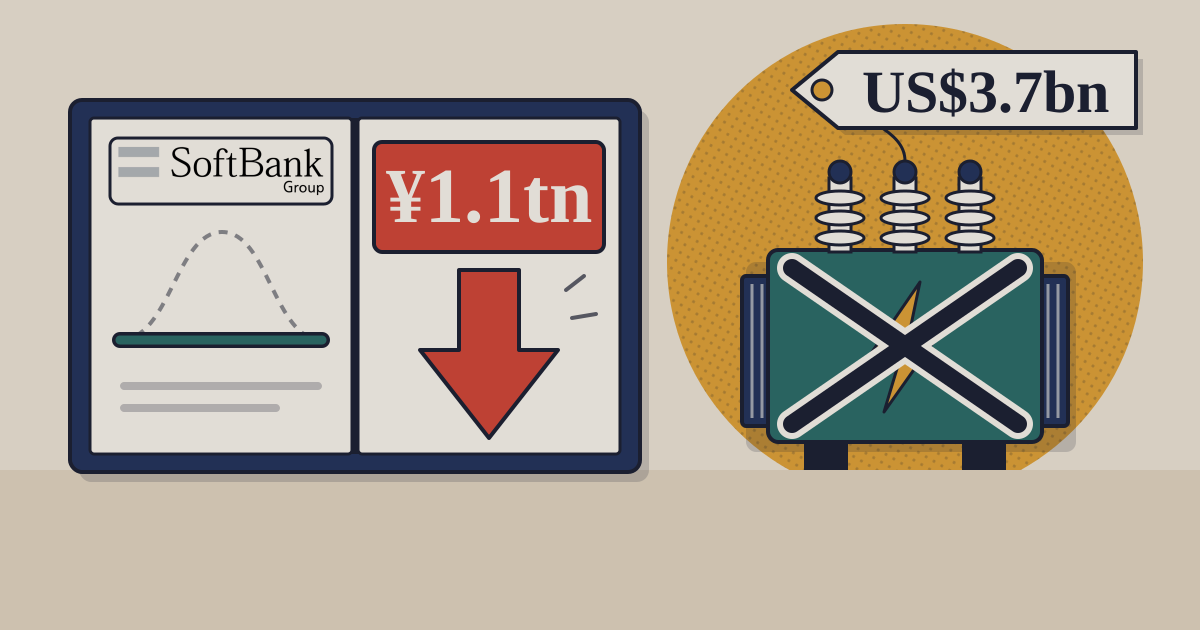
SoftBank’s profit depends on the paper value of a handful of holdings, so a single quarter can swing by trillions of yen without anyone having sold anything. This piece reads the company’s report of 10 November to answer four questions: what drove the loss, why one unchanged valuation matters so much, what writing off power equipment says about the build plan as SoftBank states it, and why the quarter, the half-year and net asset value each tell a different story.
01Quarter and half-year are two different results
SoftBank’s financial year starts in April, so its second quarter is July to September. The company’s summary leads with the half: a ¥1.7tn investment gain and a ¥0.8tn net loss.2 All of that gain came in April to June, when the investment line was ¥1,859.4bn. In July to September it was minus ¥133.6bn.2
The half-year gain is also mostly one share. Intel contributed ¥1,062.8bn of the ¥1,725.8bn: a gain of ¥1,332.9bn in the first quarter, then a loss of ¥270.1bn in the second.12 The bottom line splits the same way: ¥347.3bn of profit in the first quarter, ¥1,115.3bn of loss in the second, and a ¥768.0bn loss for the six months against a profit of ¥2,924.1bn a year earlier.12
For six quarters SoftBank's profit has moved with its investment line; this quarter both went below zero
Net income attributable to owners and total gain or loss on investments, ¥ trillion, April 2025 to September 2026
- Net income
- Investment line
¥tn
Show tableHide table
| Net income | Investment line | |
|---|---|---|
| Apr–Jun 25 | 0.42 | 0.49 |
| Jul–Sep 25 | 2.5 | 3.44 |
| Oct–Dec 25 | 0.25 | 0.29 |
| Jan–Mar 26 | 1.83 | 3.07 |
| Apr–Jun 26 | 0.35 | 1.86 |
| Jul–Sep 26 | -1.12 | -0.13 |
Source: SoftBank Group Q2 FY2026 earnings presentation, slides 14 and 15 · as of 10 November 2026 · The investment line is one component of net income; the other lines explain the gaps
02What drove the loss
Gross profit of ¥1,143.4bn covered selling and administrative costs of ¥1,081.9bn with ¥61.5bn left over. Everything below that is financing, valuation and one-off items. Other losses came to ¥669.9bn, most of it the power-equipment charge. Finance cost was ¥461.9bn, more than two and a half times the year-earlier ¥174.7bn. The investment line took off another ¥133.6bn, and a foreign-exchange gain of ¥220.3bn gave part of that back. The pre-tax loss was ¥1,027.9bn.1
Gross profit barely covered running costs; the ¥597bn write-off and interest did the rest
Main lines of the income statement for July to September 2026, ¥ billion, shown as absolute size with their direction marked
Source: SoftBank Group consolidated financial report, three-month statement of profit or loss · as of 10 November 2026 · Change in third-party interests (minus ¥2.6bn) omitted; the rows sum to the pre-tax loss
The report explains the interest bill. SoftBank drew US$30.0bn of bridge loans in April and July, added a US$11.5bn margin loan on its Arm shares in December 2025, and carried more bonds at higher rates. When it repaid the remaining US$25.9bn of the bridge loans on 15 September, it recognised at once the unamortised costs it had planned to spread to March 2027.1 It raised US$56.5bn in the quarter, which it calls a record, from borrowing (US$21.9bn), bonds (US$18.0bn) and what it calls asset monetisation (US$16.6bn).2
One figure on SoftBank’s own slide should be read with care. It flags a ¥321.9bn derivative loss on forward contracts over its Intel shares, raised in August.2 The quarter’s whole derivative line is only ¥41.7bn, because a ¥274.7bn gain in SoftBank’s other businesses offset most of it.1
03Why one flat valuation matters so much
¥0
gain or loss on SoftBank's OpenAI stake, July to September
In the same three months of 2025, the stake produced a gain of ¥2,156.3bn.
The report is plain: “The valuation was unchanged from the previous fiscal year-end,” and “No investment gain or loss was recorded on OpenAI” for the six months.1 The Vision Fund deck says the same of the quarter.3 A stake can grow without a gain. SoftBank paid in US$10.0bn on 1 April and US$10.0bn on 1 July, and each dollar raised cost and fair value equally, so the cumulative gain stayed at US$45.0bn.1
SoftBank's OpenAI stake: US$45.0bn of gain, unchanged since March
Cumulative investment, fair value and gain at 30 September 2026, and investment after the final tranche on 1 October
US$54.6bn
Invested at 30 September
Net of disposals
US$99.6bn
Fair value at 30 September
SoftBank
US$45.0bn
Cumulative gain, same since March
SoftBank
US$64.6bn
Invested after 1 October, about 13% of OpenAI
SoftBank
Source: SoftBank Group consolidated financial report; Q2 FY2026 earnings presentation · as of 10 November 2026 · About 13% on SoftBank's stated basis, including all preferred shares from OpenAI's US$122bn round
Three things make that zero count. The first is the comparison: the ¥2,156.3bn gain of a year earlier was about 63% of that quarter’s ¥3,439.7bn investment line, in a quarter of ¥2,502.2bn net profit.2 The second is the weight of the position: OpenAI was 21% of SoftBank’s equity value of holdings on 30 September, up from 17% on 30 June.2
The third is the debt tied to it. In August a subsidiary of Vision Fund 2 borrowed US$10.0bn under an agreement with a cash collateral provision and a mandatory prepayment clause, which “may be triggered under certain circumstances such as a significant decrease in the fair value of the OpenAI preferred shares”. SoftBank guarantees it and counts it as its own debt, and says the OpenAI shares themselves are not pledged.12
The mark stood still while OpenAI’s reported business moved: SoftBank’s presentation cites annualised revenue of about US$50bn at September, up more than 70% over July to September, from a post by OpenAI’s finance chief.2 SoftBank’s report lists market comparables, cash-flow models and recent transactions as its methods for private companies, without saying which set this valuation.1
04US$3.73bn of power equipment, and the plan behind it
The largest one-off charge of the quarter is a change of plan. Silver Bands 7 (SB7), a subsidiary funded by SoftBank and Vision Fund 2, reserved factory capacity and bought power-generation equipment for US AI data centres, including the PORTS-Pike campus in Pike County, Ohio. SoftBank says it made these “bridge investments in advance” to secure equipment “in anticipation of shortages”, and expects to recover them through project financing.12
SoftBank paid US$9.48bn for power equipment, then wrote off US$3.73bn when the plan changed
SB7's advance payments and the loss recorded, from the year to March 2026 through 30 September 2026
- 01
Buy ahead
US$9.48bn paid to reserve capacity and buy equipment: US$3.9bn in the year to March, US$5.6bn since.
- 02
Revise the plan
SB7 changed its procurement strategy “given the evolving requirements of its existing and planned projects”.
- 03
Write off
¥597.2bn loss: ¥457.0bn of non-refundable advances and ¥140.2bn of contract changes and settlements.
- 04
What remains
US$6.6bn of advances still on the books. Rebates of up to US$2.1bn over 10 years, not booked.
Source: SoftBank Group consolidated financial report; Q2 FY2026 earnings presentation, slides 16 to 18 · as of 10 November 2026 · US$2.85bn of the loss had already been paid; US$0.88bn is contract changes and settlements
The rebates are conditional and apply to future equipment purchases, and SoftBank did not record them as an asset because it could not determine the amount.1 It does not say which equipment or suppliers are affected. The slides add one detail: the change followed “a review of the project portfolio”.2
The write-off landed in the same quarter as the largest lease in that portfolio. On 17 August SoftBank’s group signed a 20-year agreement with OpenAI for the full 8.0 GW-IT at PORTS-Pike, which SoftBank lists as preparing for construction; it plans to fund such projects with project finance that does not reach back to the parent.2 SoftBank’s account has the site contracted and the equipment plan for it and other projects revised, in the same three months. Its next plan, announced a day before these results, is a staged investment in Malaysia with Grab.
05Up ¥20tn since March, down ¥15tn since September
SoftBank reports its value as net asset value (NAV): its holdings less net debt. Its headline says NAV was ¥59.8tn on 30 September, up about ¥20tn from March.2 That is true, and it hides the path: NAV was ¥40.1tn on 31 March, ¥72.3tn on 30 June and ¥59.8tn on 30 September. SoftBank also gives a pro forma at 9 November prices of ¥44.7tn, ¥27.6tn below June.2
NAV and the income statement describe different things. Changes in the value of shares in consolidated subsidiaries, “including Arm and SoftBank Corp.”, are not recorded in the consolidated income statement.1 So Arm’s fall since June does not appear in this quarter’s loss, while OpenAI’s flat value does. Loan-to-value, SoftBank’s debt measure, was 15.9% on 30 September against a policy of staying below 25% in normal circumstances, and its cash position of ¥5.0tn exceeds the ¥1.6tn of bonds due over two years.2
Sources
- SoftBank Group: Consolidated Financial Report for the six-month period ended 30 September 2026 — 10 November 2026
- SoftBank Group: Q2 FY2026 Earnings Results presentation — 10 November 2026
- SoftBank Vision Funds: Earnings Investor Briefing for Q2 FY2026 — 10 November 2026
Disclosure. TechBag is a software reseller: it earns a margin when a reader buys through it, including from vendors named here. The analysis is TechBag’s own; no vendor paid for or saw this piece before publication. Facts are labelled reported, TechBag count or our view.
Keep reading