Big Tech's quarterly capex hit US$202bn, more than its operations brought in
Quarterly spending on property and equipment by Microsoft, Alphabet, Amazon and Meta, Q1 2024 to Q3 2026, set against operating cash flow and each company's 2026 guidance.

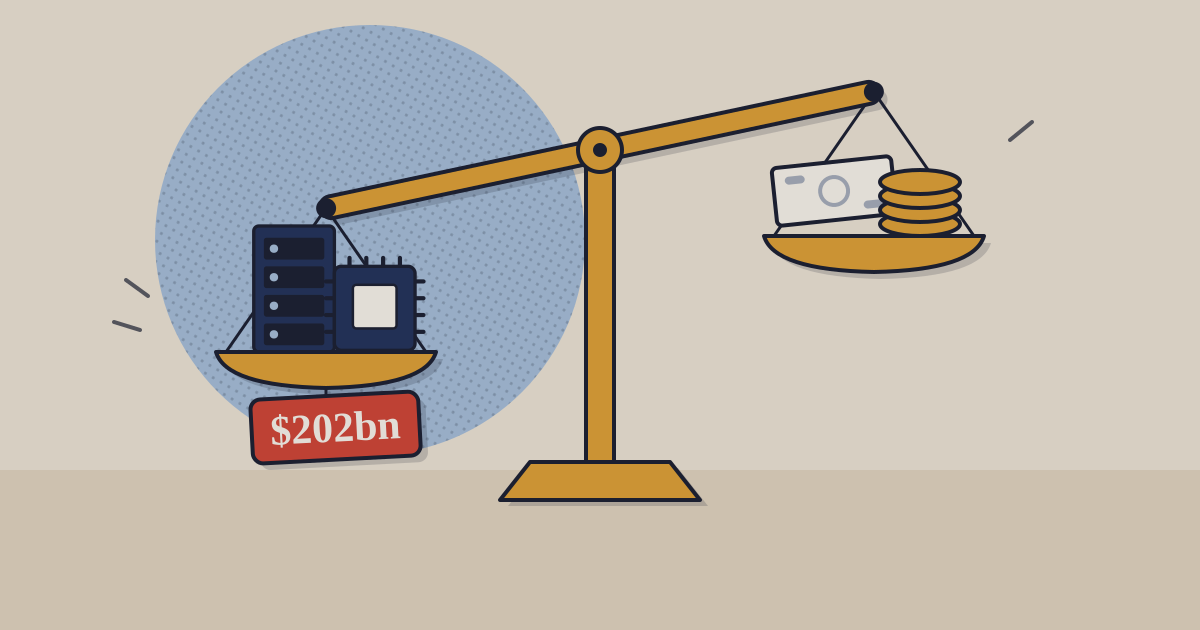
The four largest US cloud and platform companies spent US$201.9bn on property and equipment in the three months to 30 September, by our count from their filings, against US$175.5bn of cash from operations.10 In 2024 that spending took about half of what their businesses generated; in the first nine months of 2026 it took almost all of it. The companies say what the money buys: chips, servers and the data centres that hold them, mostly for AI.14
01The line: eleven quarters, four companies
Amazon spent US$77.3bn in the quarter, up from US$35.1bn a year earlier. Alphabet spent US$51.4bn (US$24.0bn), Microsoft US$39.4bn (US$19.4bn) and Meta US$33.9bn (US$18.8bn).10 Together, the first nine months of 2026 came to US$496.7bn, already a third more than the US$376.1bn they spent in the whole of 2025.10
All four doubled their quarterly spending in two years or less; Amazon's rose most in the latest quarter
Cash paid for property and equipment per quarter, US$bn, calendar Q1 2024 to Q3 2026
- Amazon
- Alphabet
- Microsoft
- Meta
US$bn
Table view
| Amazon | Alphabet | Microsoft | Meta | |
|---|---|---|---|---|
| Q1 24 | 14.9 | 12 | 11 | 6.4 |
| Q2 24 | 17.6 | 13.2 | 13.9 | 8.2 |
| Q3 24 | 22.6 | 13.1 | 14.9 | 8.3 |
| Q4 24 | 27.8 | 14.3 | 15.8 | 14.4 |
| Q1 25 | 25 | 17.2 | 16.7 | 12.9 |
| Q2 25 | 32.2 | 22.4 | 17.1 | 16.5 |
| Q3 25 | 35.1 | 24 | 19.4 | 18.8 |
| Q4 25 | 39.5 | 27.9 | 29.9 | 21.4 |
| Q1 26 | 44.2 | 35.7 | 30.9 | 19 |
| Q2 26 | 54.2 | 44.9 | 35.8 | 30.1 |
| Q3 26 | 77.3 | 51.4 | 39.4 | 33.9 |
Source: Company 10-Q and 10-K filings (SEC EDGAR XBRL data); Q3 2026 checked against each company's release or call · as of 30 October 2026 · Excludes finance leases. Microsoft's quarters are shown by calendar quarter (its fiscal year ends 30 June)
The chart counts cash paid, which leaves out assets taken on finance leases. On their own definitions, Microsoft reported US$45.2bn including US$7.4bn of finance leases, and Meta US$34.91bn including lease principal.18 Oracle, whose quarters end a month earlier, is on the same line: US$28.5bn in the quarter to 31 August, against US$8.5bn a year before and US$2.3bn two years before.910
02What drives it, and the argument over it
What the money buys. Amy Hood, Microsoft’s finance chief, said on 28 October that “roughly three quarters of our capex was for short-lived assets, primarily CPUs and GPUs, including higher memory and storage costs”.1 Alphabet’s Anat Ashkenazi put about 65% of its technical-infrastructure spending in servers and networking, with useful lives of six years, and the rest in data centres.4
What they say comes next. Alphabet’s 2026 range of US$195–205bn “remain unchanged”, and it expects capex “to increase significantly in 2027”.4 The range was US$180–190bn after the April call and was raised in July, W.Media reported.56 Amazon “continue[s] to expect 2026 cash capital expenditures to be approximately $220 billion”.7 Microsoft expects calendar-2026 spending of about US$170bn, down from about US$175bn in July “due to the 3P capacity delays”, meaning third-party data-centre deliveries that slipped.12 Meta narrowed its range to US$135–145bn from US$130–145bn.8 Oracle’s release gives no full-year figure.9
In the September quarter the four spent US$201.9bn on property and equipment, more than the US$175.5bn their operations brought in
Combined cash paid for property and equipment vs combined net cash from operating activities, US$bn, Q1 2024 to Q3 2026
- Capex
- Op. cash
US$bn
Table view
| Capex | Op. cash | |
|---|---|---|
| Q1 24 | 44.3 | 99 |
| Q2 24 | 52.9 | 108.5 |
| Q3 24 | 58.9 | 115.6 |
| Q4 24 | 72.3 | 135 |
| Q1 25 | 71.9 | 114.2 |
| Q2 25 | 88.2 | 128.5 |
| Q3 25 | 97.3 | 159 |
| Q4 25 | 118.6 | 178.8 |
| Q1 26 | 129.8 | 150.7 |
| Q2 26 | 165.1 | 171.8 |
| Q3 26 | 201.9 | 175.5 |
Source: Company 10-Q and 10-K filings (SEC EDGAR XBRL data); TechBag sum of Microsoft, Alphabet, Amazon and Meta · as of 30 October 2026 · Excludes finance leases and Oracle
Company by company, the September quarter split. Microsoft had US$18.6bn of free cash flow left.1 Alphabet was US$9.1bn short, its second negative quarter, and Meta US$2.1bn short on its own measure.38 Amazon’s free cash flow over twelve months was minus US$42.4bn.7 Oracle’s quarter was about US$5bn short, and US$11.4bn of its US$23.1bn operating cash flow was customers paying in advance for capacity to be built.9 How the gap is being paid for is a separate story.
Too much, or not enough? The Bank for International Settlements wrote on 28 June that “a wave of optimism about AI spurred a surge in capital expenditure on AI infrastructure” and that “animal spirits about AI lifted stock valuations”.11 The Bank of England’s Financial Policy Committee wrote on 7 July that “this pace of investment is unprecedented historically”, that AI valuations “on some metrics” have “become more stretched”, and that the earnings forecasts behind them “are highly uncertain”.12
The companies answer with contracts and returns. Microsoft’s commercial remaining performance obligation is US$677bn, up 73%; Oracle’s is US$664bn.19 Ashkenazi said Alphabet expects “an attractive ROIC that remains meaningfully above our cost of capital”.4 Hood said, “We feel good that the return on every dollar of CapEx we’re spending, we’re confident in that”, and in July that if demand changes, “you just slow down” the chip spending, which has short lead times.12 Andy Jassy projects AWS revenue growth “of over 40% both in 2027 and in 2028”.7 We report both sides; we take neither.
03What it means for a buyer of cloud and AI services
Capacity is short, by the sellers’ own account. Alphabet began renting third-party compute at the end of the quarter “given the supply-constraint environment”; Oracle says AI demand “continues to grow faster than supply”; Microsoft said third-party capacity it expected in the quarter arrived late.491
Components cost more. Microsoft’s spending includes “higher component pricing” and higher memory and storage costs, and Amazon lists supply volatility “including for memory chips” among the risks to its guidance.217
The largest buyers commit early. Microsoft’s backlog has a weighted average duration of 2.3 years, and Oracle is taking prepayments for capacity it has not yet built.19
What to watch. Oracle reports its quarter to 30 November next, in December. The four report the December quarter from late January; Alphabet says it will give detail on 2027 on that call, and Microsoft expects to spend “over $50 billion” in the quarter.41 The line to watch is the one in the second chart: whether operating cash catches up with spending, or the gap widens.
Sources
- Microsoft, FY27 first-quarter earnings call transcript — 28 October 2026
- Microsoft, FY26 fourth-quarter earnings call transcript — 29 July 2026
- Alphabet, Q3 2026 earnings release (8-K, Exhibit 99.1) — 28 October 2026
- Alphabet, Q3 2026 earnings call transcript — 28 October 2026
- Alphabet, Alphabet announces proposed $80 billion equity capital raise (8-K, Exhibit 99.1) — 1 June 2026
- W.Media, Brendyn Lotz: AI infrastructure demand pushes Alphabet's 2026 capex guidance to US$205 billion — 23 July 2026 Trade press; reports the Q2 call.
- Amazon, Q3 2026 results (8-K, Exhibit 99.1) — 29 October 2026
- Meta Platforms, Q3 2026 results (8-K, Exhibit 99.1) — 21 October 2026
- Oracle, Q1 FY27 results (8-K, Exhibit 99.1) — 10 September 2026
- SEC EDGAR, XBRL company facts from the 10-Q and 10-K filings of Microsoft, Alphabet, Amazon, Meta and Oracle — filings dated 25 April 2025 to 30 October 2026 CIKs 789019, 1652044, 1018724, 1326801 and 1341439; quarterly values are TechBag's arithmetic.
- Bank for International Settlements, Annual Economic Report 2026 — 28 June 2026
- Bank of England, Financial Stability Report, July 2026 — 7 July 2026
- Microsoft Source Asia: Microsoft establishes India South Central region — 21 September 2026
Related on TechBag: Microsoft Azure, Google Cloud, the AWS hub, and what Alphabet’s quarter did to its shares.
Disclosure. TechBag is a software reseller: it earns a margin when a reader buys through it, including from vendors named here. The analysis is TechBag’s own; no vendor paid for or saw this piece before publication. Facts are labelled reported, TechBag count or our view.
Keep reading