Network & SASEAnalysis
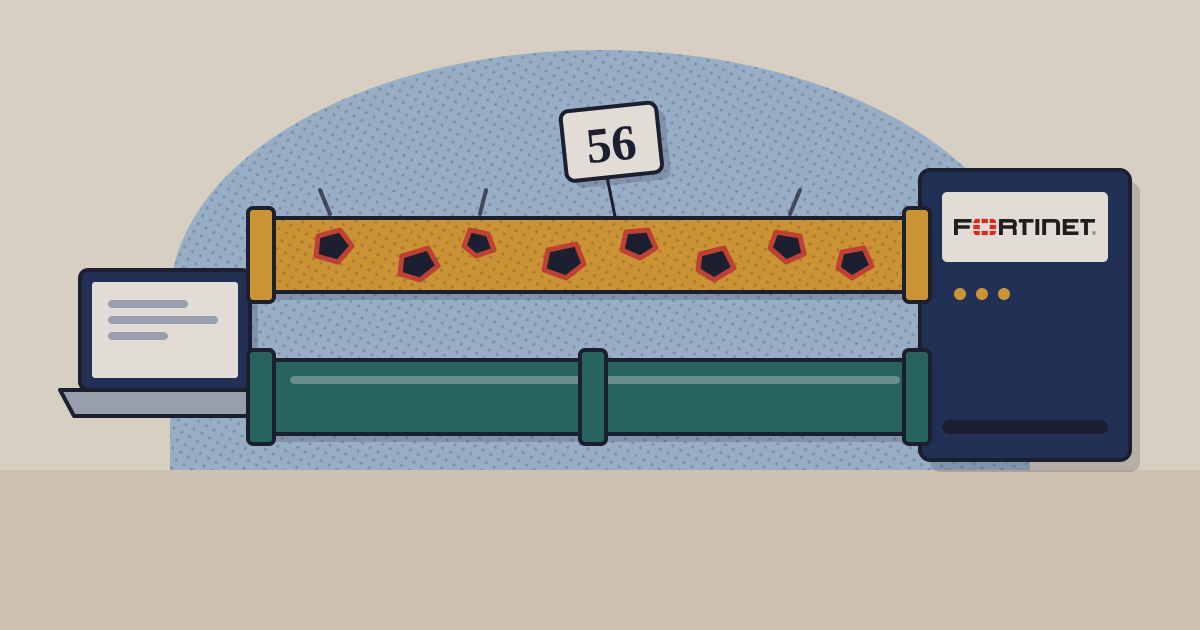
SSL VPNs: 56 exploited flaws; IPsec: 8. Fortinet has already chosen
CISA's exploited-vulnerability catalogue to 30 September 2026, split by the VPN component each flaw sits in, with NSA and CISA's advice and Fortinet's SSL VPN retirement.

Our 2024 version of this piece compared the two protocols on encryption algorithms, latency and how easy each is for a user, and concluded that SSL VPN suits remote workers and IPsec suits branch links. That was the textbook answer, and it left out the one measurement a buyer can actually check: which kind of VPN gateway attackers break into. The question an Indian IT team faces at a firewall refresh is narrower than “which is better”. It is whether to keep the SSL portal switched on at all.
0156 to 8: where the exploited flaws sit
CISA’s catalogue lists only flaws with evidence of exploitation in the wild, which makes it a better guide to real risk than a count of published CVEs. I split the VPN-related entries by the component CISA’s own description names. Flaws in SSL VPN appliances and SSL VPN components outnumber flaws in IKE/IPsec implementations seven to one.1
SSL VPN code accounts for 56 exploited flaws; IKE/IPsec code for 8
CISA KEV entries by the VPN component named, entries added November 2021 to September 2026
Source: CISA Known Exploited Vulnerabilities catalogue, TechBag count · as of 30 September 2026 · a count of exploited flaws, not of risk per customer; SSL VPN products have a larger installed base
The obvious objection is exposure. If more organisations publish SSL VPN portals for remote staff than run IPsec remote access, as seems likely, attackers have more reason to study them, and a raw count rewards the popular product. That may be so, and it is also the point: the exposure is what you inherit when you choose the design. The count cannot say that a given SSL VPN is less carefully engineered than a given IPsec gateway. It does say where attackers have actually got in, repeatedly, since the catalogue opened, and a buyer choosing between the two is choosing which list to join.
02The SSL count is not a 2021 problem
A reasonable objection is that the SSL number is history: Pulse Secure’s bad year and Fortinet’s 2018 portal flaws, all loaded into the catalogue when it opened in November 2021. The dates say otherwise. 22 of the 56 SSL VPN entries were added from January 2025 onward, 13 in 2025 and 9 more by the end of September 2026, most of them NetScaler Gateway and SonicWall SMA.1
SSL VPN entries kept arriving after the catalogue opened; IKE entries trickle in two at a time
CISA KEV entries added per year, by VPN component, November 2021 to September 2026
- SSL VPN
- IKE/IPsec
Entries added per year
Table view
| SSL VPN | IKE/IPsec | |
|---|---|---|
| 2021 | 16 | 0 |
| 2022 | 7 | 3 |
| 2023 | 3 | 1 |
| 2024 | 8 | 0 |
| 2025 | 13 | 2 |
| 2026 | 9 | 2 |
Source: CISA Known Exploited Vulnerabilities catalogue, TechBag count · as of 30 September 2026 · 2021 covers November and December only, the catalogue's opening batch; 2026 covers January to September
Two refinements make the comparison fairer, and neither changes it. First, 12 of the 56 SSL entries sit in a management console or need an administrator login; take them out and 44 remain. Second, IPsec is not immune. Four of its eight entries arrived from 2025 onward, including a Check Point flaw that let an attacker “bypass user authentication and establish a remote access VPN connection” through IKEv1 (CVE-2026-50751, added 8 June 2026), and two WatchGuard flaws in the IKE daemon.1
Half the SSL VPN entries fed ransomware; a quarter of the far smaller IKE set did
CISA KEV entries by VPN component and ransomware flag, November 2021 to September 2026
- Used in ransomware
- Not flagged
Table view
| Used in ransomware | Not flagged | |
|---|---|---|
| SSL VPN | 28 | 28 |
| IKE/IPsec | 2 | 6 |
Source: CISA Known Exploited Vulnerabilities catalogue, TechBag count · as of 30 September 2026
03Why: a web application against a key exchange
Encryption is not the difference. Both protocols use the same modern ciphers when configured properly, and the 2024 post spent most of its length on a distinction that does not decide anything. What differs is how much code an attacker can reach before logging in.
An SSL VPN is a web server with a login page, and usually much more: a clientless portal that rewrites internal web pages, single sign-on endpoints, file-share bookmarks, and on many products the management interface on the same appliance. Each is a parser exposed to anyone on the internet. An IPsec gateway exposes the IKE daemon, which negotiates keys, and then accepts only packets that are already authenticated. NSA and CISA made the same argument in their joint information sheet of 28 September 2021: “Avoid selecting non-standard VPN solutions”, a class in which they place SSL/TLS VPNs, and “NSA and CISA recommend standardized Internet Key Exchange/Internet Protocol Security (IKE/IPsec) VPNs”. They also advise administrators to “disable the SSL/TLS proprietary or non-standards-based VPN fallback, if possible”.2
An SSL VPN puts a web application on the internet; an IPsec gateway puts a key exchange there
What each design exposes to unauthenticated users, per the NSA/CISA guidance and the KEV descriptions
SSL VPN: what faces the internet
- An HTTPS web server and login portal
- A clientless portal that rewrites internal pages
- Single sign-on endpoints (SAML flaws appear in the catalogue)
- Often the appliance's own management interface
- A vendor-specific tunnel protocol, which NSA and CISA class as non-standard
IPsec: what faces the internet
- The IKE daemon on the key-exchange ports
- Only authenticated, encrypted packets after that
- A standardised protocol, recommended by NSA and CISA
- No web portal, unless you leave the SSL fallback on
- Still exploitable: keep IKE patched and drop IKEv1
Source: NSA and CISA, Selecting and Hardening Remote Access VPN Solutions; CISA KEV descriptions · as of 30 September 2026
The original post’s strongest case for SSL was convenience: it works from any browser, on almost any network, with nothing to install. That convenience is exactly the exposure. A portal any browser can reach is a portal any scanner can reach.
04Fortinet has already made the call
The most telling evidence is a vendor’s own roadmap. Fortinet has six SSL VPN flaws in the catalogue, all six marked as used in ransomware.1 In April 2025 it announced that FortiOS 7.6.3 would remove SSL VPN tunnel mode entirely, from both the interface and the command line, and that existing tunnel-mode configuration would not be carried across an upgrade.4 Its own technical note tells customers to “migrate the SSL VPN to the IPsec VPN”.3
Fortinet retired SSL VPN tunnel mode in stages and points customers to IPsec
FortiOS changes to SSL VPN by release and model, as documented by Fortinet, 2025 to 2026
- 01
Small models first
FortiGate models with 2GB of RAM or less support neither SSL VPN tunnel mode nor web mode.
- 02
7.2.12 and 7.4.8
SSL VPN removed on the 50G, 70G and 90G models from these releases onward.
- 03
FortiOS 7.6.3
Tunnel mode removed; its configuration and policies are not upgraded, so migrate first.
- 04
Web mode renamed
Now “Agentless VPN”, disabled by default, and not available on 40F, 60F and 90G models.
Source: Fortinet Community technical tip (posted 2 May 2025, updated 16 April 2026); Cyber Security News · as of 16 April 2026
The same FortiClient agent carries both SSL and IPsec tunnels, so for a FortiGate estate the switch is configuration and testing, not a new licence.5 For estates on other firewalls, the step is the same in substance: build the IPsec remote-access profile, move a pilot group, then switch the SSL portal off rather than leave it as a fallback.
- Inventory who uses the portal. Export a month of SSL VPN logins and split them into managed laptops, branch devices, and everyone else. The third group is the one IPsec will not serve well.
- Build the IPsec profile with certificates and MFA. Pre-shared keys on a remote-access profile turn every laptop into a copy of the same secret.
- Move a pilot group, then everyone on a managed device. Test the applications that broke on the SSL tunnel too: softphones, file shares, anything that relies on split tunnelling.
- Give the remaining users zero trust access, then turn the portal off. A portal kept “just for the contractors” is still a portal on the internet.
Sources
- CISA, Known Exploited Vulnerabilities catalogue (JSON feed), entries added to 30 September 2026 — entries dated November 2021 to 30 September 2026
- NSA and CISA, Selecting and Hardening Remote Access VPN Solutions (information sheet U/OO/186992-21) — 28 September 2021
- Fortinet Community, Technical Tip: Changes on SSL VPN modes starting from v7.6.3 — posted 2 May 2025; updated 16 April 2026
- Cyber Security News, Fortinet removes SSL VPN tunnel mode in FortiOS 7.6.3 — 18 April 2025
- TechBag, Fortinet FortiClient intel page (VPN: SSL and IPsec tunnels alongside ZTNA) — version committed 30 September 2026
- TechBag, Zero trust access (ZTNA) guide: 14 products, reach, India presence and prices — version committed 30 September 2026; vendor documentation verified 22 August 2026
- CERT-In, Directions under section 70B(6) of the IT Act (six-hour reporting; 180-day logs in India) — 28 April 2022
- CERT-In, FAQs on Cyber Security Directions of 28.04.2022 (Q34 enterprise VPNs; Q37 logs) — May 2022
- MeitY, Digital Personal Data Protection Act, 2023 and DPDP Rules, 2025 — 13 November 2025
- RBI, Cybersecurity, Technology Risk and Resilience Framework Directions, 2026, via practitioner summary — 31 July 2026 RBI PDF not fetched.
- SEBI, Cybersecurity and Cyber Resilience Framework (CSCRF) for SEBI Regulated Entities — 20 August 2024; in force 31 August 2025 Not re-fetched for this piece.
Related on TechBag: the zero trust access guide for the contractor question, and the firewall guide for the appliance that will terminate your IPsec tunnels.
Disclosure. TechBag is a software reseller: it earns a margin when a reader buys through it, including from vendors named here. The analysis is TechBag’s own; no vendor paid for or saw this piece before publication. Facts are labelled reported, TechBag count or our view.
Keep reading