Markets & the AI economyAnalysis
Taiwan’s TAIEX fell 17.5%, its worst week in 35 years; shorting below the close banned
TWSE data for 16 to 20 November and the FSC’s three rounds of curbs: how far Taiwan fell, who sold, and how a ban on short sales below the previous close works from Monday.

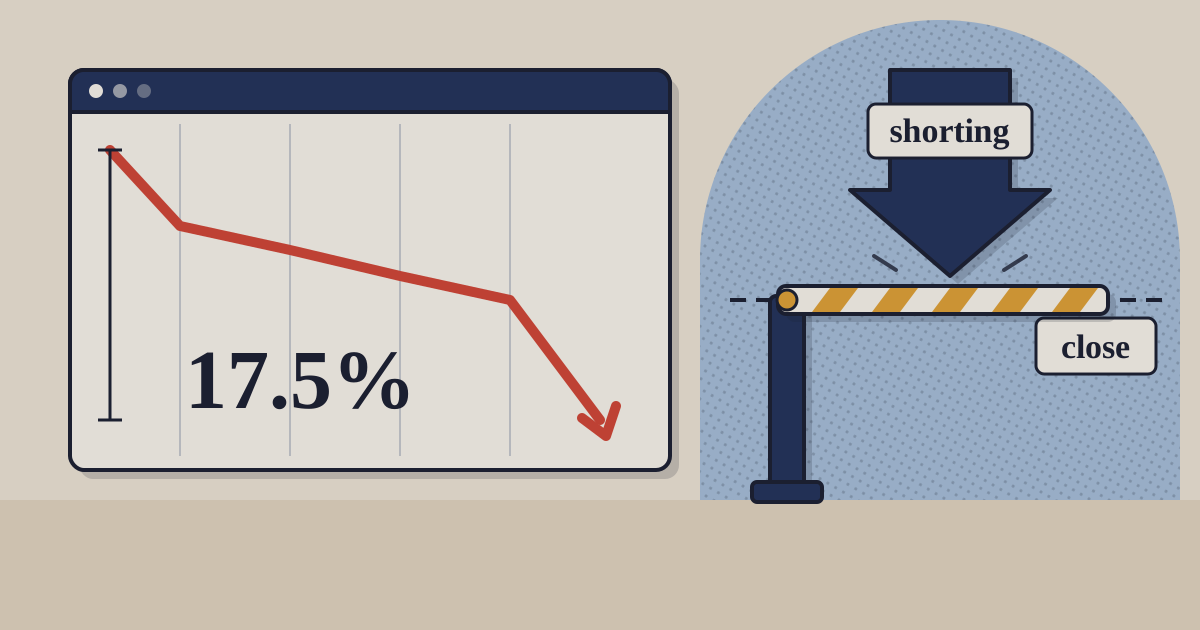
Two weeks ago Taiwan’s index fell 12.2% in a week, which we covered on 6 November; it then rose 10.0% from 9 to 13 November, starting with a 4.9% Monday, and gave that back and more in the five days to Friday.2 The regulator’s answer has been to restrict short selling, step by step, until Saturday’s blanket rule. This piece sets out how far the market fell and how the week ranks, what each round of curbs changed, how a ban on shorting below the previous close works in practice, and what the exchange’s tables say about who was selling. The global side of the same week, from the Nasdaq to Nvidia, is in our Trend on AI stocks’ worst week.
01The week, day by day
The TAIEX lost 7,641.83 points in five sessions. Monday took 2,635.04 points (6.03%), with the index closing at its low for the day (our Note that evening has the detail); Tuesday 2.31%; Wednesday added 0.26%; Thursday fell 4.40%; and Friday 2,393.60 points, or 6.23%.12 CNA, Taiwan’s national news agency, reported Monday’s fall as the second-largest one-day point loss on record and Friday’s as the third, after 17 July’s 2,953.71.15 On Friday 1,058 listed stocks fell, 179 of them by the 10% daily limit, and 16 rose.7
The TAIEX fell 17.5% in five sessions, erasing the previous week's 10% rebound and more
TAIEX, daily close, points, 30 October to 20 November 2026
Show tableHide table
| TAIEX | |
|---|---|
| 30 Oct | 45,212 |
| 2 Nov | 44,920 |
| 3 Nov | 43,308 |
| 4 Nov | 42,949 |
| 5 Nov | 41,575 |
| 6 Nov | 39,702 |
| 9 Nov | 41,662 |
| 10 Nov | 42,712 |
| 11 Nov | 44,257 |
| 12 Nov | 43,092 |
| 13 Nov | 43,675 |
| 16 Nov | 41,040 |
| 17 Nov | 40,092 |
| 18 Nov | 40,195 |
| 19 Nov | 38,427 |
| 20 Nov | 36,033 |
Source: Taiwan Stock Exchange, Highlights of Daily Trading (FMTQIK) and TAIEX historical data, October and November 2026 · as of 20 November 2026 · weekly changes are TechBag arithmetic on TWSE closes
TSMC, the market’s largest company, closed at NT$2,000 on Friday, 4.76% down on the day and 14.9% down from NT$2,350 a week earlier.5 CNA, citing the exchange, put TSMC at more than 40% of the market’s value and its Friday fall at about 800 of the index’s 2,393.60 points.19 TSMC’s own October revenue was a monthly record, as our Trend on Taiwan’s chip and server makers shows. The fall was not only in chips. Over the week the exchange’s electronic parts and components index fell 29.3%, semiconductors 16.9%, finance and insurance 14.1%, the index excluding electronics 14.9% and the small-cap 300 index 16.0%.7 November so far is down 20.3%, and Friday’s close is 27.7% below the 49,822.55 of 6 October, the year’s highest close.24
02How the week ranks since 1990
CNA called it a record weekly loss.15 In points it is: 7,641.83 is the largest weekly fall in the exchange’s daily tables, ahead of the 5,510.19 points lost in the week to 6 November. In percent, three weeks were worse, all in the collapse of 1990 and early 1991, when the index fell from above 12,000 to below 3,000.3 Points flatter recent weeks: at Friday’s level a 1% move is about 360 points, against 25 to 125 points in 1990.
Only three weeks since 1990 were worse in percent, all in 1990 and 1991
TAIEX, largest falls from one week's last close to the next, %, January 1990 to 20 November 2026
Source: Taiwan Stock Exchange, Highlights of Daily Trading (FMTQIK), monthly tables January 1990 to November 2026 · as of 20 November 2026 · TechBag ranking of 1,903 weeks on TWSE closes
The day-by-day record is different again. The largest one-day fall in percent remains 9.70% on 7 April 2025; Monday’s 6.03% and Friday’s 6.23% are the largest of 2026 after 17 July’s 6.47%.3 And the year still shows a gain: Friday’s close is 24.4% above the 28,963.60 of 31 December 2025.3
03Three rounds of curbs in 15 days
Saturday’s release opens: “Taiwan stocks have recently continued to swing widely. To maintain the order and stability of the securities market, the FSC today (the 21st) announced that from 23 November 2026 it will further adopt the following measures.”10 It came after Premier Cho Jung-tai met the heads of the economic and financial agencies on Saturday morning and asked the FSC for more measures, CNA reported.1617 The five measures, in our translation of the Chinese text:
- No short sales below the previous close. Short sales on margin and sales of borrowed shares of listed shares and Taiwan depositary receipts may not be priced below the previous business day’s close. Short sales by securities and futures firms to hedge their business are exempt.
- More margin. The minimum margin on short sales of listed securities rises from 130% to 150%.
- No new put warrants. Applications from securities firms to list put warrants are suspended.
- Buybacks. Listed companies are encouraged to buy back shares; programmes that expire or finish between the fourth quarter of 2026 and the first quarter of 2027 count towards the 2026 ESG evaluation score.
- Lenders. Financial institutions and other lenders are encouraged to stop lending shares, and to recall shares already lent early where contracts allow, or not renew them.
The release gives no end date: the FSC says it will keep watching markets and “adjust the above stabilisation measures as appropriate”.10 It was the third round. On 6 November, effective 9 November, the FSC cut the shares an investor may sell short with borrowed stock during a session from 30% of the stock’s average daily volume over the previous 30 business days to 3%, and raised the minimum short-sale margin from 90% to 130%.12 On 19 November, effective 20 November, it barred short sales below the previous close for any stock that had closed 3.5% or more lower, cut the borrowed-share limit to 1%, and urged financial firms to buy shares and dealers to make markets.11
Taiwan went from a volume cap to a blanket ban on shorting below the close in 15 days
FSC short-selling and market measures announced 6, 19 and 21 November 2026, with the TAIEX's moves; effective dates as stated
Show tableHide table
| Date | Event | Detail |
|---|---|---|
| 6 Nov 2026 | TAIEX −4.5%; round one | Borrowed-share cap 30% → 3%; short margin 90% → 130%, from 9 Nov |
| 13 Nov 2026 | TAIEX 43,675.12 | After a 10.0% rise in the week |
| 16 Nov 2026 | TAIEX −6.03% | 2,635.04 points |
| 19 Nov 2026 | Round two | No shorting below the close after a 3.5% fall; cap to 1%, from 20 Nov |
| 20 Nov 2026 | TAIEX −6.23% | 36,033.29; −17.5% on the week |
| 21 Nov 2026 | Round three | Blanket ban below the close; margin 150%; no new put warrants |
| 23 Nov 2026 | Round three takes effect | No end date stated |
Show tableHide table
| Measure | Before 9 Nov | From 9 Nov | From 20 Nov | From 23 Nov |
|---|---|---|---|---|
| Short sales below the previous close | Allowed | Allowed | Barred for a stock that closed 3.5% or more down | Barred for every listed share and TDR |
| Minimum margin on short sales | 90% | 130% | 130% | 150% |
| Borrowed-share sale orders a day, share of 30-day average volume | 30% | 3% | 1% | 1% (not changed) |
| New put-warrant listings | Accepted | Accepted | Accepted | Applications suspended |
| Share lending | No request | No request | No request | Lenders asked to stop and recall |
| Exempt from the new limit | — | Hedging for warrants and market-making (borrowing cap) | Market-making quotes and hedging (3.5% rule) | Hedging by securities and futures firms |
Source: FSC press releases of 6, 19 and 21 November 2026 (Chinese; translation ours); TWSE FMTQIK · as of 21 November 2026
04What a ban on shorting below the previous close does
A short seller sells shares it does not own, borrowed through a broker on margin or through the securities lending system, hoping to buy them back cheaper. The new rule draws a line at each stock’s previous close. Below it, owners may still sell, but a short sale may not be priced there, so on a falling day new short selling stops; once a stock trades at or above its previous close, short sales can resume at those prices.10
Below yesterday's close, only owners can sell
How Taiwan's price test on short sales works from 23 November 2026, for a share that closed at NT$100
- 01
Yesterday's close is the line
The share closed at NT$100. No short sale, on margin or with borrowed shares, may be priced below NT$100.
- 02
Falling: owners only
At NT$95, a holder can sell at NT$95. A short seller can only offer at NT$100 or more, which nobody takes while the price is lower.
- 03
Flat or up: shorts return
If the share trades back at NT$100 or above, short sales can fill at those prices.
- 04
Who is exempt
Securities and futures firms selling short to hedge their business. The 19 November rule also exempted market-making quotes.
Source: FSC press release of 21 November 2026 (Chinese; translation ours); the NT$100 share is an illustration · as of 21 November 2026
The United States uses a narrower version. The SEC’s Rule 201, adopted in February 2010, applies only after a stock has fallen 10% or more from the previous close, for the rest of that day and the next, and then allows short sales only above the current national best bid, so that, in the SEC’s words, “long sellers” can “stand in the front of the line”.14 Taiwan’s line is the previous close, applied to every listed share every day. The wording is almost word for word the FSC’s release of 23 August 2015, which imposed the same ban from 24 August 2015.13 CNA reported Saturday’s as the first such blanket restriction since 2015.16
05Who sold, and what officials said
The exchange publishes who traded and what is owed, and in the week the short-sale balance hardly changed while other positions shrank. Foreign investors sold a net NT$218.67bn of shares; dealers’ hedging accounts sold a net NT$111.23bn; domestic investment trusts sold NT$8.47bn net, and dealers’ own accounts bought NT$8.05bn net.6 Investors who buy with borrowed money cut their margin loans from NT$536.60bn to NT$435.23bn, and on Friday alone repaid NT$60.17bn by selling.8
Margin loans fell 18.9% in the week; the short-sale balance barely moved
TWSE-listed securities, 13 to 20 November 2026: net sales by foreign investors, and margin and short-sale balances
NT$218.7bn
Net sales by foreign investors, 16–20 November
TWSE BFI82U
−NT$101.4bn
Change in margin loans, to NT$435.2bn (−18.9%)
TWSE MI_MARGN
+0.47%
Borrowed-share short balance, to 18.49bn shares
TWSE TWT93U
−4.3%
Margin short balance, to 199.8m shares
TWSE MI_MARGN
Source: TWSE, BFI82U (week of 16–20 November), MI_MARGN and TWT93U (13 and 20 November) · as of 20 November 2026 · changes and the NT$1.19tn valuation are TechBag arithmetic on TWSE tables
Officials have pointed abroad. The FSC wrote on 19 November that Taiwan stocks’ fundamentals “remain fairly sound”, that listed companies’ revenue had hit records, and that “affected by the international political and economic situation, investors lack confidence”; it put listed companies’ revenue to October at about NT$56.75tn, up 39.05%, and pre-tax profit to September at about NT$6.61tn, up 86.43%.11 On Saturday the Cabinet’s spokesperson cited the finance ministry as saying the fall “largely mirrored heavy losses in global markets”, CNA reported.17 On the day of the fall the economics ministry reported record October export orders of US$123.82bn, up 78.3% from a year earlier, CNA reported.18 Of the analysts CNA quoted, Fan Chen-hung of Capital Investment Management attributed the fall to the US midterm results, uncertainty surrounding Nvidia and tighter US controls on AI chip exports; Huang Yi-ting of First Capital Management said fear had made the market hard to judge on fundamentals.15
Sources
- Taiwan Stock Exchange, TAIEX historical data (open, high, low, close), November 2026 — 20 November 2026
- Taiwan Stock Exchange, Highlights of Daily Trading (FMTQIK), November 2026 — 20 November 2026
- Taiwan Stock Exchange, Highlights of Daily Trading (FMTQIK), monthly tables January 1990 to October 2026 (January 1990 shown) — January 1990 to October 2026
- Taiwan Stock Exchange, TAIEX historical data, October 2026 — 30 October 2026
- Taiwan Stock Exchange, daily trading of 2330 (TSMC), November 2026 — 20 November 2026
- Taiwan Stock Exchange, trading value of foreign and other investors (BFI82U), week of 16–20 November — 20 November 2026
- Taiwan Stock Exchange, daily market report (MI_INDEX): indices and advancers/decliners, 13 and 20 November — 20 November 2026
- Taiwan Stock Exchange, margin transaction summary (MI_MARGN), 13 and 20 November — 20 November 2026
- Taiwan Stock Exchange, daily short sale balances, margin and borrowed shares (TWT93U), 13 and 20 November — 20 November 2026
- Financial Supervisory Commission, 為維護市場交易秩序,金管會宣布「全面禁止平盤以下放空」等5項措施 (five measures including a full ban on short selling below the previous close; Chinese) — 21 November 2026
- Financial Supervisory Commission, 金管會宣布當日收盤價跌幅達3.5%以上,次一交易日不得低於前一交易日收盤價放空 (the 3.5% rule and lower borrowed-share limit; Chinese) — 19 November 2026
- Financial Supervisory Commission, 金管會宣布調整每日盤中借券賣出委託數量及融券保證金成數等措施 (borrowed-share limit and short-sale margin; Chinese) — 6 November 2026
- Financial Supervisory Commission, 為維護市場交易秩序,金管會宣布「禁止平盤以下放空」等3項措施 (the 2015 ban; Chinese) — 23 August 2015
- US Securities and Exchange Commission, SEC approves short selling restrictions (press release 2010-26) — 24 February 2010
- Focus Taiwan (CNA), Taiwan stocks suffer record weekly loss amid AI industry concerns — 20 November 2026
- Focus Taiwan (CNA), Taiwan further tightens short-selling amid stock market volatility — 21 November 2026
- Focus Taiwan (CNA), Cabinet says Taiwan stock plunge short-term, urges stabilization measures — 21 November 2026
- Focus Taiwan (CNA), October export orders hit record US$123.82 billion on AI demand (quoting the Ministry of Economic Affairs) — 20 November 2026
- Focus Taiwan (CNA), Retail investors snatch up odd lot shares amid TSMC's plunge — 21 November 2026
- SEBI, Master Circular for Stock Exchanges and Clearing Corporations, Chapter 1: Trading, Annexure 3 (from circular SEBI/HO/MRD/MRD-PoD-3/P/CIR/2024/1 of 5 January 2024) — December 2024
- NSE Indices, closing values of all indices, 13 and 20 November 2026 — 20 November 2026
Disclosure. TechBag is a software reseller: it earns when companies buy through it, including from vendors named here. The analysis is TechBag’s own; no vendor paid for or saw this piece before publication. Facts are labelled reported, TechBag count or our view.
Keep reading