TeraWulf’s US$710m profit came from warrants it owes Google
TeraWulf’s results and 10-Q for July to September: how a 40% fall in its share price became a US$728m gain, and what its US$19bn Anthropic lease is.

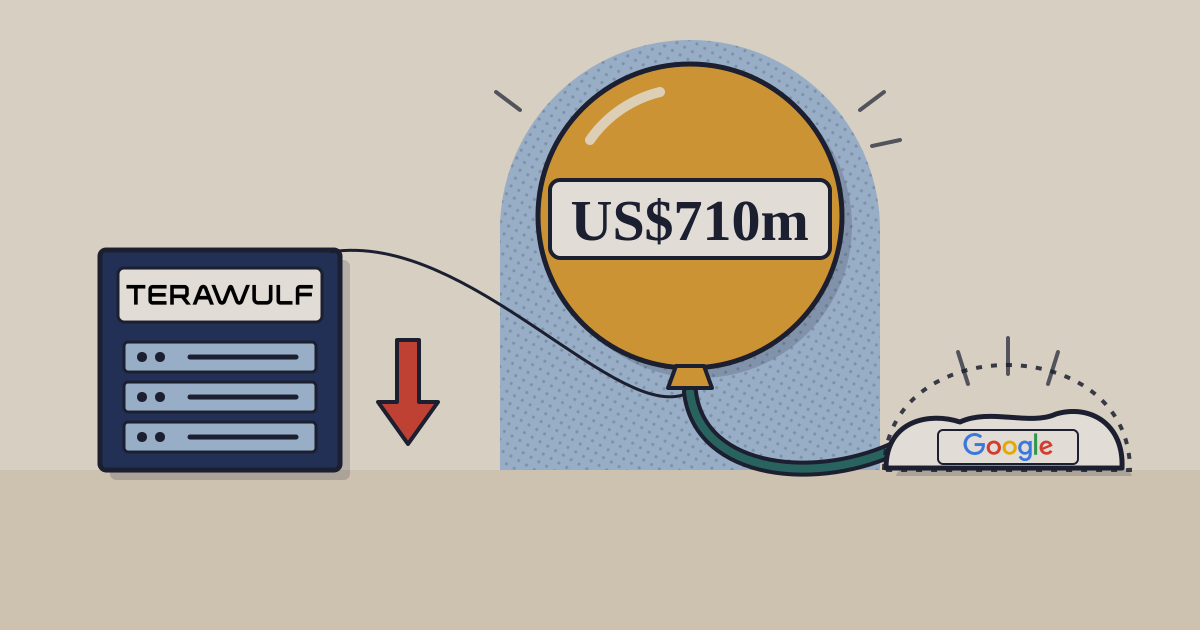
TeraWulf, which builds data centres in New York and Kentucky and leases them out for AI computing, reported net income of US$709.9m for July–September on revenue of US$76.2m. It lost US$88.2m from operations and carried US$53.6m of interest expense.1 The profit came from one line: a US$728.4m gain as the value of share warrants it issued to Google fell with its own share price. On a diluted basis, which counts Google’s warrants as shares and takes that gain back out, TeraWulf’s own figures show a loss of US$18.5m, or three cents a share.2
−US$88.2m
operating loss, July–September
10-Q
+US$728.4m
gain on the Google warrants
10-Q
+US$95.0m
gain on selling its Abernathy stake
10-Q
−US$18.5m
net loss on the diluted basis
10-Q, EPS note
01What TeraWulf owes Google
One of TeraWulf’s AI tenants at its Lake Mariner campus in New York is Fluidstack. Google agreed to backstop Fluidstack’s leases: if Fluidstack misses rent or becomes insolvent, Google either pays a termination fee or pays the rent due and takes over the lease. In return TeraWulf issued Google warrants to buy 73,580,000 of its shares at US$0.01 each, expiring in August 2030; 8,443,606 became exercisable in the quarter, when one of those leases began.2 At a cent apiece, each warrant is worth almost exactly one share.
03The US$19bn Anthropic lease
In its release TeraWulf says it “executed a 20-year lease with Anthropic for approximately 401 MW of critical IT capacity, representing approximately $19 billion of contracted revenue over the initial term”, at its Justified Data Campus in Hawesville, Kentucky.1 The leases were signed in July and had not begun on 30 September; capacity is due in phases from late 2027 to the second quarter of 2028, and Anthropic may extend for two five-year terms.25 On 4 November Google agreed to backstop Anthropic’s obligations, from the day the last data hall begins until Anthropic holds investment-grade ratings for at least three months; if Google pays a termination fee, it may take an equity stake in the TeraWulf subsidiary that owns the campus.5 “TeraWulf is not granting Google any incremental upfront equity here,” Fleury said on the call, and the cost of Google’s support falls on the tenant.6
TeraWulf’s shares closed 12.8% higher at US$11.37 on 6 November, the day of the results.7 What to watch: the warrant line in the fourth quarter, set by the 31 December price; rent beginning at Lake Mariner’s CB-4 building this quarter; and the project debt for Justified.1
Sources
- TeraWulf, TeraWulf Reports Third Quarter 2026 Results (8-K, Exhibit 99.1) — 6 November 2026
- TeraWulf, quarterly report on Form 10-Q, quarter to 30 September 2026 (Notes 3, 4, 8 and 18) — 6 November 2026
- TeraWulf, quarterly report on Form 10-Q, quarter to 30 June 2026 — 5 August 2026
- TeraWulf, quarterly report on Form 10-Q, quarter to 31 March 2026 — 8 May 2026
- TeraWulf, Form 8-K, Item 1.01: Justified Data Campus Credit Support Agreements with Google — 4 November 2026
- The Motley Fool, TeraWulf (WULF) Q3 2026 earnings call transcript (Paul Prager, Patrick Fleury) — 6 November 2026
- Nasdaq, WULF historical prices (closes, 31 December 2025 to 6 November 2026) — 6 November 2026
Disclosure. TechBag is a software reseller: it earns a margin when a reader buys through it, including from vendors named here. The analysis is TechBag’s own; no vendor paid for or saw this piece before publication. Facts are labelled reported, TechBag count or our view.
Keep reading