Wipro takes over 3,000 bp finance staff in India, Hungary and Malaysia
The joint bp and Wipro release of 25 November: how a staff-transfer deal works, what bp keeps, and what 3,000 people mean against Wipro’s 236,328 staff.

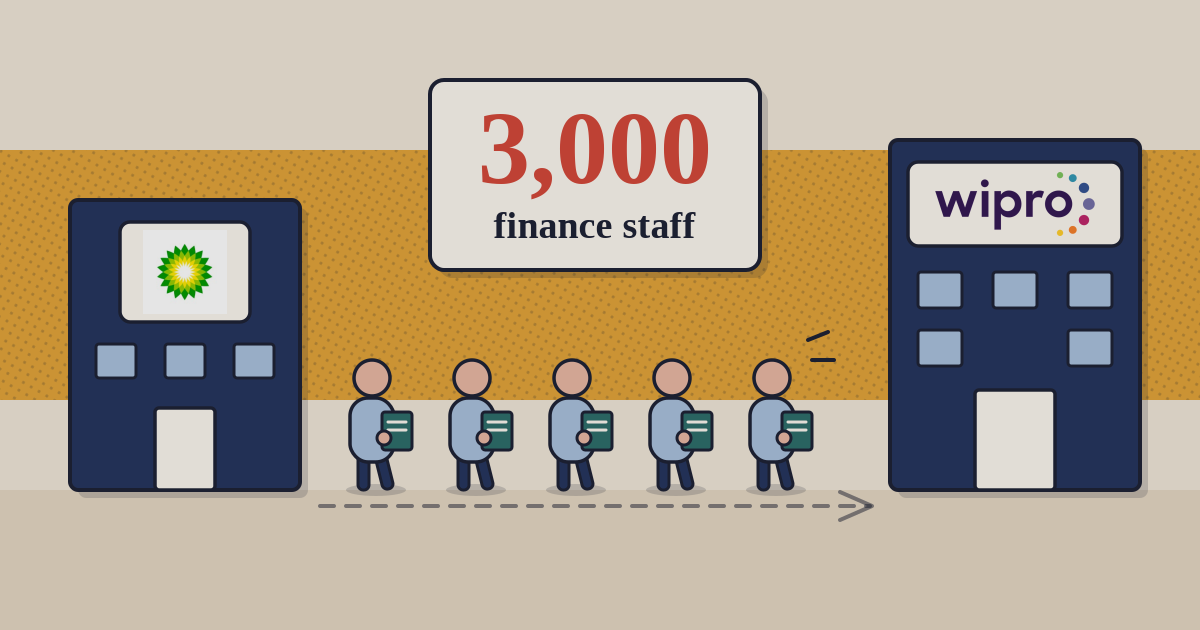
bp is handing its core finance operations to Wipro, and the people who do the work go with it. “Around 3,000 bp employees supporting finance operations in India, Hungary and Malaysia will move to Wipro,” says the joint announcement, which Wipro filed with the stock exchanges on Wednesday 25 November under a covering letter signed at 15:31, a minute after the market closed. bp calls it “a strategic supplier partnership” to “transform its core finance operations as it continues to strengthen performance and improve long-term cost competitiveness”. The new operating model “is expected to take effect in 2027, subject to applicable conditions”. Neither company gave the contract’s value, length or price.1
01Why the buyer takes the people as well as the work
This is a staff-transfer deal, which the outsourcing trade calls rebadging. Instead of hiring and training a new team, the supplier takes on the client’s own employees who already run the process, here the finance operations bp runs from three countries, and they carry on as the supplier’s staff. The client stops employing them and pays for a service; the supplier gets a working team on day one and the contract that pays for it. The release does not say on what terms the 3,000 move.1
What bp keeps is spelled out: it “will retain overall accountability for standards, controls, data and technology governance, with PwC providing controls oversight”. In other words, Wipro runs the processes, bp still answers for the numbers they produce, and a third firm watches the controls. Kate Thomson, bp’s chief financial officer, said Wipro “brings specialist digital capabilities and investment that will help us make better use of finance operations technology”. Wipro’s chief executive, Srini Pallia, called it a “landmark engagement” and said the aim is large-scale technology change using the company’s AI platforms.1 We found no separate bp filing on the deal: its latest report to the US Securities and Exchange Commission is dated 17 November.5
02What 3,000 people mean to Wipro
Wipro had 236,328 people on 30 September, down 6,716 in three months; the bp transfer equals about 1.3% of that headcount.2 It comes after a weak quarter for new business. In July–September Wipro booked contracts worth US$2,595m in total, down 22.9% in constant currency from the quarter before, and large deals, those of US$30m or more, came to US$674m, down 58.6%. Its IT services revenue was flat at US$2,611.5m, and it guided October–December at between 1.5% lower and 0.5% higher in constant currency.3
Wipro’s large-deal bookings fell to US$674m in July–September, the lowest in six quarters
Total contract value booked by Wipro each quarter, total and large deals (US$30m or more), April 2025 to September 2026, US$ million
- Total bookings
- Large deals
US$
Show tableHide table
| Total bookings | Large deals | |
|---|---|---|
| Apr–Jun 2025 | 4,971 | 2,666 |
| Jul–Sep 2025 | 4,688 | 2,853 |
| Oct–Dec 2025 | 3,335 | 871 |
| Jan–Mar 2026 | 3,455 | 1,440 |
| Apr–Jun 2026 | 3,370 | 1,626 |
| Jul–Sep 2026 | 2,595 | 674 |
Source: Wipro, quarterly highlights filed with the SEC on Form 6-K · as of 30 September 2026 · Bookings are recorded at the exchange rates of the day and include renewals
Wipro’s shares closed at ₹189.05 on Wednesday, up 0.9% from Monday’s ₹187.29, in a session that ended before the release; Indian markets were shut on Tuesday.4 Thursday 26 November is the first session to trade on it. The next fact to watch is in Wipro’s results for the quarter to 31 December: whether the bp contract appears in its bookings, and at what value.
Sources
- Wipro Limited, press release: “bp signs strategic partnership with Wipro to build best-in-class finance operations” (NSE) — 25 November 2026
- Wipro Limited, highlights for the quarter ended 30 September 2026 (Form 6-K, exhibit 99.5) — 15 October 2026; filed 20 October 2026
- Wipro Limited, results for the quarter ended 30 September 2026 (Form 6-K, exhibit 99.1) — 15 October 2026
- National Stock Exchange of India, daily price files for the cash market, 23 and 25 November 2026 (WIPRO, series EQ) — 25 November 2026
- US Securities and Exchange Commission, EDGAR: bp p.l.c. filings (latest Form 6-K dated 17 November 2026) — Read 25 November 2026
Disclosure. TechBag is a software reseller: it earns when companies buy through it, including from vendors named here. The analysis is TechBag’s own; no vendor paid for or saw this piece before publication. Facts are labelled reported, TechBag count or our view. How the Journal works.
Keep reading