AI in the enterpriseAnalysis
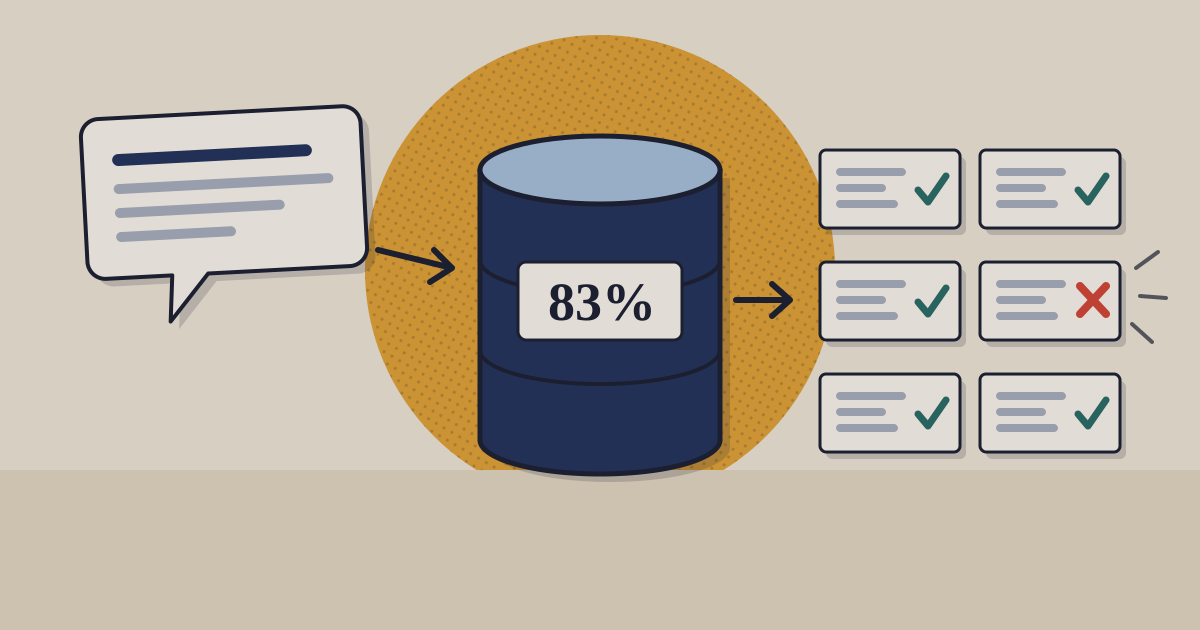
AI analytics writes correct SQL 83% of the time; humans manage 93%
What the BIRD text-to-SQL leaderboard, a 2023 knowledge-graph benchmark and Microsoft's Copilot rules show about asking data questions in English, as of September 2026.

In 2023 this blog described AI analytics as software that finds patterns faster than people can, sorted into descriptive, predictive and prescriptive kinds. Three years on, the product that Indian buyers are actually offered is narrower and more useful to judge: type a business question in English, and the software writes the query, runs it against your data and draws the chart. The question for a CIO or a head of finance is whether to trust those answers enough to let business users ask on their own, and what has to be in place first.
01Three years took text-to-SQL from 39% to 83%
BIRD is the public benchmark most vendors and labs quote for turning English into SQL: thousands of questions over real databases, scored on whether the generated query returns the right rows. Its leaderboard keeps the 2023 baselines alongside the current entries, which makes the trend easy to read.1 ChatGPT, given the database and hints, scored 39.30% in March 2023. GPT-4 scored 54.89% that July. The best entry dated on or before 30 September 2026, a Purdue University system submitted on 26 September, scored 82.95%.
The best text-to-SQL score more than doubled since 2023, but is still ten points short of people
BIRD test-set execution accuracy, %, selected entries by submission date, March 2023 to September 2026
Source: BIRD-SQL leaderboard, entries dated on or before 26 September 2026 · as of 30 September 2026
Two caveats keep this honest. A benchmark database is cleaner than yours: tidy names, documented columns, no fifteen-year-old table called CUST_MSTR_NEW2. And the leaderboard systems are research pipelines tuned for the test, not the assistant bundled into a BI licence. Read 83% as a ceiling for well-described data, not a promise for your ERP export.
02The business definitions are the multiplier, not the model
The most useful experiment on enterprise data is still a 2023 one. Juan Sequeda, Dean Allemang and Bryon Jacob at data.world took an insurance-industry schema, wrote 43 business questions, and asked GPT-4 to answer each one two ways: by writing SQL straight against the tables, and by querying a knowledge graph that described what the tables meant. Every question ran repeatedly between September and October 2023.2
Given a model of what the tables mean, GPT-4 answered three times as many questions correctly
Average execution accuracy, %, GPT-4 on 43 insurance questions, SQL on raw tables vs a knowledge graph, by question and schema complexity, 2023
- SQL on raw tables
- With a knowledge graph
Table view
| SQL on raw tables | With a knowledge graph | Change | |
|---|---|---|---|
| All questions | 16.7 | 54.2 | 37.5 pts |
| Simple both | 25.5 | 71.1 | 45.6 pts |
| Hard question | 37.4 | 66.9 | 29.5 pts |
| Hard schema | 0 | 35.7 | 35.7 pts |
| Hard both | 0 | 38.5 | 38.5 pts |
Source: Sequeda, Allemang and Jacob, arXiv 2311.07509, Table 1 · as of 13 November 2023 · simple and hard refer to question and schema complexity as the authors defined them
Models have improved since, as section 1 shows, but the direction of the finding has not changed and the vendors now say it themselves. Microsoft’s own Copilot documentation tells customers to prepare the semantic model first, because without it Copilot “can misinterpret the data and return generic or inaccurate results”.3 ThoughtSpot sells Spotter on the same argument: answers grounded in a governed semantic model, and a separate agent, SpotterModel, whose job is to help build that model.5
03What it takes to switch it on in Power BI
Our Power BI page records it as the de facto BI default in Indian GCC analytics teams, and Pro is often already paid for inside Microsoft 365 E5, so its rules are the practical ones.4 Microsoft’s requirements, as documented in August 2026, have four gates, and a Pro licence passes none of them on its own.3
Four gates stand between a Power BI Pro licence and a working Copilot
Requirements for Copilot in Power BI, per Microsoft's documentation, August 2026
- 01
Paid capacity
Fabric F2 or higher, or Premium P1. “A Power BI Pro or Premium Per User license alone isn’t sufficient.” F2 lists from about US$262 a month.
- 02
Admin switch
The tenant setting that lets users use Copilot and Azure OpenAI features must be on. It is on by default, but an admin may have turned it off.
- 03
Cross-region consent
Outside the US and EU data boundary, Copilot is off by default until an admin allows data sent to Azure OpenAI to be processed outside the tenant’s region.
- 04
A prepared model
Descriptions, synonyms and verified answers on the semantic model. Without them Copilot falls back on generic answers.
Source: Microsoft Learn, Copilot for Power BI overview; TechBag Power BI intel page for the F2 price · as of 30 September 2026
The third gate is the one Indian buyers miss. An Indian Fabric tenant sits outside both named boundaries, so Copilot stays off until someone with authority accepts that prompts and the data in them may be processed in another country. Microsoft also lists India West among the regions where the standalone and app-scoped Copilot experiences were not yet available.3 That is a data-protection decision, not an IT toggle, and it should be written down by whoever signs for personal data.
The bill also behaves differently from a seat. Microsoft says token consumption drives Copilot billing, that Copilot’s use is measured in the capacity’s own compute units and processed as background operations, and that a newly bought or resized capacity can take up to 24 hours before Copilot recognises it.3 In our reading, a popular Copilot competes with the reports that share its capacity; watch the capacity metrics in the first month before deciding the F2 was enough.
04What the 2023 promise looks like now
The original piece promised speed, accuracy greater than manual methods, and predictive insight for every team. Set against the evidence above, the claims that held are narrower and more operational.
AI analytics turned out to be a query writer that depends on your definitions, not an oracle
The 2023 framing of this blog against what the benchmarks and vendor documentation show, as of September 2026
What we said in 2023
- AI analytics is more accurate than manual analysis
- Descriptive, predictive and prescriptive are the categories to buy
- The main barrier is specialist skills
- Adopt it and insight follows
What the evidence says in 2026
- The best benchmark system is right 83% of the time; people 93%
- The product is an English question turned into a governed query
- The main barrier is an undocumented data model
- Adopt it after the definitions, the capacity and the data-transfer decision
Source: BIRD leaderboard; Sequeda et al. 2023; Microsoft Learn · as of 30 September 2026
The practical consequence is that you can measure your own version of the BIRD number before you buy, and you should. It takes a week, not a project:
- Write down twenty to thirty questions your business users already ask, each with the answer finance or sales would sign off: last quarter’s revenue by region, open orders over ninety days, churned customers by plan.
- Ask each one three times in the tool, in the words a user would type, and score it the way BIRD does: does the result match the signed-off answer, yes or no.
- Add the definitions: table and column descriptions, synonyms, the three or four measures everyone argues about. Then run the same questions again.
- Compare the two scores. The gap is what the semantic model is worth to you, and it is usually the better investment than a pricier licence.
Sources
- BIRD-SQL, A Big Bench for Large-Scale Database Grounded Text-to-SQLs, leaderboard — entries dated March 2023 to 26 September 2026
- Sequeda, Allemang and Jacob, A Benchmark to Understand the Role of Knowledge Graphs on LLM Accuracy for Question Answering on Enterprise SQL Databases (arXiv 2311.07509) — 13 November 2023
- Microsoft Learn, Copilot for Power BI overview (requirements, regions, data preparation) — 24 August 2026
- TechBag, Microsoft Power BI intel page (Pro, PPU and Fabric F-SKU prices in USD and INR) — as committed 30 September 2026
- TechBag, ThoughtSpot Spotter intel page (semantic-model grounding, SpotterModel, India R&D) — as committed 30 September 2026
- DPDP Rules 2025, commencement timeline — notified 13 November 2025
- RBI, Cybersecurity, Technology Risk and Resilience Framework Directions, 2026, via practitioner summary — 31 July 2026 RBI PDF not fetched.
Related on TechBag: the ThoughtSpot Spotter page covers the agentic analyst and its semantic model; the Power BI page prices Pro, PPU and Fabric capacity in INR. For the seat-versus-capacity arithmetic, see our note on when Power BI F64 beats Pro seats.
Disclosure. TechBag is a software reseller: it earns a margin when a reader buys through it, including from vendors named here. The analysis is TechBag’s own; no vendor paid for or saw this piece before publication. Facts are labelled reported, TechBag count or our view.
Keep reading