AI in the enterpriseAnalysis
37% of firms see any profit from AI, 6% a real one, as agents spread
What McKinsey's survey of 1,719 executives, published 25 August 2026, says about AI's return, set against PwC, Deloitte and Nasscom data from January to July 2026.


Four in five people who use AI at work say it makes them more productive. Far fewer of their companies can find that gain in their accounts.1 McKinsey’s annual survey, released on 25 August, is the best single measure of that gap, and this year it shows the gap holding steady while spending on AI agents grows. The question for anyone who signs off on an AI renewal is practical: what separates the few firms that profit from the many that do not, and how do you know which group your own deployment is in before you pay for another year?
01Most users feel faster; few firms see it in profit
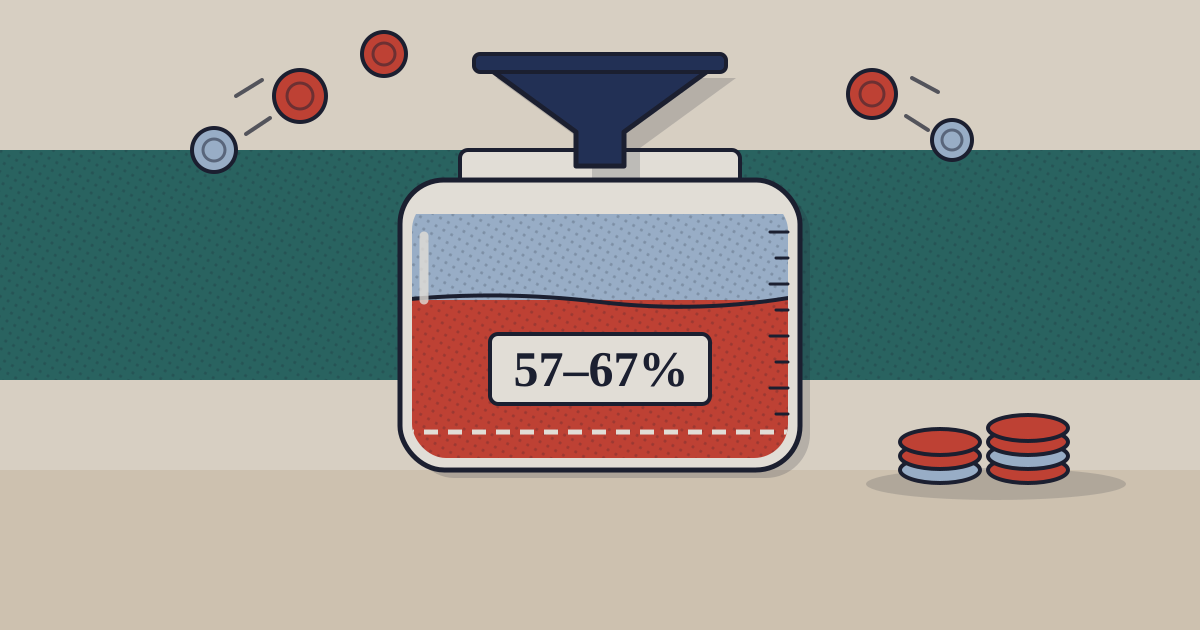
McKinsey’s 2026 survey covered 1,719 professionals and business leaders across regions and industries. 37% of respondents attribute at least some impact on EBIT (earnings before interest and taxes) to AI, about the same share as in the 2025 survey. McKinsey keeps a stricter group, the “high performers”: firms where AI accounts for at least 5% of EBIT and the respondent calls the impact significant. Just 6% of respondents meet both tests, the same as last year.1
Productivity is where the survey looks good. 80% of respondents who use AI in their own roles say it has improved their individual productivity, and The Register notes that this has not turned into a broad financial effect.1 These numbers come from different bases, which is why the chart shows them separately: the first is about people, the other two are about firms.
Eight in ten AI users feel more productive; fewer than four in ten firms see any profit from it, and six in a hundred a real one
Share of respondents, McKinsey State of AI survey (1,719 respondents), published 25 August 2026
80%
Say AI improved their own productivity
respondents who use AI in their roles
37%
Attribute any EBIT impact to AI
about the same as 2025
6%
High performers: 5% or more of EBIT from AI, significant impact
flat on 2025
Source: McKinsey, The state of AI in 2026, as reported by The Register (25 Aug 2026) · as of 25 August 2026 · the productivity figure is among respondents who use AI in their roles; the EBIT figures are among all respondents
03Every 2026 survey finds the same thing: a minority with a return
McKinsey is not alone. PwC’s 2026 Global CEO Survey, of 4,454 chief executives in 95 countries, found 56% saying they have got “nothing out of” their AI investments so far, and 12% reporting that AI both grew revenue and cut costs. Deloitte’s 2026 State of AI in the Enterprise, which surveyed 3,235 leaders from director to C-suite, found 66% reporting productivity gains from AI and 20% reporting revenue growth.3 In India, a Nasscom-KPMG whitepaper of July 2026 puts the share of organisations reporting ROI across multiple AI use cases at 24%.4
Whatever the question and whoever is asked, the share reporting a financial return from AI stays a minority
Share of respondents reporting each measure of AI return, four surveys published January to August 2026
Source: McKinsey via The Register (25 Aug 2026); PwC and Deloitte via The Next Web (1 May 2026); Nasscom-KPMG (Jul 2026) · as of 25 August 2026 · each survey asks a different question of a different sample; read the bars side by side, not as one series
The gap between how productive people feel and what shows up in the accounts appears in every one of these surveys. Deloitte has 66% for productivity against 20% for revenue; McKinsey has 80% against 37%.13 The likeliest reason is accounting, not technology. An hour saved by one employee is not profit until the firm either stops paying for that hour or uses it to sell more, and most deployments are not designed to do either.
04What the few do differently: redesign first, then measure in business terms
McKinsey’s November 2025 State of AI reached the same conclusion, as The Next Web summarised it: what set the high performers apart was “not better technology choices but better organisational practices”. They redesigned workflows, scaled faster, built AI into business processes, tracked KPIs for their AI solutions, and had senior leaders visibly committed to the work.3 A separate McKinsey report covered by the same outlet described most current AI as “tools that accelerate existing work” while they “largely preserve underlying workflows”.3
Indian industry bodies say much the same. The Nasscom-KPMG whitepaper argues that workflows and decision rights “must be redesigned from first principles, rather than simply automating broken processes to make them move faster”, and that the advantage goes to firms that reorganise, not to those running the most pilots.4 Nasscom’s June study of 505 enterprises in more than 12 regions found that its AI-first group mostly tracks AI value with the enterprise KPIs it already uses, on growth, monetisation, resilience and governance, rather than with new AI metrics.5
The difference is not the model: the few redesign the work and judge AI on the numbers the business already reports
Practices of AI high performers against the typical deployment, as described by McKinsey (Nov 2025) and Nasscom (Jun and Jul 2026)
The typical deployment
- AI added to an existing workflow, which stays as it was
- Success measured by usage, licences issued and how people say they feel
- Many pilots, few scaled
- Owned by IT or an innovation team
- AI spend tracked as a general cost of doing business
The 6% (high performers)
- The workflow is redesigned around AI before scaling
- KPIs tracked for each AI solution, in existing business terms
- Scaled faster, built into business processes
- Senior leaders visibly committed
- Return attributed to organisational change, not to the tool
Source: McKinsey via The Next Web (1 May 2026); McKinsey via The Register (25 Aug 2026); Nasscom (22 Jun 2026); Nasscom-KPMG (Jul 2026) · as of 25 August 2026
05Before you renew: six tests for an AI deployment
Most AI is bought as a subscription, so the moment to apply all this is the renewal. The seat price is the easy part. Microsoft 365 Copilot, for example, is listed on TechBag’s intel page at about US$30 a user a month as an add-on to an existing Microsoft 365 licence.7 Agents increasingly add usage-based charges on top, which is why one respondent in five already says operating costs constrain their use.1
An AI renewal should pass six tests, and the first one is set before the tool is switched on
Measuring an AI deployment before renewal, TechBag's sequence built from the high-performer practices, August 2026
Step 1 of 6
1. Name the workflow and its number
One process, one business measure you already report: cost per case, cycle time, error or rework rate, days of working capital. Not “productivity”.
Source: TechBag analysis of McKinsey via The Register (25 Aug 2026) and The Next Web (1 May 2026); Nasscom (22 Jun 2026) · as of 26 August 2026
None of this needs a consultant. It needs the measure chosen before the tool goes live, which is the step most deployments skip. The older pattern of paying for software nobody uses is in our piece on where enterprise software ROI leaks, and what an AI seat costs a small firm is in our note on SMB AI seat prices.
Sources
- The Register (Brandon Vigliarolo): McKinsey says enterprise AI is finally 'on the road to ROI' (reports McKinsey's State of AI 2026 survey, 1,719 respondents, and McKinsey's statement) — 25 August 2026
- McKinsey & Company, QuantumBlack: The state of AI in 2026 — 25 August 2026 The page did not load for us; figures are cited through source 1.
- The Next Web (Allison Steffens Herrera): McKinsey's new AI report argues the productivity payoff is real but conditional (covers McKinsey's November 2025 State of AI, PwC's 2026 Global CEO Survey and Deloitte's 2026 State of AI in the Enterprise) — 1 May 2026
- Nasscom and KPMG: Reorganise Or Fall Behind: The Real Race In The AI Decade (whitepaper key findings) — 30 July 2026
- Nasscom: AI-First Enterprises: Trends and Emerging Directions (survey of 505 global enterprises, key findings) — 22 June 2026
- Nasscom: WORK REIMAGINED: The Rise of Human-AI Collaboration (Indian technology industry, key findings) — 13 January 2026
- TechBag, Microsoft Copilot intel page: Microsoft 365 Copilot about US$30 a user a month as an add-on — mid-2026
- India Briefing: Digital services in India: OIDAR, GST applicability and reverse charge — updated 29 September 2023
- MeitY, Digital Personal Data Protection Act, 2023 and the DPDP Rules, 2025 (notified 13 November 2025; substantive duties from 13 May 2027) — 13 November 2025
Related on TechBag: the Microsoft Copilot intel page sets out what the add-on includes; where enterprise software ROI leaks covers idle seats; what an SMB’s AI seat costs compares the bundles.
Disclosure. TechBag is a software reseller: it earns a margin when a reader buys through it, including from vendors named here. The analysis is TechBag’s own; no vendor paid for or saw this piece before publication. Facts are labelled reported, TechBag count or our view.
Keep reading