Cloud & DevOpsAnalysis
Akamai signed over US$14bn of cloud deals; it earned US$109m from cloud last quarter
Akamai’s filings of May to November: what Anthropic’s US$11.6bn and the other cloud contracts commit, what the build costs, how it is funded, and what US$7bn in 2028 needs.

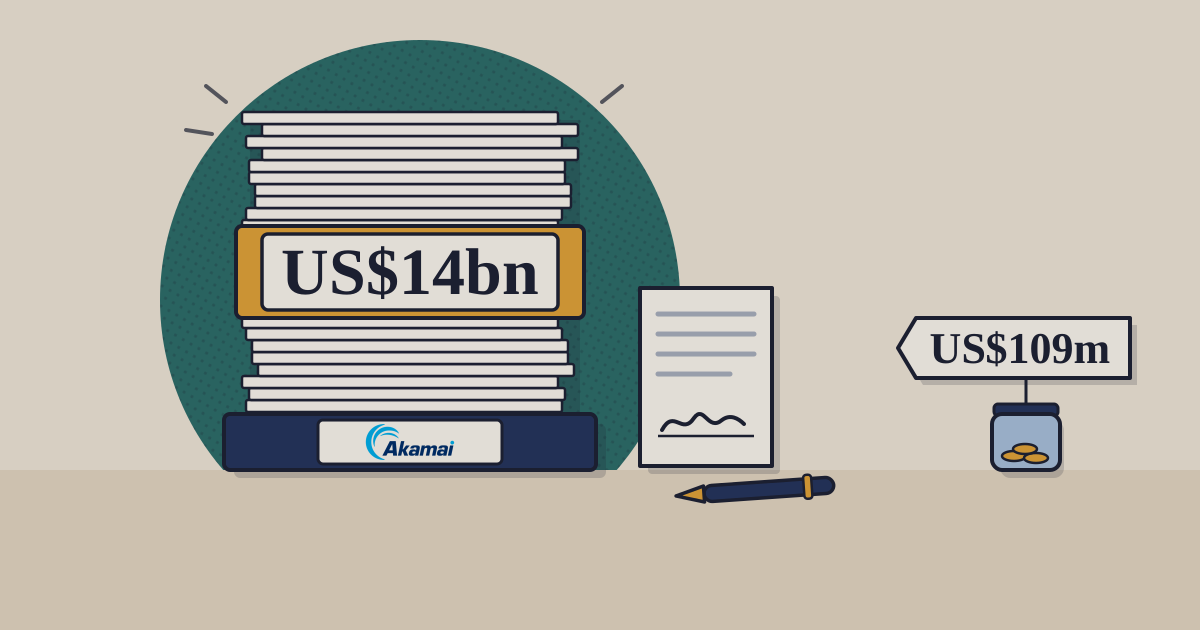
Akamai is best known for delivering websites and video and for protecting them. On 5 November it told investors that a third business, renting computing capacity, would turn a company growing about 6% a year into one growing up to 22%. The case rests on contracts signed in the last six months, mostly with one customer, and on a building programme that has barely begun. This piece reads Akamai’s own filings to separate what has been signed from what has been earned, what the build will cost and how it is being paid for, and what has to happen for the 2028 target to hold.
01Three businesses: security pays the bills, delivery shrinks, cloud grows
Akamai has reported revenue in three lines since the start of 2026. Security, where Akamai names API security, web application and Guardicore segmentation products as the growth drivers, brought in US$622m in the quarter to September, up 9%. Delivery and other cloud applications, the content-delivery business, brought in US$391m, down 3%. Cloud infrastructure services (CIS), the compute business built on Linode, brought in US$109m, up 34%.129 Total revenue was US$1,122m, up 6%.1
Akamai puts the delivery decline down to “downward pricing of contract renewals” and to customers optimising traffic to cut costs, and CIS growth to “growth in sales to new and existing customers of our compute solutions, as well as the compute partner solutions running on our platform”.2 In the quarter, security was 55% of revenue, delivery 35% and CIS 10%, on our arithmetic from the release.
Security still earns more than half; cloud infrastructure is the only line growing fast, from a small base
Revenue by solution, US$ million, quarters to March 2025 through September 2026 (2025 recast by Akamai)
- Security
- Delivery and other cloud applications
- Cloud infrastructure services
US$
Show tableHide table
| Security | Delivery and other cloud applications | Cloud infrastructure services | |
|---|---|---|---|
| Q1 2025 | 531 | 417 | 68 |
| Q2 2025 | 552 | 420 | 71 |
| Q3 2025 | 568 | 405 | 81 |
| Q4 2025 | 592 | 409 | 94 |
| Q1 2026 | 590 | 389 | 95 |
| Q2 2026 | 604 | 396 | 99 |
| Q3 2026 | 622 | 391 | 109 |
Source: Akamai quarterly results, Form 8-K Exhibit 99.1, Q1, Q2 and Q3 2026 (each showing the matching 2025 quarter) · as of 5 November 2026 · Rounded to the nearest US$ million
Profit fell as the cloud build began. Cost of revenue rose to 45% of revenue from 41%, led by “network build-out and supporting services” (up 45%, mostly partner costs) and co-location (up 25%). The non-GAAP operating margin fell 6 points to 25%, and GAAP net income fell 16% to US$117m.12
02What was signed: about US$14.4bn, US$11.6bn of it from one customer
The commitments arrived in three steps. On 7 May Akamai announced that “a leading, U.S. based frontier model provider” had committed US$1.8bn over seven years.6 By 6 August the year’s multi-year CIS contracts were “collectively worth over $2.8 billion”, including more than US$600m over four years from a new US technology customer.5 On 18 September Akamai and Anthropic signed two project plans under a master services agreement dated 5 May, under which Anthropic “has committed to pay the Company approximately $11.6 billion”, each plan for “an initial seven-year term commencing on their respective service start dates”.3 Akamai said the capacity supports Anthropic’s “CPU workload” growth.4 It has not said whether the May customer was Anthropic.
A commitment is not revenue. It shows up first in remaining performance obligations (RPO), the contracted revenue Akamai has not yet earned under noncancellable contracts. RPO was US$19.9bn on 30 September, up from US$7.6bn three months earlier.7 Akamai expects to recognise about 35% of it within two years, 28% in years three and four, 21% in years five and six and 16% in years seven and eight.2 It had been US$4.8bn a year earlier and US$5.2bn at the end of 2025.89 A quarter earlier it expected 40% within twelve months: the backlog is now much larger and much longer.7
Contracted revenue not yet earned jumped to US$19.9bn in the quarter Anthropic signed
Remaining performance obligations at quarter end, US$ billion, September 2025 to September 2026
US$
Show tableHide table
| Remaining performance obligations | |
|---|---|
| Sep 2025 | 4.8 |
| Dec 2025 | 5.2 |
| Mar 2026 | 5.5 |
| Jun 2026 | 7.6 |
| Sep 2026 | 19.9 |
Source: Akamai Forms 10-Q (Q3 2025, Q1, Q2 and Q3 2026) and Form 10-K for 2025, revenue recognition note · as of 6 November 2026 · RPO covers all of Akamai's contracts, not only cloud infrastructure, and excludes variable usage
The contract can still fall short. Revenue depends on Akamai meeting “delivery and service availability requirements”; Anthropic may end a project plan “upon notice of a material outage, subject to certain conditions”, or the whole agreement if Akamai is taken over by “a direct competitor of Anthropic”.3 Akamai’s 10-Q now carries a risk factor that its CIS revenue “may become increasingly dependent on Anthropic”.2
03From contract to revenue: the capacity comes first
Akamai expects revenue from the new contracts “to begin to be recognized in the fourth quarter of 2026, accelerate in 2027, with anticipated capacity fully operational by the end of 2028”, and says that revenue “will primarily be derived in the U.S.”.2 Before then it has to buy and install the machines. It estimates capital spending for the large contracts at “approximately $6.8 billion”, starting in the fourth quarter and continuing into 2028, and warns that these investments “are expected to precede a significant portion of the related customer cash inflows”.2 In September it put the capex for the Anthropic plans alone at about US$5.5bn, with about US$1.7bn more in 2026 “to secure and pre-purchase critical supply chain components, including memory”.4
Akamai spends first and is paid later: about US$6.8bn of capex before the capacity is fully running in 2028
How a signed cloud commitment becomes revenue and cash at Akamai, as its filings of September to November 2026 describe it
- 01
The contract is signed
Anthropic commits about US$11.6bn over seven-year terms; it enters the backlog, not revenue.
- 02
Capacity is bought
About US$6.8bn of capex; US$1.7bn of memory through Jabil, servers from Lenovo, US$2.4bn of new data-centre leases.
- 03
Service starts
Revenue is recognised as capacity is delivered, from October–December 2026, accelerating in 2027.
- 04
Cash comes back
Akamai expects “a meaningful increase in cash flows from operations beginning in 2028”.
Source: Akamai Form 10-Q for Q3 2026; Form 8-K and press release of 24 September 2026 · as of 6 November 2026
The supply chain is already contracted. On 24 September Akamai authorised Jabil, which builds its custom servers, to buy about US$1.7bn of memory components; a day earlier it had signed a seven-year statement of work with Lenovo for hardware and services.3 At 30 September it had US$2.4bn of co-location leases that had not yet started, most due to begin by the end of 2027, and about US$1.0bn of server purchase commitments that are “noncancellable, except upon customer cancellation”.2 The 10-Q also notes “a significant increase in server and memory costs due to market dynamics driven by hyperscalers”, the same memory squeeze we charted in PC shipments and DRAM prices.2
04How it is paid for: convertible notes, cash, and no buybacks
Capital spending was US$464m in the quarter, 41% of revenue, against US$224m and 21% a year earlier.1 On the cash-flow statement, Akamai paid US$605m for property, equipment and capitalised software while operations brought in US$433m: on our arithmetic, the first quarter of the three this year in which cash capex exceeded operating cash. It bought back no shares in the quarter, after spending US$616m on buybacks in the first half.1
The money came mostly from convertible notes. In May Akamai sold US$1.75bn of notes due 2030 and US$1.75bn due 2032, both at a 0% coupon, and said it would use part of the proceeds “to fund the accelerated capital expenditure requirements” of CIS. Its convertible notes now total US$7.64bn of principal, including US$1.15bn due on 1 September 2027; its US$1.0bn revolving credit facility was undrawn.2 Cash and marketable securities were US$4.239bn on 30 September.1
The build is funded from a US$4.2bn cash pile raised largely through US$7.6bn of convertible notes
Akamai's capital spending and funding, quarter to and position at 30 September 2026
US$6.8bn
Estimated capex for the large CIS contracts, Q4 2026 into 2028
Akamai 10-Q
41%
Capex as a share of revenue in Q3 2026, from 21% a year earlier
Akamai
US$7.64bn
Convertible notes outstanding; US$1.15bn due September 2027
Akamai 10-Q
US$4.24bn
Cash, cash equivalents and marketable securities, 30 September
Akamai
Source: Akamai Q3 2026 release (8-K Exhibit 99.1) and Form 10-Q · as of 6 November 2026 · Capex here is Akamai's accrual measure; the US$6.8bn is its estimate for the large CIS contracts over several years
Akamai expects to fund the build from cash, operations and its credit lines, but says it “may evaluate a range of financing alternatives”, “with consideration given to potential dilution to shareholders”, if spending and customer payments fall out of step.2 There is also the warrant it gave Anthropic: up to 7.74 million common shares on conversion, about 5% of the company, at US$111.33 a share. About 2% vests with the first payment under the third project plan; the rest vests in three steps, one for each further US$3bn Anthropic commits.34 Borrowing to build AI capacity ahead of revenue is the pattern we traced at Oracle and across Big Tech.
05What has to happen for US$7bn in 2028
The targets are steep against today’s base. Akamai guides 2026 revenue of US$4,440m to US$4,465m, against US$4,208m in 2025, which is growth of about 6%.19 For 2027 it guides CIS revenue of US$1.1bn to US$1.3bn and total growth of 17% to 22% at constant currency; for 2028, revenue “projected to exceed $7.0 billion”.1 In August its quarterly release gave no 2027 or 2028 figure.5
Signed in 2026, built through 2028: the dates Akamai's targets depend on
Akamai's commitments, financing and targets, May 2026 to December 2028, as disclosed to 6 November 2026
Show tableHide table
| Date | Event | Detail |
|---|---|---|
| May 2026 | US$1.8bn | Seven-year commitment from an unnamed frontier model provider |
| May 2026 | US$3.5bn of notes | 0% convertible notes due 2030 and 2032, partly for CIS capex |
| Aug 2026 | Over US$2.8bn | Multi-year CIS commitments signed year to date |
| Sept 2026 | Anthropic, US$11.6bn | Two seven-year project plans; a warrant for up to about 5% |
| Nov 2026 | More than US$14bn | 2027 and 2028 targets set; CIS revenue from the deals starts this quarter |
| Sept 2027 | US$1.15bn notes due | The 2027 convertible notes mature |
| Dec 2028 | Capacity fully running | Akamai's expectation; 2028 revenue above US$7.0bn |
Source: Akamai releases of 7 May, 6 August and 5 November 2026; 8-K and press release of 24 September 2026; Form 10-Q for Q3 2026 · as of 6 November 2026 · Dates after 6 November 2026 are Akamai's expectations, not events
The market has not settled on a reading. Akamai’s shares closed at US$77.84 on 5 November, down 9.4% that day before the results came out after the close, and rose 6.7% to US$83.09 on 6 November. That is 27% below the US$113.94 close of 25 September, the first session after the Anthropic announcement, and 25% below the warrant’s US$111.33 exercise price.10 We found no company statement on the moves.
Sources
- Akamai: Akamai Reports Third Quarter 2026 Financial Results (Form 8-K, Exhibit 99.1) — 5 November 2026
- Akamai: Quarterly Report on Form 10-Q, quarter ended 30 September 2026 — filed 6 November 2026
- Akamai: Form 8-K, Items 1.01, 3.02 and 5.03 (Anthropic project plans, warrant, Lenovo and Jabil agreements) — filed 24 September 2026
- Akamai: Akamai Announces $11.6 Billion Multi-year Agreement with Anthropic (Form 8-K, Exhibit 99.1) — 24 September 2026
- Akamai: Akamai Reports Second Quarter 2026 Financial Results (Form 8-K, Exhibit 99.1) — 6 August 2026
- Akamai: Akamai Reports First Quarter 2026 Financial Results (Form 8-K, Exhibit 99.1) — 7 May 2026
- Akamai: Forms 10-Q for the quarters ended 31 March and 30 June 2026 (remaining performance obligations) — filed 8 May and 7 August 2026 Q1: https://www.sec.gov/Archives/edgar/data/1086222/000108622226000058/akam-20260331.htm
- Akamai: Form 10-Q for the quarter ended 30 September 2025 (remaining performance obligations) — filed 7 November 2025
- Akamai: Annual Report on Form 10-K for 2025 — filed 20 February 2026
- Nasdaq: Akamai Technologies (AKAM) historical quotes — closes to 6 November 2026
- Akamai Cloud (Linode) API v4: regions and the g6-nanode-1 plan type — read 7 November 2026 plan prices: https://api.linode.com/v4/linode/types/g6-nanode-1
- European Central Bank euro reference rates, USD/INR cross rate (via the Frankfurter API) — 6 November 2026
- India Briefing: Digital services in India: OIDAR, GST applicability and compliance — updated 29 September 2023
Disclosure. TechBag is a software reseller: it earns a margin when a reader buys through it, including from vendors named here. The analysis is TechBag’s own; no vendor paid for or saw this piece before publication. Facts are labelled reported, TechBag count or our view.
Keep reading