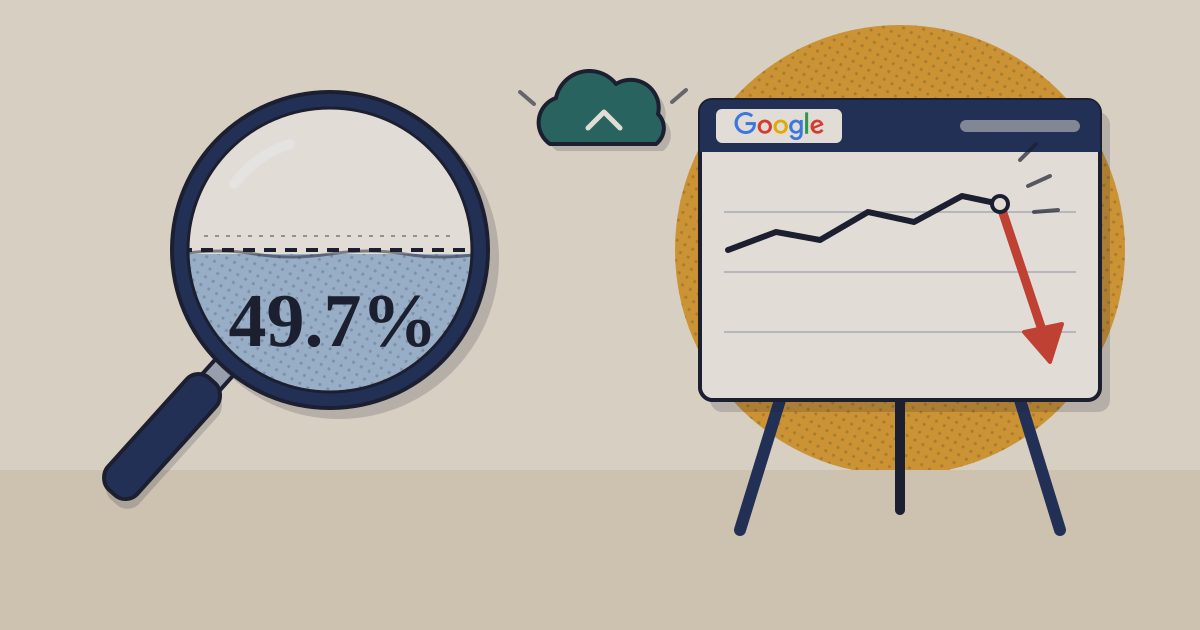
Google Search & other earned US$63.35bn of Alphabet’s US$127.58bn revenue in the quarter to 30 September: 49.7%, down from 55.3% a year earlier.1 Search did not shrink. It grew 12%; the rest of Alphabet grew faster, led by Google Cloud, up 103% to US$30.71bn.1 On 29 October, the day after the results, Alphabet’s Class A shares closed 12.64% lower and its Class C shares 12.29% lower, about US$497bn of market value by our count. For the Class A shares it was the worst daily close since they listed in August 2004.78
01Where the share went
Search’s share has fallen for three quarters running: 55.4% in the last quarter of 2025, then 55.0%, 52.8% and now 49.7%. Its growth rate over those quarters was 17%, 19%, 17% and then 12%.4561 Cloud went from 14.8% of revenue to 24.1%. The 10-Q splits the Search line into its two drivers: paid clicks rose 8% year on year and cost per click 4%.2
Search fell from 55.3% to 49.7% of Alphabet's revenue in a year, while Cloud rose from 14.8% to 24.1%
Share of Alphabet's total revenue by line, %, quarters from Q3 2025 to Q3 2026
Search & other
Google Cloud
%
Table view
Search & other
Google Cloud
Q3 2025
55.3
14.8
Q4 2025
55.4
15.5
Q1 2026
55
18.2
Q2 2026
52.8
20.7
Q3 2026
49.7
24.1
Source: Alphabet quarterly earnings releases, Q4 2025 to Q3 2026 (Q3 2025 from the Q3 2026 comparatives) · as of 28 October 2026 · Other Google Services (about 26–30%) and Other Bets and hedging (under 0.5%) are not drawn
The TechBag Journal
02What moved the shares, and who said so
Alphabet’s account. In the release, Sundar Pichai said: “Our AI investments are driving overall Search query growth, including commercial queries. In fact, our year-over-year query growth rate is the highest it’s been in the last five years.”1 On the call, Philipp Schindler, chief business officer, named currency as “the single largest driver” of the slowdown from the second quarter, followed by advertiser factors: the EU ending its de minimis customs exemption, which hit some Asia-Pacific retailers, and a World Cup that pulled ad budgets into June. He added that “the strong growth in AI Mode queries had an impact because of the lower monetization we were seeing in AI Mode”, and that Google is now scaling ads in AI Overviews and AI Mode.3
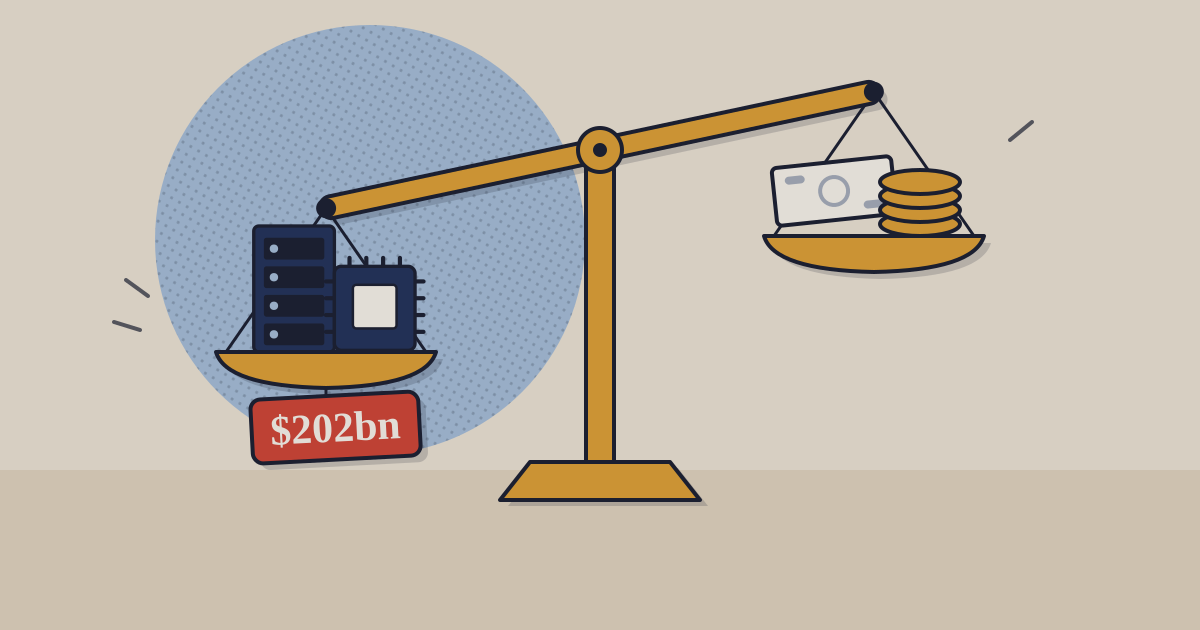
The spending. Capital expenditure was US$51.4bn in the quarter, against US$24.0bn a year earlier, and free cash flow was minus US$9.1bn, the second negative quarter in a row.1 Alphabet kept its 2026 capex guidance at US$195–205bn and said capex would “increase significantly” in 2027.3 It bought back no shares in the quarter (US$11.5bn a year earlier), raised US$12.4bn by selling new shares and US$28.7bn in senior notes, and ended September with US$125.1bn of long-term debt, up from US$46.5bn at the end of 2025.1
The coverage’s reading. CNBC reported that Search revenue missed analysts’ estimates and that free cash flow was more negative than analysts expected. Ben Barringer of Quilter Cheviot called it “a fairly messy set of results and a poorly handled earnings call”; Scott Devitt of Rosenblatt Securities said, “I don’t think it’s a sea change.”8 D.A. Davidson’s Gil Luria wrote that investors would worry the misses showed “AI has finally come for Google”, while saying he would not rush to conclusions on one quarter, The Next Web reported.9 Neither report named the new debt as a cause.
03What is not known yet
How the slowdown splits. Alphabet ranked currency first and AI Mode after it, but gave no split, and it does not publish revenue per AI Mode query.3
Whether AI Mode ads close the gap. On 28 October Google began scaling ads in AI Mode in ten more countries, India among them, with Brazil, Mexico and the UK planned for the fourth quarter.10 There is no revenue figure for them yet.
The next quarter. Alphabet said a larger currency headwind and lapping last year’s Search acceleration will pressure fourth-quarter growth, and that it will give 2027 capex on the fourth-quarter call.3
Whether the fall holds. This Note uses closes up to 29 October; one session is the market’s first reading, not its last.
Disclosure. TechBag is a software reseller: it earns a margin when a reader buys through it, including from vendors named here. The analysis is TechBag’s own; no vendor paid for or saw this piece before publication. Facts are labelled reported, TechBag count or our view.