Cloud & DevOpsNote
AWS WAF pricing change: US$0.01 an hour per resource from 1 February; rule fees end
AWS WAF’s old and new price lists, read side by side: what replaces the web ACL and rule fees on 1 February 2027, with three monthly bills worked both ways.

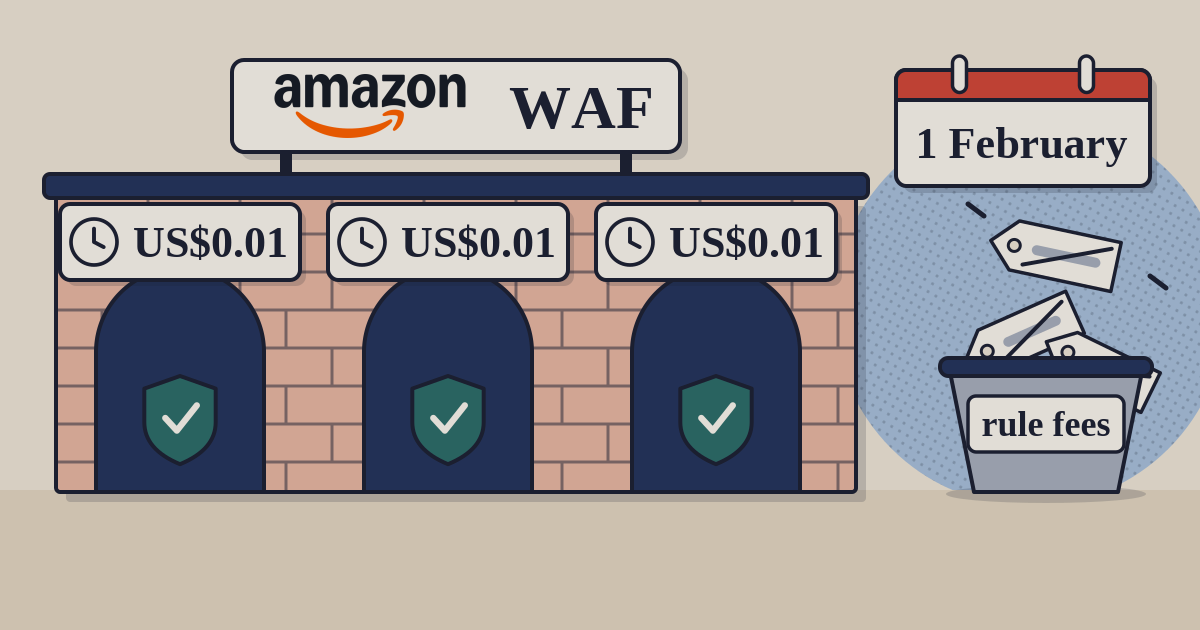
From 1 February 2027, AWS WAF, Amazon’s web application firewall, bills existing customers US$0.01 an hour for every resource a web ACL protects, about US$7.30 a month, and drops its monthly fees of US$5.00 per web ACL and US$1.00 per rule or rule group. Requests stay at US$0.60 per million, with US$5.00 per million more for those that premium protections inspect.1 AWS announced the change on 23 November as “available starting today”; an account that already uses AWS WAF “stays on current pricing until February 1, 2027”.23
One web ACL on 50 load balancers goes from US$11.20 to US$366.20 a month; on one load balancer, from US$30 to US$13.30
Monthly AWS WAF bill for three setups, at the prices through 31 January 2027 and from 1 February 2027, base protections only
Source: AWS WAF pricing page: its examples 1 and 6 for the new prices; today’s bills and the two-resource case are TechBag arithmetic from the page’s rates · as of 24 November 2026, 7:45pm IST · 730-hour month
01What is billed, before and after
A web ACL is the rule set; a protected resource is whatever it is attached to: a CloudFront distribution, an Application Load Balancer, an API Gateway REST API stage, an AppSync API, a Cognito user pool, an App Runner service, a Verified Access instance or an Amplify app. “A web ACL associated with 10 resources counts as 10 protected resources.” Each web ACL now includes 2,500 capacity units (WCUs), up from 1,500.1 The rate card, old and new:
Show tableHide table
| Charge | Through 31 January | From 1 February |
|---|---|---|
| Web ACL | US$5.00 a month | None |
| Rule, rule group or managed rule group | US$1.00 a month each | None |
| Protected resource | None | US$0.01 an hour, about US$7.30 a month |
| Requests inspected | US$0.60 per million | US$0.60 per million |
| Capacity | 1,500 WCUs included; US$0.20 per million requests for each 500 more | 2,500 WCUs included; no surcharge |
| Bot Control, common | US$10.00 a month; US$1.00 per million after 10 million | Included |
| Bot Control, targeted | US$10.00 a month; US$10.00 per million after 1 million | US$5.00 per million, premium |
| Fraud Control | US$10.00 a month per rule group; tiered, US$1,000 per million for the first 2 million | US$5.00 per million, premium |
| CAPTCHA, Challenge, larger bodies | Charged separately | Included |
02Who pays less, and who pays more
The request fee does not move, so on base protections the comparison is between fixed charges: US$5.00 per web ACL plus US$1.00 per rule today, US$7.30 per protected resource from February. AWS’s first example, one web ACL with 19 rules on one load balancer taking 10 million requests a month, costs US$13.30 on the new prices; at today’s rates it is US$30.00. One web ACL with 10 rules on two resources barely moves: US$21.00 to US$20.60. AWS’s sixth example runs the other way: five rules on 50 load balancers sharing 2 million requests costs US$366.20, against US$11.20 today, about 33 times as much.1
The smallest setups rise too. The single rate-limit rule we priced in an earlier piece goes from US$12.00 to US$13.30. AWS’s own line: “Most AWS WAF customers will pay less. Customers who protect many resources with low traffic per resource may pay more.”1
03What to do before 1 February
The switch is automatic: “No action is needed”, and February’s bill is the first on the new prices.1 The work is counting, with 69 days to do it. For each web ACL, list its associated resources in the AWS WAF console, or run aws wafv2 list-resources-for-web-acl once per resource type (it defaults to Application Load Balancers) and aws cloudfront list-distributions-by-web-acl-id for CloudFront.345 Multiply the count by US$7.30 and set it against the web ACL and rule lines on the last bill.
If the total rises, AWS suggests protecting traffic once at CloudFront rather than at many resources behind it, and asks customers who expect an increase to contact their account team before 1 February.13 A request that passes two web ACLs, one at CloudFront and one at the load balancer behind it, is billed by each.3 The US$5.00 premium fee applies only to requests a premium rule group inspects: in AWS’s third example, placing Bot Control targeted protection after rules that handle 80% of requests cuts a US$217.90 bill to US$77.90.1
Private pricing agreements and Shield Advanced subscriptions keep their terms. The price is the same in every region, Mumbai and Hyderabad included, and is published in US dollars only: there is no rupee price.12
Sources
- AWS, AWS WAF Pricing (both tabs, pricing examples and FAQs) — undated page, carrying the 1 February 2027 notice
- AWS What’s New, AWS WAF introduces simplified pricing — 23 November 2026
- AWS Security Blog, Introducing AWS WAF simplified pricing (Fenil Patel, Eitav Arditti, Alok Rana) — 23 November 2026
- AWS WAF API Reference, ListResourcesForWebACL — undated page
- AWS CLI Command Reference, cloudfront list-distributions-by-web-acl-id — undated page
Disclosure. TechBag is a software reseller: it earns when companies buy through it, including from vendors named here. The analysis is TechBag’s own; no vendor paid for or saw this piece before publication. Facts are labelled reported, TechBag count or our view. How the Journal works.
Keep reading