Bank of England puts hyperscalers’ potential exposure at just over US$4 trillion
The Bank’s Financial Stability Report of 26 November: debt and off-balance-sheet commitments, US$305bn of hyperscaler bonds this year, and why it says the risk is spreading.

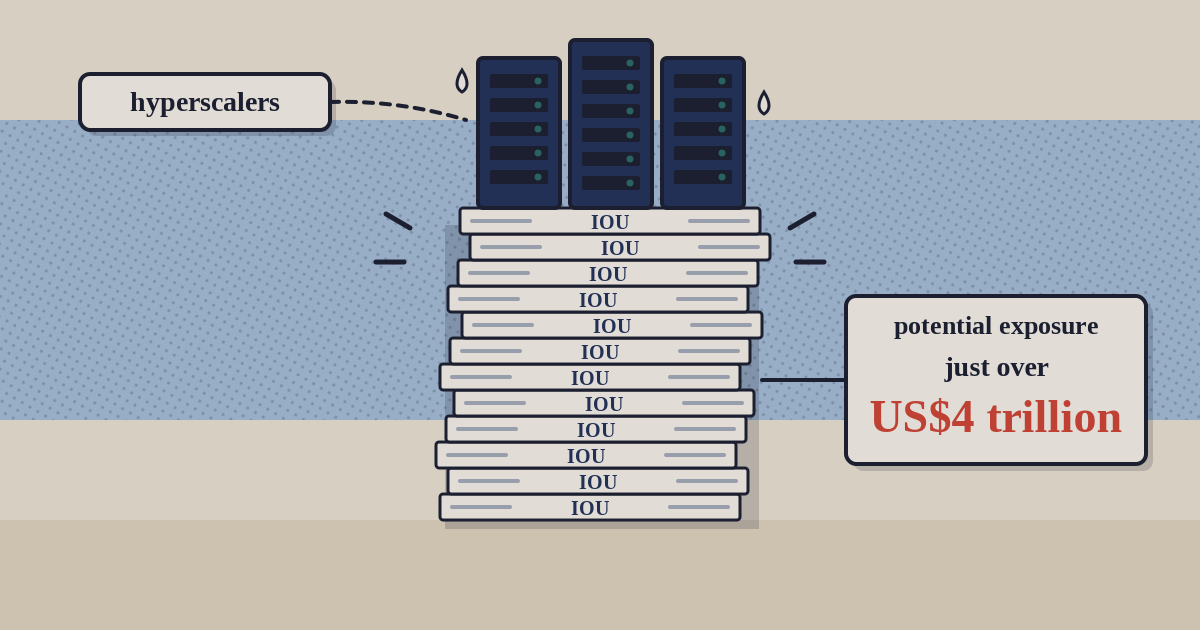
The Bank of England puts the total potential exposure of the hyperscalers, counting their debt and their off-balance-sheet contractual commitments, at “just over $4 trillion”, according to “internal Bank estimates” in the Financial Stability Report it published on 26 November.1 The estimate includes existing debt, leases, purchase commitments and contingent obligations such as guarantees and backstops. The hyperscalers, in the Bank’s definition, include Alphabet, Amazon, Microsoft, Meta, Oracle and SpaceX.1 Borrowing by hyperscalers, data-centre operators and other AI-infrastructure firms is “almost double its 2025 level”, and the hyperscalers’ bond issuance is set to exceed US$305bn in 2026, around 8% of all investment-grade bonds issued worldwide.12
Hyperscalers' potential exposure, at just over US$4 trillion, is the largest AI-financing figure in the Bank's report
AI-related financing figures in the Bank of England's Financial Stability Report, US$bn, as published 26 November 2026
Source: Bank of England, Financial Stability Report, November 2026 (with the Morgan Stanley, J.P. Morgan and BIS figures as the Bank cites them) · as of 26 November 2026 · Different measures from different sources; the Bank says the analysts' estimates are not directly comparable
01Where the money comes from
The Bank lists the sources: investment-grade bonds, leveraged finance and private credit, alongside public and private equity. Counting semiconductor companies and data-centre operators with the hyperscalers, total issuance in 2026 “exceeds that of many individual sovereigns, including the UK”. The pace has slowed since the first half of 2026, “though it remains high”.1 It cites Morgan Stanley analysts’ estimate that US$700bn of data-centre capital spending in 2026–28 would be financed by private credit, and J.P. Morgan analysts’ that US$1.4 trillion of AI capex could come from “alternative capital”, against a private credit market of around US$2.5 trillion.1 How the four largest spenders have paid so far is in our Trend on their borrowing and share sales.
02What the Bank says the risk is
The Bank also points to what sits outside the balance sheet. Firms across the AI supply chain rely on “leases, purchase agreements, backstops and guarantees” from a few hyperscalers and chip designers, which are “in some cases” at once investors, customers and suppliers: “circular financing”. Joint ventures and special purpose vehicles raise debt against the hyperscalers’ long-term contracts, and off-balance-sheet arrangements make the serviceability of future liabilities harder to assess.1 Amazon renting back 13 data centres it sold to Blackstone’s BXDC is one such lease. The commitments “could come under strain in a stress or if expectations around future AI revenues were revised down, particularly where the path to monetisation remains uncertain”.1
Markets have started to price some of it. The Nasdaq 100 is around 13% below its October peak; credit spreads have widened “particularly sharply” for some lower-quality AI-related borrowers; and some private credit funds are becoming more selective about AI and data-centre loans, some looking to “distribute or offload exposures”. AI-related companies still make up slightly over half of the S&P 500’s market value.1
03What the Bank is doing, and what to watch
The report sets no new requirement for lenders on AI. The Financial Policy Committee says it continues to monitor what banks lend to non-bank lenders and funds, and supports the Prudential Regulation Authority’s work on risk management at banks lending to hedge funds through prime brokerage, which has fuelled many of the leveraged positions in equity markets, AI shares among them.1 Private markets “have not been tested through a broad-based macroeconomic stress at their current size”, so the Bank is running a system-wide exercise to see how they would behave under stress. What to watch: its initial findings in early 2027 and the full report in the second quarter.1
Sources
Disclosure. TechBag is a software reseller: it earns when companies buy through it, including from vendors named here. The analysis is TechBag’s own; no vendor paid for or saw this piece before publication. Facts are labelled reported, TechBag count or our view. How the Journal works.
Keep reading