Markets & the AI economyAnalysis
Nvidia’s US$115.8bn quarter: US$518bn of commitments and a US$105bn guarantee for OpenAI
Nvidia’s results and CFO commentary for the quarter to 25 October: where US$115.8bn came from, US$390bn of supply commitments, guarantees of up to US$118bn, and the outlook.

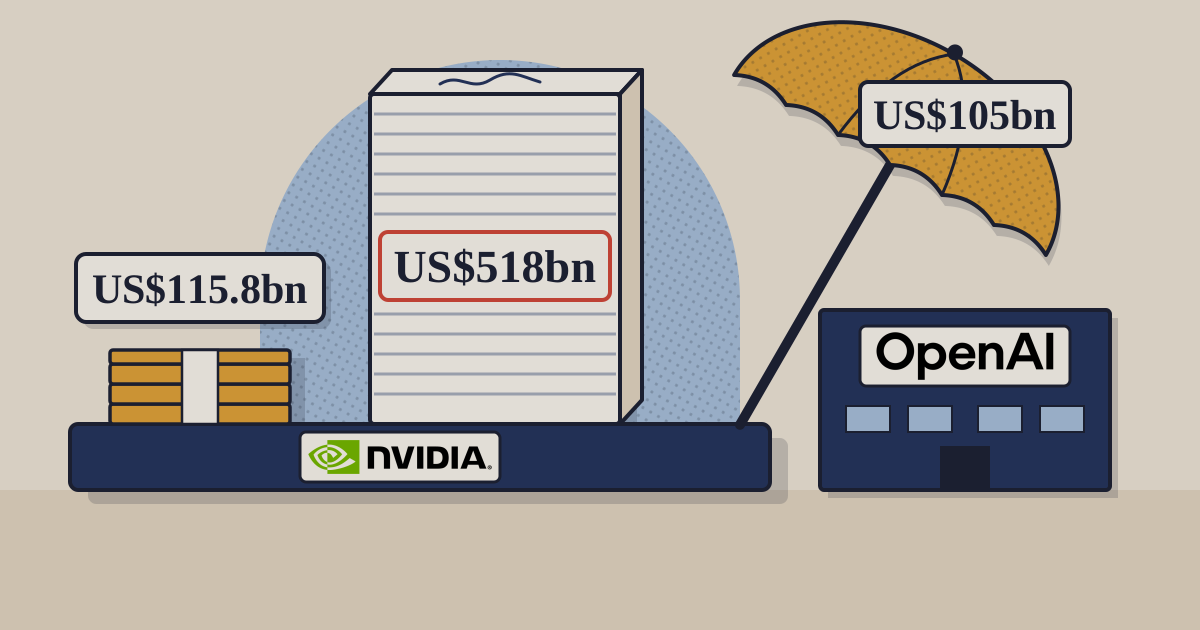
Nvidia’s results are usually read for one line, revenue against the guide. This quarter the CFO commentary filed with them carries a second story: how much Nvidia has promised to pay suppliers, landlords and cloud partners over the coming years, and what it has promised to cover if a customer cannot pay. For anyone trying to understand where the AI build-out’s money and risk sit, those tables say more than the headline number. We read the 8-K of 17 November and its three exhibits, the August quarterly report that defines each commitment, and the August filing on the Ohio guarantee.
01A US$115.8bn quarter, US$5.7bn above the top of the guide
Nvidia filed its results with the SEC at 4:20pm New York time on 17 November (2:50am IST on 18 November), after the US market closed.1 Revenue for the quarter ended 25 October was a record US$115.8bn, up 20% from the previous quarter and 103% from a year earlier. GAAP operating income was US$77.5bn and net income US$65.3bn, or US$2.70 a diluted share.2 In August Nvidia had guided revenue to US$108.0bn, plus or minus 2%, and gross margins to 74.0%, plus or minus half a point.5 It came in at 74.8% on a GAAP basis and 74.9% on Nvidia’s non-GAAP measure, above the guide, though slightly below the second quarter’s 75.0%, which Nvidia puts down to “the initial Rubin ramp”.3
Nvidia's quarterly revenue doubled in a year, to US$115.8bn
Quarterly revenue (US$bn) and growth on the same quarter a year earlier (%), fiscal quarters ended October 2025 to October 2026
- Revenue, US$bn
- Growth on a year earlier (%)
Show tableHide table
| Revenue, US$bn | Growth on a year earlier (%) | |
|---|---|---|
| Q3 FY26 | 57 | 62 |
| Q4 FY26 | 68.1 | 73 |
| Q1 FY27 | 81.6 | 85 |
| Q2 FY27 | 96.2 | 106 |
| Q3 FY27 | 115.8 | 103 |
Source: Nvidia CFO commentaries, 19 November 2025 to 17 November 2026 · as of 18 November 2026 · Nvidia's fiscal year ends in late January: Q3 FY27 is the quarter to 25 October 2026
The growth rate eased from 106% in the second quarter to 103%, on a far larger base. The fourth-quarter guide of US$130.0bn would be about 91% above the US$68.1bn of the same quarter last year, though this quarter has 14 weeks, not 13.310
02AI clouds and enterprises nearly tripled; hyperscalers still bought most
Data centre revenue was US$107.6bn, up 110%. Nvidia now splits it into two customer groups. Hyperscalers, the largest cloud companies, bought US$60.1bn, up 71%. “AI Clouds, Industrial, & Enterprise”, the group that includes the neoclouds renting out GPUs, bought US$47.5bn, up 195%. Nvidia credits both to “the introduction of our Rubin infrastructure, our fastest architecture ramp ever”, its new standalone Vera CPUs and continued Blackwell Ultra sales. Edge computing (PCs, workstations, cars, robots and other devices) was US$8.2bn, up 42%.39
Sales to AI clouds and enterprises nearly tripled in a year; hyperscalers rose 71%
Nvidia revenue by market platform, US$bn: quarter to October 2025 against quarter to October 2026
- Q3 FY26
- Q3 FY27
Show tableHide table
| Q3 FY26 | Q3 FY27 | Change | |
|---|---|---|---|
| Hyperscale | 35.1 | 60.1 | 71% |
| AI clouds, industrial, enterprise | 16.1 | 47.5 | 195% |
| Edge computing | 5.8 | 8.2 | 41% |
Source: Nvidia CFO commentary, 17 November 2026 · as of 18 November 2026 · Change labels use rounded billions; Nvidia moved one company from the second group to Hyperscale in August and recast earlier quarters
The buyers are few. Three direct customers accounted for 14%, 11% and 11% of revenue in the quarter, and two for 18% and 17% of what Nvidia is owed.4 The hyperscalers’ own spending on buildings and equipment is in our Trend on Big Tech’s capex.
China came back into the numbers. Nvidia shipped US$2.4bn of Hopper data centre products to China in the quarter, after none in the first quarter and less than 1% of data centre revenue in the second.395 By the location of customers’ headquarters, China including Hong Kong accounted for US$11.05bn of revenue, against US$2.97bn a year earlier. The fourth-quarter outlook assumes no data centre compute revenue from China.43
03US$390bn of supply, mostly memory, mostly due next year
Nvidia’s August quarterly report explains what the largest line is. Supply commitments “are for our data center infrastructure systems, primarily memory and manufacturing facilities, to produce our products for long-term demand across current and future product architectures.” Suppliers may “procure inventory based upon our defined criteria”.6
US$518bn
Nvidia's future commitments at 25 October, from US$366bn three months earlier
Supply and capacity US$390bn, data centre leases not yet begun US$74bn, cloud services US$28bn, equity investments US$20bn, capital spending US$6bn.
The supply line went from US$279bn to US$390bn in one quarter, “primarily related to the multi-year procurement of memory supply”.3 A year earlier it was US$50.3bn.14 The timing moved with it. US$203bn of the supply now falls due in fiscal 2028, the year to January 2028, against US$87bn for the same year in August’s table. Leases for data centres that have not yet started rose from US$25bn to US$74bn; they run up to 20 years, begin between now and fiscal 2033, and Nvidia “may assign some of these leases to third parties in the future”. In August a separate US$20bn of leases signed to be reassigned was listed on its own; November’s tables have no such line.35
Supply commitments grew 7.8 times in a year; quarterly revenue doubled
Nvidia's supply commitments at each quarter end and revenue for that quarter, US$bn, October 2025 to October 2026
- Supply commitments
- Quarterly revenue
US$
Show tableHide table
| Supply commitments | Quarterly revenue | |
|---|---|---|
| Oct 2025 | 50.3 | 57 |
| Jan 2026 | 95.2 | 68.1 |
| Apr 2026 | 119 | 81.6 |
| Jul 2026 | 279 | 96.2 |
| Oct 2026 | 390 | 115.8 |
Source: Nvidia CFO commentaries, 19 November 2025 to 17 November 2026 · as of 18 November 2026 · Nvidia called the line 'total supply-related commitments' until April 2026 and 'supply and capacity' from July
Inventory shows the same build. It rose from US$31.6bn to US$39.7bn in the quarter “to support our Rubin product ramp”, and raw materials within it went from US$3.8bn in January to US$15.8bn.34 Supply commitments of US$390bn are larger than the US$361.7bn of revenue Nvidia booked in its last four quarters together.21095 What memory makers’ prices did over the same year is in our Trend on DRAM prices and PC shipments.
04Up to US$105bn behind OpenAI's Ohio leases
The guarantees are a different kind of promise. A commitment is a payment Nvidia expects to make; a guarantee is one it makes only if someone else fails to pay. The CFO commentary describes “land, power, shell, and hardware financing arrangements, under which we may be required to make payments to third parties if certain of our partners default on their obligations”. Their maximum gross exposure at 25 October was US$118.0bn, up from US$108.5bn in August, with a new US$9.5bn line for “power and systems credit support guarantees”.35
Neoclouds and frontier labs are seeing extraordinary demand for AI infrastructure, yet many are growing faster than their balance sheets and long-term credit profiles can support.
Almost all of the exposure is one site. On 17 August Nvidia signed residual value guaranties with SB Energy for leases covering about 4.25 gigawatts of IT load at the PORTS-Pike Technology Campus in Pike County, Ohio, on the site of the decommissioned Portsmouth Gaseous Diffusion Plant. SB Energy builds, owns and operates the nine buildings; an OpenAI affiliate is the tenant on 20-year leases; and the site will host only Nvidia infrastructure, “subject to limited exceptions”. Nvidia also agreed to invest US$1.5bn in SB Energy.78
Nvidia pays only if OpenAI defaults, and OpenAI must pay Nvidia back
How the SB Energy guarantees work, from Nvidia's filings of 17 August, 26 August and 17 November 2026
- 01
A building is finished
The guarantees take effect phase by phase, each only when its building, one of nine, is ready for service. The first is expected in fiscal 2029. - 02
Exposure builds to US$105bn
It grows as each building comes online, to a cap of US$105bn, then falls over each 20-year lease as OpenAI pays rent. - 03
If OpenAI defaults
On insolvency or missed rent, Nvidia pays the gap between the lease’s guaranteed minimum value and what a new tenant or a sale recovers. - 04
OpenAI repays Nvidia
OpenAI agreed to reimburse Nvidia for any amount paid. A guarantee ends after its 20-year lease, or earlier if, among other events, OpenAI reaches a satisfactory credit rating.
Source: Nvidia Form 8-K of 17 August 2026; 10-Q of 26 August 2026; CFO commentary of 17 November 2026 · as of 18 November 2026
The August report sets the limits. The guarantees cover “defined portions of lease and power payments and not the full cost of the site or all of the tenant’s obligations”, and if one is triggered Nvidia may take over the lease, have the landlord relet the space, start a sale, let the lease end, or defer for up to a year.67 Nvidia holds an option to back about 3.8 more gigawatts. It estimated in August that each generation of its hardware at the site “could represent approximately 1.5 million NVIDIA GPUs, or approximately $150 billion to $200 billion in NVIDIA revenue”.5 “To date, we have not made any payments related to our guarantees,” the November commentary says.3
A further US$32bn of “neocloud agreements”, which Nvidia called AI cloud agreements until this quarter, sits in its own table. Under these, Nvidia’s August report says, “if AI clouds do not successfully sell committed capacity to third-party customers, we have agreed to purchase that capacity”; the November commentary adds that they take effect only once the neocloud has financed and deployed the hardware and Nvidia has accepted it.63 How one listed neocloud carries its debt is in our piece on CoreWeave’s quarter.
Sources
- NVIDIA Corporation, Form 8-K: results of operations (Item 2.02), filing index, accession 0001045810-26-000088 (accepted 21:20:51 UTC) — 17 November 2026
- NVIDIA: NVIDIA announces financial results for third quarter fiscal 2027 (Exhibit 99.1) — 17 November 2026
- NVIDIA: CFO commentary on third quarter fiscal 2027 results (Exhibit 99.2) — 17 November 2026
- NVIDIA: supplemental financial information for the quarter ended October 25, 2026 (Exhibit 99.3) — 17 November 2026
- NVIDIA: CFO commentary on second quarter fiscal 2027 results (Exhibit 99.2) — 26 August 2026
- NVIDIA Corporation, Form 10-Q for the quarter ended July 26, 2026 (Note 10, commitments and guarantees; risk factors) — 26 August 2026
- NVIDIA Corporation, Form 8-K: residual value guaranties with SB Energy (Items 1.01 and 2.03) — 17 August 2026
- NVIDIA and SB Energy: release on the PORTS-Pike Technology Campus (Exhibit 99.1) — 17 August 2026
- NVIDIA: CFO commentary on first quarter fiscal 2027 results (Exhibit 99.2) — 20 May 2026
- NVIDIA: CFO commentary on fourth quarter and fiscal 2026 results (Exhibit 99.2) — 25 February 2026
- NVIDIA Corporation, Form 8-K: departure and appointment of officers and directors (Item 5.02) — 12 November 2026
- Nasdaq: NVIDIA (NVDA) historical prices — 3 to 17 November 2026
- Nasdaq: NVIDIA (NVDA) after-hours and pre-market trading — 17 and 18 November 2026
- NVIDIA: CFO commentary on third quarter fiscal 2026 results (Exhibit 99.2) — 19 November 2025
Disclosure. TechBag is a software reseller: it earns when companies buy through it, including from vendors named here. The analysis is TechBag’s own; no vendor paid for or saw this piece before publication. Facts are labelled reported, TechBag count or our view.
Keep reading