SaaS & business softwareAnalysis
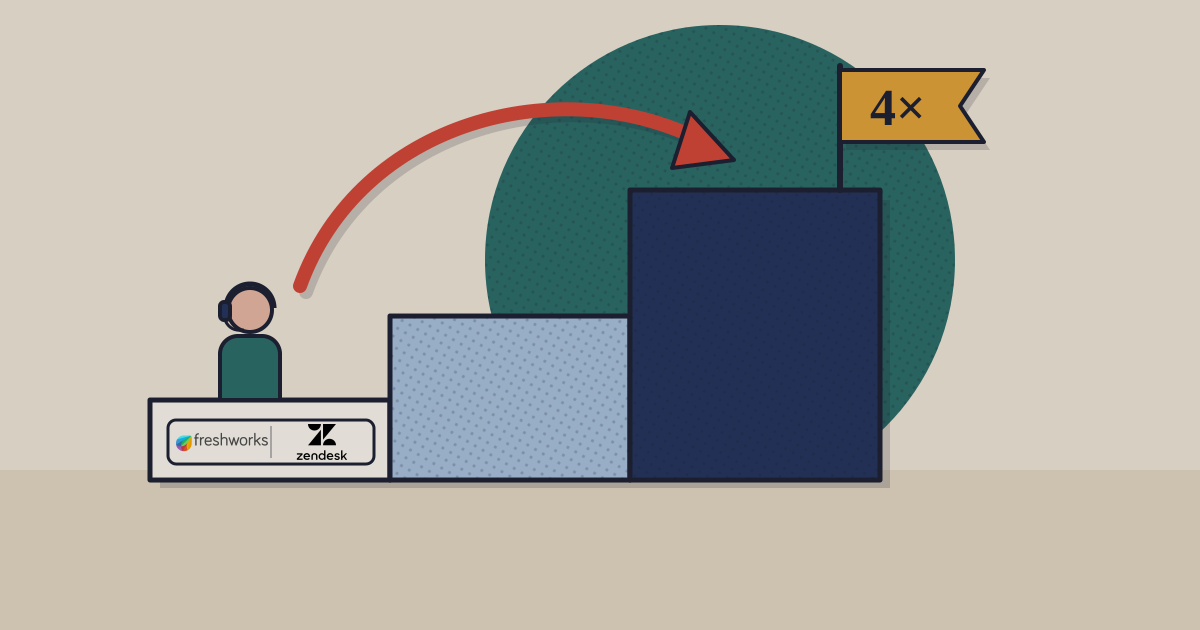
Helpdesks start at US$19 an agent; the next tier up costs 2.2× to 4× that
Six helpdesks’ own pricing pages read tier by tier: entry seats, free plans, AI meters, and what five agents cost in INR with GST, as of September 2026.

The question a small business asked in 2023 was whether a helpdesk was worth having at all. In 2026 that is settled; in our experience a shared Gmail inbox breaks somewhere around the third support agent. The question now is which tier to buy, whether a free plan will do, and what the AI on the pricing page will add to the bill. We read six helpdesks’ own pricing pages, tier by tier, to answer it.
01The basics are cheap; routing and SLAs are the upgrade
The 2023 post grouped the benefits under three headings: efficiency, customer satisfaction and simpler communication. Each maps to a feature you can find on a pricing page. Efficiency is the shared inbox that turns every email into a ticket with an owner, plus reply templates. Satisfaction is the ticket history, so a customer is not asked for the order number twice, and a knowledge base that answers the common questions before they arrive. Simpler communication is internal notes and threads on the ticket instead of a forwarded email chain. None of these is a premium feature any more.
Freshdesk’s Growth plan at US$19 an agent a month, billed annually, lists ticketing and a shared inbox, a customer portal and knowledge base, out-of-the-box reports, and threads and tasks. Its Pro plan at US$55 adds intelligent routing, multiple SLA policies, custom dashboards and a multilingual helpdesk.1 Zendesk draws the same line at the same prices: Support Team at US$19 has email ticketing, routing, prebuilt dashboards, pre-written responses and customer context; Suite Team at US$55 adds messaging and live chat, telephony, a knowledge base and AI agents.2
Entry seats cluster at US$19 to US$25; the next tier up costs 2.2× to 4× that
List price, US$ per agent per month, annual billing, first paid tier against the second, 2026
- First paid tier
- Second paid tier
Table view
| First paid tier | Second paid tier | Change | |
|---|---|---|---|
| Freshdesk | 19 | 55 | 189% |
| Zendesk | 19 | 55 | 189% |
| Hiver | 25 | 55 | 120% |
| Salesforce Service Cloud | 25 | 100 | 300% |
Source: Freshdesk, Zendesk, Hiver and Salesforce Service Cloud pricing pages · as of September 2026 · third paid tiers: Freshdesk US$89, Zendesk US$115, Hiver US$85, Salesforce US$175; Salesforce also prints Unlimited at US$350 and Agentforce 1 Service at US$550; Zendesk Enterprise is quote-only
HubSpot Service Hub follows the pattern with a steeper step: Starter gets “simple automation”, Professional at US$90 a seat on an annual commitment gets advanced automation, and Professional carries a one-time US$1,500 onboarding fee.3 Zoho Desk is the one helpdesk that prints rupees: Express ₹420, Standard ₹800, Professional ₹1,400 and Enterprise ₹2,400 an agent a month, billed annually.4
Two smaller lines on the same pages matter more to a small business than the tier names. Freshdesk sells day passes for occasional agents, US$2 a day on Growth, US$7 on Pro and US$12 on Enterprise, so the finance person who answers billing tickets at month-end does not need a full seat.1 Zoho Desk sells light agents at ₹345 a month for the same job.4 A team with three full-time agents and four part-timers should price both ways before choosing a tier.
02Three of six let a small team start at zero
The cheapest helpdesk is the one you do not pay for. Hiver has a free plan with unlimited users covering email, live chat, a knowledge base and shared inboxes.5 Zoho Desk’s free edition carries three user licences; HubSpot’s free tools cover two users.43 Freshdesk and Zendesk offer 14-day trials of a higher plan and no free tier on their pricing pages; Salesforce offers Service Cloud free for 30 days.126
Half the helpdesks we read have a permanent free plan; the other half are trial-only
Free plan or trial as published on each pricing page, 2026
Trial only
- Freshdesk: 14 days, on the Enterprise plan
- Zendesk: 14 days, on Suite Professional
- Salesforce Service Cloud: 30 days
Free plan, no end date
- Hiver: unlimited users, email, chat and knowledge base
- Zoho Desk: three user licences
- HubSpot Service Hub: up to two users
Source: Hiver, Zoho Desk, HubSpot, Freshdesk, Zendesk and Salesforce pricing pages · as of September 2026
A free plan is a sales tool, not charity: it is how a vendor gets the inbox before the company has a budget. The trial-only vendors make the opposite bet: that a team which has used the Enterprise or Suite Professional feature set for two weeks will not settle for the entry tier. Both are reasonable; both are designed to move you up a tier. Zendesk also runs a startups programme that gives early-stage companies a six-month trial of its Suite for up to 50 agents, which is worth asking about if you qualify.2 That is fine as long as the upgrade path is one you would choose anyway. Check two things before you load a year of tickets into one: whether exports are complete, and what the first paid tier costs for your real agent count.
03AI is billed on a meter of its own
The 2023 post promised automation in general terms. The 2026 pricing pages put a number on it, and the number is separate from the seat. Freshdesk includes the first 500 sessions of its Freddy AI Agent on every paid plan, once per account, then charges US$49 for each further 100 sessions; its Copilot for human agents is US$29 an agent a month on Pro and Enterprise.1 Zendesk bills AI agents by “automated resolutions”, a request resolved without escalation to a person, and sells Copilot as an add-on at US$50 an agent a month.2
The AI line is priced per conversation or per agent, on top of the seat
Published AI add-on prices, US$, annual billing, 2026
US$49
Per 100 Freddy AI Agent sessions after the first 500
Freshdesk
US$29
Freddy AI Copilot, per agent per month
Freshdesk
US$50
Zendesk Copilot add-on, per agent per month
Zendesk
Source: Freshdesk and Zendesk pricing pages · as of September 2026
The incentive is plain. Seats stop growing once the AI answers the easy tickets, so vendors are moving revenue to the thing that replaces the seat. A buyer should ask for the per-resolution or per-session price in writing and set a monthly cap before switching an AI agent on.
Test it the cheap way first. Freshdesk’s 500 included sessions are enough to run its AI agent against a month of real questions on a small team. Measure two things: the share of conversations it closes without a person, and the share it closes wrongly, which you find only by reading a sample. A resolution the customer reopens is not a resolution, and on a per-resolution meter you may pay for it anyway. Ask how the vendor counts a reopened conversation before you sign.
Sources
- Freshworks, Freshdesk pricing (archived copy) — 23 September 2026
- Zendesk, pricing (archived copy) — 25 September 2026
- HubSpot, Service Hub pricing — September 2026
- Zoho, Zoho Desk pricing; TechBag Zoho Desk intel page — September 2026
- Hiver, pricing (archived copy) — 5 May 2026
- Salesforce, Service Cloud pricing (archived copy) — 7 May 2026
- India Briefing, GST on online information and database access services — updated 29 September 2023
- Freshworks support, Where are your data servers located? — undated page
- Freshworks support, Data processing for AI-powered suggestions — undated page
- Zoho, Know your datacenter — undated page
- HubSpot, Data center locations — undated page
- DPDP Rules 2025, commencement timeline — notified 13 November 2025
- Digital Personal Data Protection Act, 2023, Schedule (penalties) — 11 August 2023
- CERT-In, Directions under section 70B(6) of the IT Act — 28 April 2022
Related on TechBag: the Freshdesk page and the Zoho Desk page cover the two helpdesks we quote most often in INR; the ITSM and service desk guide covers the internal IT helpdesk, a different purchase.
Disclosure. TechBag is a software reseller: it earns a margin when a reader buys through it, including from vendors named here. The analysis is TechBag’s own; no vendor paid for or saw this piece before publication. Facts are labelled reported, TechBag count or our view.
Keep reading