SaaS & business softwareAnalysis
Zoho Books charges 6.7× for Amazon sync: what an Indian seller's ERP must do
E-invoicing thresholds, marketplace TCS and TDS, and the published INR price ladders of Zoho Books and TallyPrime, as of September 2026.

The 2023 version of this post asked which ERP an e-commerce business should choose, and listed six products with a paragraph each. The buyer it was written for is usually a seller on Amazon, Flipkart or its own Shopify store, with one to ten people touching the books, a chartered accountant outside, and stock in one or two places. That buyer is deciding something narrower than “ERP”: which system will turn orders, returns and marketplace payouts into GST-correct books without a person retyping them every week. This piece answers that question with the rules that define the work and the prices the two Indian defaults publish.
01E-invoicing came down a hundredfold in three years
The first job of any system an Indian business keeps its books in is now e-invoicing. A business whose aggregate turnover crosses the threshold must register every B2B invoice on the government’s Invoice Registration Portal and print the reference number it returns. The threshold began at ₹500 crore on 1 October 2020 and was cut five times; Notification 10/2023 took it to ₹5 crore from 1 August 2023.56
E-invoicing now reaches every B2B seller above ₹5 crore, a hundredth of where it started
Aggregate-turnover threshold for mandatory B2B e-invoicing, ₹ crore, by date in force, October 2020 to August 2023
₹ crore of aggregate turnover
Table view
| Threshold | |
|---|---|
| Oct 2020 | 500 |
| Jan 2021 | 100 |
| Apr 2021 | 50 |
| Apr 2022 | 20 |
| Oct 2022 | 10 |
| Aug 2023 | 5 |
Source: CBIC notifications 61/2020, 88/2020, 5/2021, 1/2022, 17/2022 and 10/2023 (Central Tax), via Zoho Books knowledge base and TaxGuru · as of 30 September 2026
Two things follow for the choice. A seller that sells mostly to consumers is not caught by the B2B rule, so e-invoicing is not by itself a reason to pay for more software. A seller with business customers above ₹5 crore needs the invoice to go to the portal from the system where it was raised. Zoho Books includes e-invoicing from its Standard plan;1 TallyPrime does it through the connected services that come with its annual Tally Software Services renewal.3
In a demo, ask to see three things rather than a slide about compliance: an invoice raised and registered on the portal from the same screen, a credit note against a registered invoice, and what the system does when the portal is slow or down. The third is where desktop and cloud products differ most, and the one a seller discovers on the last day of the month.
02A marketplace payout is three numbers, not one
When a marketplace pays a seller, the amount that lands in the bank is the sale less commission and fees, less two statutory deductions. The operator collects GST tax at source on the net taxable value of supplies made through it; the rate fell from 1% to 0.5% from 10 July 2024.7 It also deducts income tax at source on the gross amount under section 194-O; that rate fell from 1% to 0.1% from 1 October 2024.8
Statutory deductions on a marketplace payout fell by 70% in 2024, but both still have to be reconciled
GST TCS and income-tax TDS deducted on ₹1,00,000 of marketplace sales, ₹, before and after the 2024 rate cuts
- Before the 2024 cuts
- From October 2024
Table view
| Before the 2024 cuts | From October 2024 | Change | |
|---|---|---|---|
| GST TCS | 1,000 | 500 | -50% |
| Income-tax TDS | 1,000 | 100 | -90% |
Source: Notification 15/2024 (Central Tax), 10 July 2024; Finance (No. 2) Act 2024, section 194-O, from 1 October 2024; TechBag calculation · as of 30 September 2026 · Assumes the full ₹1,00,000 is net taxable value for TCS and the gross amount for TDS
Smaller deductions did not make the work smaller. The TCS is a credit the seller claims in its GST cash ledger once the operator files it; the TDS is a credit against income tax once it appears in Form 26AS. Commission and shipping fees carry GST of their own, which is input tax credit. Returns reverse part of all of it. A system that records the payout as one bank receipt leaves your accountant to rebuild those lines by hand at quarter end. The feature to test in any demo is a settlement-report import that splits a payout into sale, fee, tax and deduction.
Marketplaces pay on their own cycles, and a single payout can cover orders from several weeks, cancelled orders and returns from earlier months. Ask the vendor to load one real settlement file from your seller account during the trial, not a sample file from its own library, and check that the TCS and TDS figures it books agree with what the operator reports for the same period.
03The price ladder: where marketplace sync starts
Both Indian defaults publish INR prices. Zoho Books charges per organisation per month: Standard ₹749 with three users, Professional ₹1,499 with five, Premium ₹2,999 with ten, Elite ₹4,999 with fifteen, billed annually and before GST. Connecting Amazon and up to two Shopify stores is listed from Elite.1 TallyPrime sells Silver (one user) at ₹22,500 and Gold (multi-user) at ₹67,500 as perpetual licences, or rents them at ₹8,100 and ₹24,300 a year.2 Its price page lists Cloud Access and WhatsApp as separate purchases and no marketplace connector.2
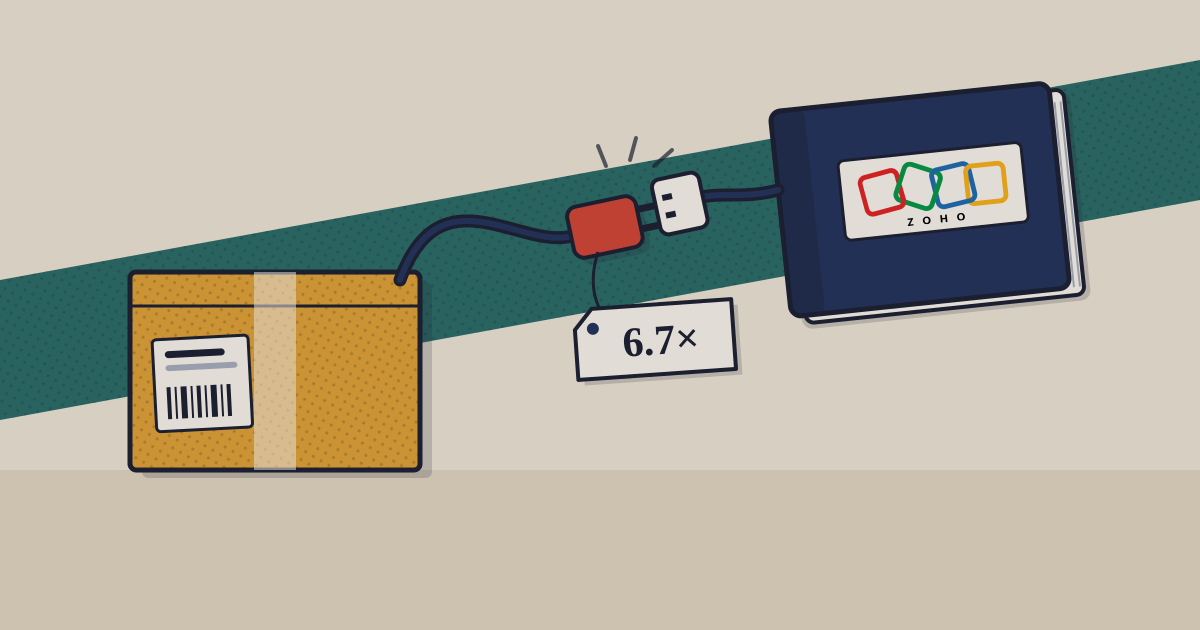
In Zoho Books, the first plan that syncs Amazon and Shopify costs 6.7 times the entry plan
Published annual cost before 18% GST, ₹, Zoho Books (billed annually) and TallyPrime (12-month rental)
Source: Zoho Books India pricing page; Tally Solutions buy page; TechBag Zoho Books and TallyPrime pages · as of 30 September 2026
In fairness to Zoho, Elite is not only a connector: it adds ten users over Premium and the rest of the higher tier’s features.1 And at the bottom of the ladder, Zoho Books has a free plan for businesses under ₹25 lakh turnover, which a new seller should use before paying for anything.4 But a three-person seller who needs only the marketplace import pays for twelve unused seats to get it. On the Tally side, the sync is a third-party add-on or a manual spreadsheet import, and the cost of either belongs in the comparison.
Tally’s own two models are worth a line of arithmetic. A Silver licence at ₹22,500 costs as much as two years and nine months of the ₹8,100 rental, and Gold at ₹67,500 against ₹24,300 a year breaks even at the same point.2 A business that expects to run TallyPrime for more than three years should buy the licence, and then budget for the annual services renewal that keeps e-invoicing and connected features working.3
04When an accounting package stops being enough
The 2023 list put Vyapar and myBillBook beside NetSuite and SAP Business One. They solve different problems. TechBag’s own TallyPrime assessment places Vyapar and myBillBook as mobile-first billing for the smallest shops and SAP Business One and Microsoft Dynamics 365 for firms that have outgrown SMB tools.3 The line between the two groups is operational, not a revenue figure.
The move to a full ERP is triggered by entities, warehouses and production, not by turnover
Conditions for staying on an accounting package versus moving to a full ERP, TechBag assessment, September 2026
Stay on Zoho Books or TallyPrime
- One legal entity and one or two GSTINs
- Stock in one or two locations, tracked by item
- Marketplace and store orders imported daily
- An outside CA who already works in the tool
Move to SAP Business One, Dynamics 365 or NetSuite
- Several entities with intercompany billing and consolidation
- Warehouses with bins, batches and pick-pack-ship
- Manufacturing beyond a simple bill of materials
- Approval workflows an auditor expects to see enforced
Source: TechBag TallyPrime and Zoho Books intel pages; our view · as of 30 September 2026
The larger ERPs are quoted, not listed, so we do not chart them. Odoo, which the 2023 post also named, publishes per-user pricing that we did not re-check for this rewrite. The practical advice holds: ask for an implementation estimate in writing, because for this tier the partner’s days usually cost more than the first year’s licence.
Whichever tier you are in, four tests in the trial separate a system that fits an online business from one that only claims to:
- Import a real settlement file and reconcile it to the bank receipt to the rupee, fees and deductions included.
- Process a return that arrives after the payout, and see the credit note, the stock and the TCS all reverse.
- Hand the books to your CA for a mock quarter close, and ask how long the GST return took compared with now.
- Add a second sales channel, a store or another marketplace, and check that stock is shared rather than duplicated.
Sources
- Zoho Books, India pricing (Standard to Ultimate; Elite lists Amazon, Etsy and two Shopify stores) — undated page Standard and Professional match TechBag's 30 September 2026 record.
- Tally Solutions, Buy TallyPrime (Silver and Gold, rental and perpetual) — undated page
- TechBag, TallyPrime intel page (competitor lanes; TSS and connected services) — as committed 30 September 2026
- TechBag, Zoho Books intel page — as committed 30 September 2026
- Zoho Books knowledge base, When and how was e-invoicing introduced in India? — undated page
- TaxGuru, Notification 10/2023 (Central Tax): e-invoicing threshold reduced to ₹5 crore — 10 May 2023
- Taxmann, ECOs to collect 0.5% TCS on net value of taxable supplies (Notification 15/2024, Central Tax) — 10 July 2024
- TaxGuru, Section 194-O amendment: lower TDS rate on e-commerce payments — effective 1 October 2024
- DPDP Rules 2025, commencement timeline — notified 13 November 2025
Related on TechBag: the TallyPrime page and the Zoho Books page compare the two defaults line by line, with editions and plans quoted in INR.
Disclosure. TechBag is a software reseller: it earns a margin when a reader buys through it, including from vendors named here. The analysis is TechBag’s own; no vendor paid for or saw this piece before publication. Facts are labelled reported, TechBag count or our view.
Keep reading