Data centres lost 40 of 41 local ballots; KOSPI fell 5.28%
What 41 local measures in 10 US states decided on 3 November, by Ballotpedia’s count, and how Seoul’s chip-heavy KOSPI read the result on 5 November.

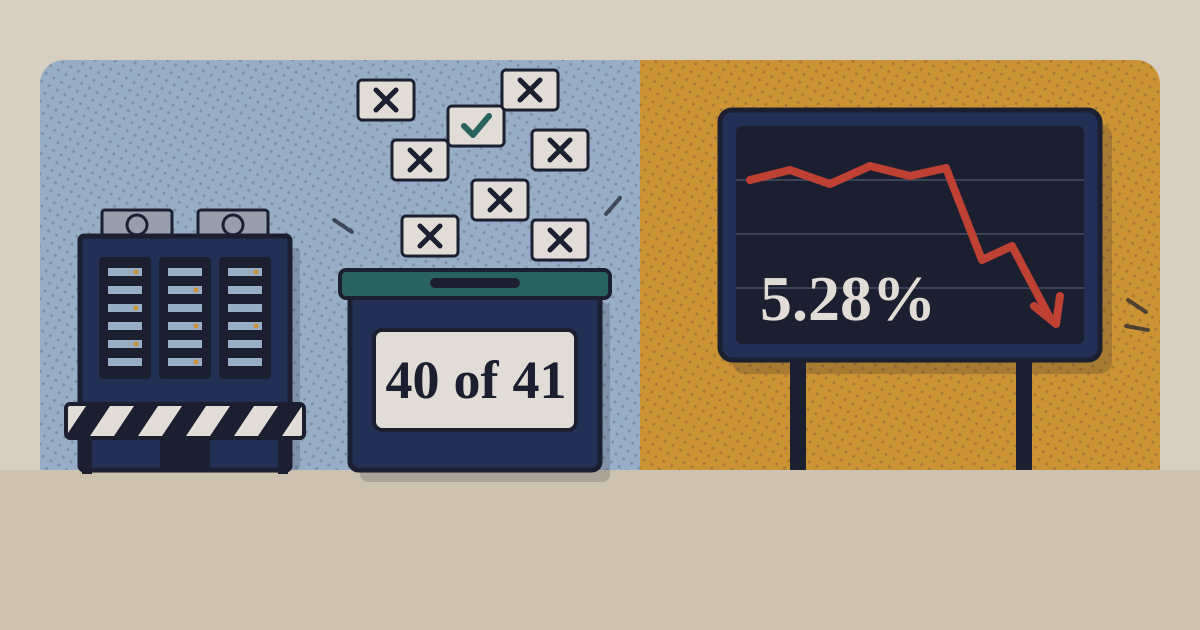
On 3 November, voters in 10 US states decided 41 local ballot measures about data centres. In 40 of them the majority chose greater limits on building them, either by approving a restriction or by rejecting a measure that would have helped a project along. The one exception was Harwood, North Dakota, where voters turned down an extra review of industrial projects, data centres included. That is Ballotpedia’s count and its classification.1 Two days later in Seoul, the KOSPI index closed 5.28% lower at 5,383.80, with SK hynix down 9.46% and Samsung Electronics down 7.57%.34
−5.28%
KOSPI, to 5,383.80, on 5 November
Korea Times; JoongAng Daily
−9.46%
SK hynix, to ₩1,264,000
Korea Times; JoongAng Daily
−7.57%
Samsung Electronics, to ₩201,500
Korea Times; JoongAng Daily
₩3.43trn
net selling of KOSPI shares by foreign investors
JoongAng Daily
01What the 41 measures decided
Ohio voted on 21 of the 41 measures; only North Dakota's one went the builders' way
Local data-centre ballot measures decided on 3 November 2026, by state, number of measures
Source: Ballotpedia, Data center-related ballot measures, 2026 · as of 4 November 2026 · Harwood, North Dakota, is the one outcome Ballotpedia counts as favouring development
These were town, city, township and county votes, each binding or advising only its own government. Most were blunt. Alhambra, California, banned data centres in the city with 82% of the vote; Ottawa, Kansas, and four places in Ohio banned any using more than 25 megawatts; North Berwick, Maine, banned those of 25,000 square feet or more. Grove City, Ohio, now needs a public vote before any development of 50 contiguous acres, more than 20 megawatts of peak demand or more than 500,000 gallons of water a day; it passed with 55%. Perry, Ohio, requires hyperscale developers seeking special tax incentives to provide financial guarantees (87%).1
Counts differ by what is counted. The 41 are the 3 November ballot, the figure CNBC reported.2 Ballotpedia’s whole-year tally is 50 measures in 13 states, 47 decided by 4 November, 46 of them for greater limits.1
02How Seoul read it
The Korea Times attributed the fall to concerns that tighter US regulation of AI and data-centre development, after the midterm results, could slow AI infrastructure spending. Samsung and SK hynix make up roughly half of the KOSPI’s market value, it noted, which leaves the index exposed to chip sentiment; overnight in New York, Micron had fallen 7% and Nvidia 3.17%.3 Foreign investors sold a net ₩3.43 trillion of KOSPI shares while individuals bought ₩2.28 trillion; the KOSDAQ fell 5.11%.4
Two Seoul analysts read it differently. Han Ji-young of Kiwoom Securities said the hit to chipmakers should be limited, because projects already under way are unlikely to face major delays and nationwide restrictions would be hard to put in place.3 Kim Dae-jun of Korea Investment & Securities linked the fall to “concerns over tighter AI regulations” alongside supply-and-demand uncertainty before Anthropic’s listing.4
03What to watch
Three measures are still to come. On 1 December, Clarksville, Arkansas, votes on whether to keep two ordinances authorising up to US$50bn and US$5bn of taxable industrial development bonds for data-centre projects, each with a payment in lieu of taxes. On 15 December, Mandan, North Dakota, votes on banning data centres of 25 megawatts or more.1 In Seoul, the test of Han’s reading is whether projects already under way keep their schedules; the spending those projects represent is tracked quarter by quarter in our Big Tech capex Trend.
Sources
- Ballotpedia, Data center-related ballot measures, 2026 — as of 4 November 2026
- CNBC, Voters rebuff data centers in every ballot measure except one during the 2026 midterms (MacKenzie Sigalos) — 4 November 2026
- The Korea Times, KOSPI tumbles as Democrat sweep fuels AI infrastructure concerns (Park Han-sol) — 5 November 2026
- Korea JoongAng Daily, Kospi sinks below the waves as U.S. 'Blue tsunami' soaks Korean tech shares (Park Yu-mi) — 5 November 2026
Disclosure. TechBag is a software reseller: it earns a margin when a reader buys through it, including from vendors named here. The analysis is TechBag’s own; no vendor paid for or saw this piece before publication. Facts are labelled reported, TechBag count or our view.
Keep reading