AI agents booked 4 Uber rides and about 500 orders in a week of 320 million trips
What Uber’s finance chief said on its 4 November call, checked against its filed trip count, with what DoorDash and Shopify said: how small buying through an AI agent still is.

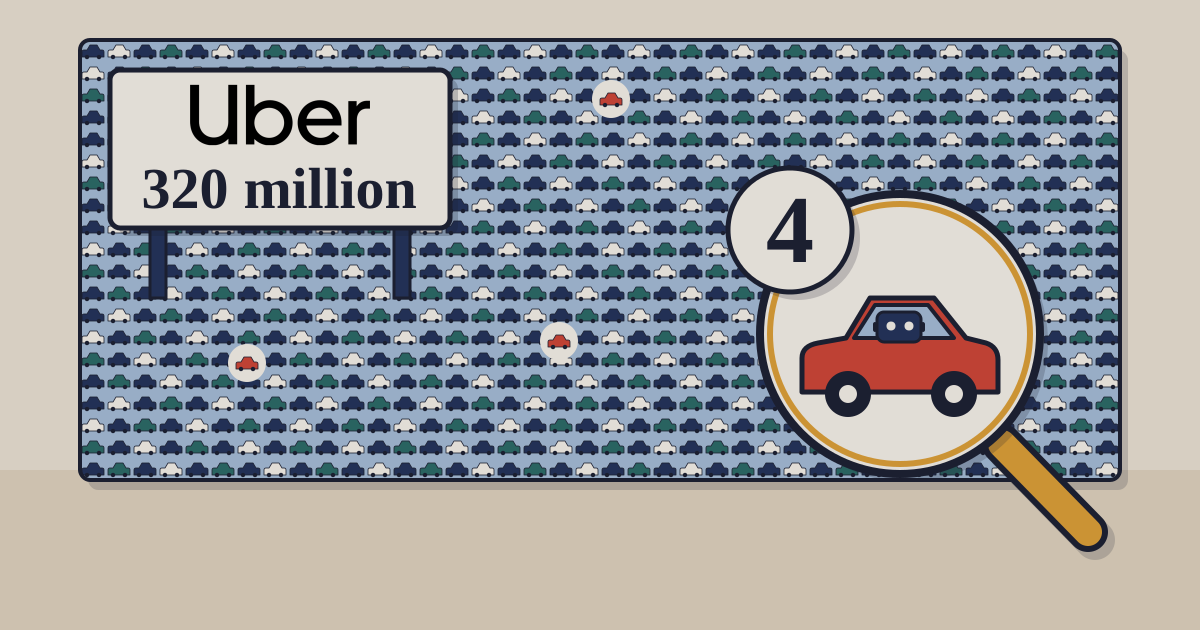
In the week of Halloween, one of its largest, Uber handled about 320 million trips and orders. AI agents placed about 500 of them on Uber Eats and four on its ride service. “The volumes coming from AI agents for Uber Eats were around 500. 500 orders total. And for our Rides business, it was a grand total of 4 trips that we have fulfilled from agents,” the chief financial officer, Balaji Krishnamurthy, said on the results call on 4 November.1
1 in 635,000
of Uber’s trips and orders that week came from an AI agent
About 504 bookings out of about 320 million, as reported on Uber’s 4 November results call.
01What the count covers
The figure was spoken, in answer to an analyst’s question at the end of the call. Neither Uber’s results release nor its 10-Q gives an agent count.27 The week’s total was Krishnamurthy’s own rounding, “just around 320 million trips on Uber and Uber Eats”, and it fits the filed numbers: Uber reported 4,061 million trips for July to September, up 16%, a trip being one completed ride or delivery order.2
Three things Uber did not say. It did not define “AI agents”; the figures followed the chief executive’s answer on third-party assistants. It did not say whether its own in-app assistant is counted. And it did not split the week between rides and orders, so the four rides cannot be set against rides alone.1
02Why Uber says the number is this small
Dara Khosrowshahi, the chief executive, made the case from his own app. A ride takes 50 seconds to book on average, 75% of rides are booked in a single tap, and the median time to reorder a favourite meal is 90 seconds. In his telling, an agent has little friction to remove. Uber is also building its own: baskets built with its cart assistant are, on early signs, “roughly twice” the average. And it would rather not rely on someone else’s front door: “I used to work in the travel business, and we were dependent on the Googles of the world. I do not wanna go back there.”1
The channel is also not fully open. “Every single AI system company is talking to us, and we are really now negotiating the terms of trade,” he said, counting eight assistants and expecting more than ten. He expects third-party agents to be “a net positive in terms of demand”, and called today’s traction “very, very early and very limited”.1
03One platform is not the market
Two delivery platforms count AI agents in hundreds of orders; Shopify gives only a growth rate
What each company said about orders from AI agents or AI channels on its July–September 2026 results call
4
Uber rides booked by AI agents, in the week of Halloween
Uber, 4 Nov
~500
Uber Eats orders from AI agents, the same week
Uber, 4 Nov
Hundreds
DoorDash orders from third-party agents, in total since they began
DoorDash, 29 Oct
3.3×
Shopify orders from AI channels, against a year earlier; no base given
Shopify, 3 Nov
Source: Uber, DoorDash and Shopify results calls (transcripts) · as of 4 November 2026 · Periods and definitions differ: not to be added or ranked
DoorDash, which handled 993 million orders in July–September, told investors on 29 October: “we’re seeing maybe several hundred orders in total from some of these third-party agents”, and later said that was “across the time that they’ve been up and running”.34 That is a running total, where Uber’s is one week. Its chief executive, Tony Xu, said “a task that’s as simple as ordering food, we tend to see that come directly to DoorDash”, and that agents may do more with “long consideration purchases”.3
Shopify, which runs online shops for merchants of every kind, reports something different. “Volume again is small,” its president, Harley Finkelstein, said on 3 November, but traffic from AI channels was 2.6 times a year earlier and orders 3.3 times, and 74% of AI-attributed purchases fell outside its hundred largest product categories.5 He gave no share of total orders, so the growth has no base we can size.
Sources
- The Motley Fool, Uber (UBER) Q3 2026 earnings call transcript (Dara Khosrowshahi, Balaji Krishnamurthy) — 4 November 2026
- Uber Technologies, Q3 2026 results release (8-K, Exhibit 99.1): Trips and their definition — 4 November 2026
- The Motley Fool, DoorDash (DASH) Q3 2026 earnings call transcript (Tony Xu) — 29 October 2026
- DoorDash, Q3 2026 results release (8-K, Exhibit 99.1): Total Orders — 29 October 2026
- Earnings Whispers, Shopify (SHOP) Q3 2026 earnings call transcript (Harley Finkelstein) — 3 November 2026
- TechCrunch, Almost no one uses AI agents to book their Uber, company says — 4 November 2026
- Uber Technologies, quarterly report on Form 10-Q, quarter to 30 September 2026 — 4 November 2026
Disclosure. TechBag is a software reseller: it earns a margin when a reader buys through it, including from vendors named here. The analysis is TechBag’s own; no vendor paid for or saw this piece before publication. Facts are labelled reported, TechBag count or our view.
Keep reading