Cloud & DevOpsAnalysis
FCC licenses SpaceX’s Starmind: up to 1 million orbital data-centre satellites
The FCC Space Bureau’s order of 25 November: radio for backup only, 100,000 satellites due by November 2035, the surety bond waived, and three petitions to deny turned down.

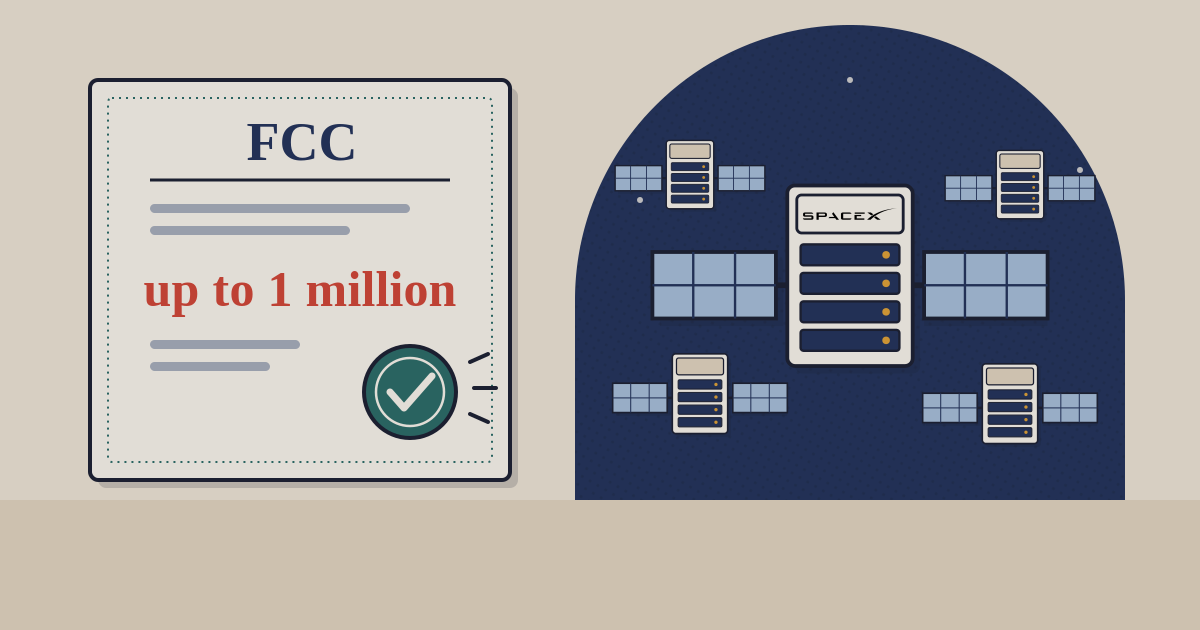
A million satellites is about 88 times the number of working satellites the European Space Agency estimates are in orbit today, and on 25 November a US regulator said yes to it. The order is short, 14 pages, and much of what it decides turns on what it says the FCC does not regulate.110 This piece reads it in full, together with SpaceX’s filings and the petitions against it, to answer four questions: what exactly was licensed, what the deadlines and the waived bond mean, how the number compares with what is in orbit, and what each objector argued and how the Bureau answered.
01What the FCC licensed: radio for emergencies, and an orbit plan
The grant authorises Space Exploration Holdings, SpaceX’s licensing company, to deploy and operate a non-geostationary “constellation of 1,000,000 satellites” in orbital shells “each spanning 50 km at altitudes from 500 to 1,002 km”, at 30-degree and sun-synchronous inclinations, under call sign S00798. It lists six nominal shells, from 550–568 km at 26–32 degrees up to 967–1,002 km at 99.4 degrees.1 That is narrower than the application of 30 January, which asked for 500 to 2,000 km; the six shells come from a letter SpaceX filed on 29 May at the Bureau’s request.25
What the FCC actually licenses is radio. The scope of the grant is “backup and emergency telemetry, tracking, & command” in two Ka-band slices, 18.8–19.3 GHz down and 28.6–29.1 GHz up, on “an unprotected and non-interference basis”. Normal traffic will run over optical links to SpaceX’s Starlink satellites. SpaceX told the FCC the radios are “cold backup only” and that “the nominal number of space stations transmitting via radiofrequency at any one time is zero”.15 Because the FCC is still asking, in a pending rulemaking, whether such standalone control links fit the fixed-satellite service, the Bureau waived the US frequency table “on our own motion” rather than decide that question itself.1
One million satellites, six shells, radio only as a backup
Key terms of the Starmind grant, FCC DA 26-1273, adopted and released 25 November 2026
1,000,000
satellites authorised, operating as data centres in low-Earth orbit
500–1,002 km
altitude range of the licensed shells (asked for: 500–2,000 km)
15 years
licence term, starting when the first satellite is certified in orbit
US$0
surety bond: the requirement is waived
Source: FCC Space Bureau, DA 26-1273, grant and conditions 1, 10 and 11 · as of 25 November 2026
What an orbital data centre is for appears in SpaceX’s filings only in outline. The technical attachment says the shells were chosen “to maximize the time during which these satellites can generate solar power and to meet the rapidly evolving global AI compute needs”; the waiver requests promise “energy efficient AI compute for consumers, enterprises, and government users around the world”; and the narrative, as the FCC’s notice quotes it, calls the system a “first step towards becoming a Kardashev II-level civilization”, one that harnesses the sun’s full power.234 Data would reach the ground through Starlink’s “high capacity (petabit)” laser mesh. The filings we read give no figures for computing power, cooling design or latency.2
02The deadlines that replace the bond
Two FCC rules exist to stop a company holding orbit and spectrum it never uses, which the FCC calls warehousing. Under the milestone rule, section 25.164, a non-geostationary licensee must launch and operate 50% of its authorised satellites within six years of the grant and the rest within nine.8 Under the surety-bond rule, section 25.165, it posts a bond within 30 days of the grant; for a non-geostationary system the amount owed on default is US$1m plus US$4m scaled by the days elapsed, reaching US$5m after six years.9 The order states the purpose: to “encourage satellite operators to launch spacecraft expeditiously or surrender an authorization early if necessary”.1
SpaceX first asked to be excused from both. Its argument was that radio used “only for limited backup purposes” on a non-interference basis cannot preclude anyone, so “there is no risk of warehousing”.4 On 19 October it withdrew the milestone request and asked instead for the new schedule the Commission adopted in its Space Modernization order of 23 July. The Bureau granted both: the bond waiver, citing its October guidance that the Commission had found it in the public interest to waive bonds for systems outside a processing round, and the new schedule.1
SpaceX has seven years to fly one satellite and 14 to fly them all
Deployment milestones in the Starmind grant; the licence becomes null and void if one is missed
Show tableHide table
| Date | Event | Detail |
|---|---|---|
| 2026 | Licence granted | Bureau order released; 30 days to decline the conditions |
| 2033 | 1 satellite | Deployed, in its assigned orbit and operating |
| 2035 | 100,000 satellites | 10% of the maximum authorised |
| 2038 | 500,000 satellites | 50% of the maximum authorised |
| 2040 | 1,000,000 satellites | The remaining satellites launched and operating |
Source: FCC Space Bureau, DA 26-1273, condition 10 · as of 25 November 2026
Disposal is the second open item. FCC rules say a satellite ending its mission below 2,000 km must re-enter the atmosphere within five years. SpaceX asked to send satellites above 600 km to “Earth disposal orbits or heliocentric orbits” instead. The Bureau deferred that request because SpaceX “has not provided sufficient information”, and it found the debris plan compliant only for satellites below 600 km. Before deploying anything higher, SpaceX must file a modification with a final debris plan.1
03One million against about 11,300 working satellites
ESA’s Space Debris Office estimates that on 1 February 2026 there were 68,450 objects larger than 10 cm in orbit, “including approximately 11,300 active payloads”, an estimate from its MASTER model rather than a count.10 In 2025, ESA says, more than 300 launches put over 4,000 new payloads into orbit, about ten a day.11
Starmind's 10% milestone alone is nearly nine times every working satellite in orbit
Satellites: ESA's estimate of active payloads in orbit, 1 February 2026, against the Starmind milestones
Source: ESA Space Environment Report, issue 10.1; FCC DA 26-1273, condition 10 · as of 25 November 2026 · ESA's figure is a model estimate of active payloads larger than 10 cm, all operators
Both commercial petitioners built their case on that scale. Viasat wrote that the system would increase the number of satellites SpaceX operates in low-Earth orbit “by a factor of about 67”, and pointed out that the FCC had capped SpaceX’s second-generation Starlink at 15,000 satellites while it studied the risks.7 Amazon Leo, citing 4,526 satellites launched worldwide in 2025, wrote that at that pace one million “would take more than 220 years”, even if every satellite launched anywhere went to Starmind.6
04Three petitions, and the Bureau’s answer to each
Three parties filed petitions to deny on 6 March: Amazon’s Kuiper Systems, which now trades as Amazon Leo; Viasat, which holds Ka-band licences in the same frequencies; and the American Astronomical Society (AAS). The order also notes “a substantial number of comments from the public”. All three petitions were denied.12
Amazon Leo asked the FCC to dismiss the application as “facially incomplete”. Its petition says SpaceX gave radio and orbital data for only three representative satellites, “0.0003% of the full system”, gave no detailed collision or disposal analysis, and described “a lofty ambition rather than a real plan”. If the FCC took the plan seriously, Amazon asked it to weigh competition and warehousing, and argued that shells across most of low-Earth orbit would make SpaceX “the de facto gatekeeper to space”.6
Viasat argued that SpaceX offered “conclusory statements” instead of interference analysis for other satellite systems, and that rules written for smaller systems scale badly: a 0.001 collision probability across 1,000,000 satellites “suggests that 1,000 collisions would occur”, and a casualty risk below 1 in 10,000 suggests 100.7
The AAS, as the order records its petition, argued that the satellites’ waste heat gives the system a “thermal signature” that could brighten the infrared sky, raised radio astronomy, and asked for an environmental review.1
Each objection met one of three answers: a condition, a commitment, or no jurisdiction
Objections in the petitions to deny (6 March 2026) and the Space Bureau's response (25 November 2026)
Show tableHide table
| Objection | Raised by | The Bureau's answer |
|---|---|---|
| Aggregate radio interference from a million satellites | Viasat | Licensed only as unprotected, non-interference backup; must stop on a documented report of interference; Ka-band use reported twice a year |
| Application incomplete; no real plan | Amazon Leo | Debris plan complies below 600 km; a modification is required before any higher shell |
| Milestone waiver creates uncertainty | Amazon Leo, others | Moot: SpaceX now takes the new milestone schedule |
| Collision, disposal and casualty risk | Viasat, Amazon Leo | SpaceX's commitments (low-altitude testing, controlled re-entry over the ocean, satellites that fully burn up) address the record |
| Too many satellites for one orbit region | Commenters | No rule caps the number; the Bureau declines to invent one |
| SpaceX cannot manage this on top of Starlink | Viasat, commenters | No specific evidence offered |
| Infrared glow from waste heat | AAS | Outside the scope of radio operations |
| Optical astronomy | AAS, commenters | SpaceX commits to coordinate with the NSF; no extra conditions |
| Environmental review | AAS, commenters | Space operations are not a major federal action under the FCC's October NEPA order; launches are the FAA's |
Source: FCC DA 26-1273, paras 5, 9, 11–18 and footnotes 25, 29, 35; Amazon Leo and Viasat petitions · as of 25 November 2026
On congestion the order is blunt. Answering commenters, it says the Commission’s rules “do not place limits on the number of space stations that can be authorized with similar orbital parameters and the Space Bureau declines to invent a de facto rule in this adjudicatory licensing proceeding.”1 On interference, it agrees with SpaceX that “it is unlikely that an outage of the optical communications system will occur at sufficient scale” to put all one million satellites on Ka-band at once.1
The Bureau also declined to judge whether the idea works. Comments doubting the feasibility, the thermal management or the economics of orbital data centres are “not obviously related to the limited mandate given by Congress to the FCC to regulate radiocommunications”. “In many cases, the comments seek to substitute the government’s judgment regarding the viability of business endeavors for that of the applicant and private enterprise. We decline to do so.”1
Sources
- FCC Space Bureau: Space Exploration Holdings LLC, Application for Launch and Operating Authority for the SpaceX Orbital Data Center System, Memorandum Opinion and Order and Authorization, DA 26-1273 (call sign S00798) — 25 November 2026
- FCC Space Bureau: Space Bureau Accepts for Filing SpaceX's Application for Orbital Data Centers, public notice DA 26-113 — 4 February 2026
- SpaceX: SpaceX Orbital Data Center System, Attachment A, Technical Information to Supplement Schedule S (ICFS SAT-LOA-20260108-00016) — 30 January 2026
- SpaceX: Waiver Requests, application for the SpaceX Orbital Data Center System (ICFS SAT-LOA-20260108-00016) — 30 January 2026
- SpaceX: letter to the FCC supplementing the record (orbital configuration, backup TT&C, debris), ICFS SAT-LOA-20260108-00016 — 29 May 2026
- Kuiper Systems LLC (Amazon Leo): Petition to Deny, ICFS SAT-LOA-20260108-00016 (copy posted by the American Astronomical Society) — 6 March 2026
- Viasat, Inc.: Petition to Deny, redacted for public inspection, ICFS SAT-LOA-20260108-00016 (copy posted by the American Astronomical Society) — 6 March 2026
- eCFR: 47 CFR 25.164, Milestones — current to 20 November 2026
- eCFR: 47 CFR 25.165, Surety bonds — current to 20 November 2026
- ESA Space Debris Office: ESA's Annual Space Environment Report, issue 10.1 (GEN-DB-LOG-00288-OPS-SD), section 2.4 — 8 September 2026
- ESA: ESA Space Environment Report 2026 — 14 September 2026
- Reserve Bank of India: Storage of Payment System Data, RBI/2017-18/153 — 6 April 2018
Disclosure. TechBag is a software reseller: it earns when companies buy through it, including from vendors named here. The analysis is TechBag’s own; no vendor paid for or saw this piece before publication. Facts are labelled reported, TechBag count or our view. How the Journal works.
Keep reading