Markets & the AI economyAnalysis
India runs 1.8 GW of data centres; AI alone may add 26.3 GW of grid load by FY32
India's data-centre capacity, the power ministry's AI projection, the grid and water, four states' policies and three hyperscalers' pledges, as of 1 October.

Every AI service an Indian company buys runs on a building that needs a grid connection, cooling and land. The question this piece answers is how much of that India has, how much the government and the industry expect it to need, who is paying to close the gap, and what the answer means for a company that wants its AI workloads, and its data, to stay in the country.
01What India runs today: about 1.8 GW, half of it in Mumbai
The trackers broadly agree on the stock and disagree on the pace. Savills counts 1.8 GW of operational IT capacity after 258 MW was added in the first half of 2026, 59% more than in the first half of 2025; it expects more than 7 GW by 2030.1 Cushman & Wakefield counts 1,789 MW across the seven largest markets, with 178 MW added in the same half, 147 data centres run by 33 providers, a colocation vacancy of 14.9% and a pipeline of 3,860 MW to 2030, of which 509 MW is under construction.2 The government’s own figure, given to the Rajya Sabha in March, is “around 1500 MW by 2025”, up from about 375 MW in 2020.3
The half-year additions differ by 80 MW between the two firms, mostly because they draw the market differently (Savills counts the country, Cushman & Wakefield its top seven cities), so we chart one firm’s city data rather than mix the two.
Mumbai has half of India's operational capacity; Hyderabad's pipeline would grow it almost sixfold
Operational data-centre capacity, H1 2026, and operational plus upcoming supply to 2030, MW, seven largest markets
- Operational, H1 2026
- With upcoming supply
Table view
| Operational, H1 2026 | With upcoming supply | Change | |
|---|---|---|---|
| Mumbai | 890 | 2,616 | 194% |
| Hyderabad | 151 | 861 | 470% |
| Chennai | 214 | 582 | 172% |
| Delhi NCR | 183 | 570 | 211% |
| Pune | 133 | 391 | 194% |
| Bengaluru | 162 | 262 | 62% |
| Kolkata | 22 | 106 | 382% |
Source: Cushman & Wakefield, India data centre H1 2026 update (23 September 2026) · as of 23 September 2026 · the city figures sum to 1,755 MW operational and 3,633 MW upcoming, against national totals of 1,789 MW and 3,860 MW; the firm does not explain the gap
02What AI will ask for: 26.3 GW, and what that number is
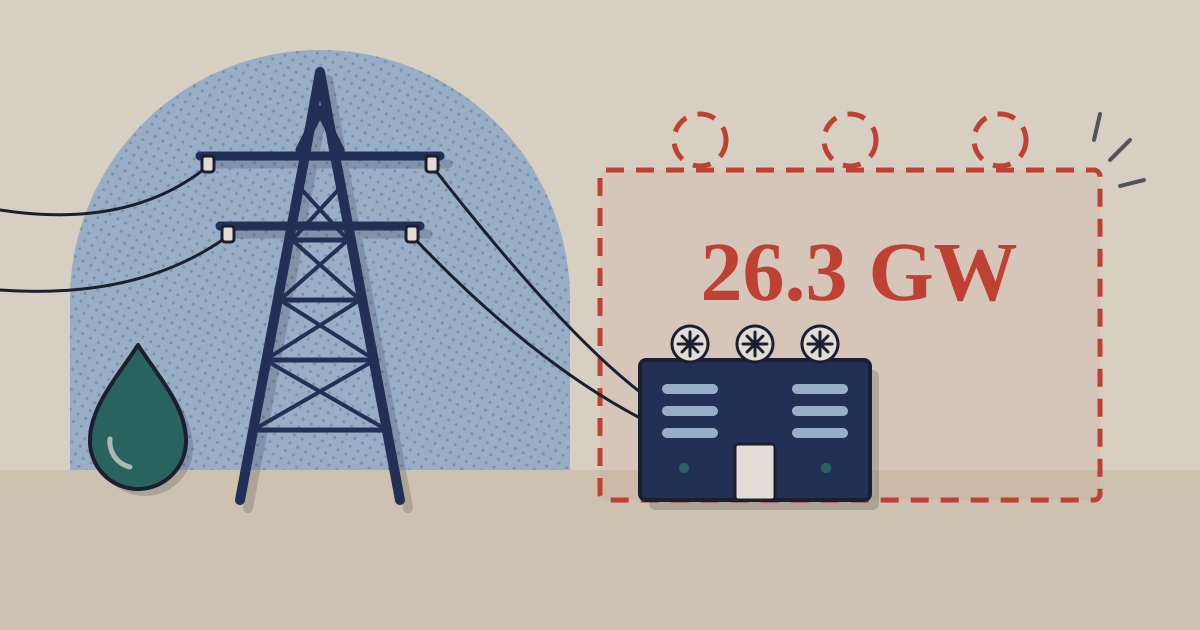
On 27 July, in a written reply in the Rajya Sabha, Minister of State for Power Shripad Naik said: “An additional load of 26.3 GW from Artificial Intelligence (AI) Data Centres is projected by 2031-32, which is expected to be integrated into the grid and primarily served by renewable energy capacity.”4 Energy Watch’s report of the same reply attributes the estimate to the mid-term review of the 20th Electric Power Survey, the Central Electricity Authority’s five-yearly demand assessment.5
Four months earlier, answering a question on the energy and water footprint of the IndiaAI Mission, the IT ministry said that “as per information available with the Ministry of Power, electricity demand from data centres is estimated to reach 13.56 GW by 2031−32.”3 Coverage called the July figure almost twice the March one.6 That reading needs care. March gives total data-centre demand; July gives additional load from AI data centres. Neither answer states its assumptions about utilisation, cooling overhead or how much of the announced pipeline is counted.
The government's AI projection is about 15 times the IT capacity India runs today
Gigawatts: operational IT capacity, H1 2026, against two official projections for 2031-32, as stated in Parliament
Source: Savills via Indian Infrastructure (22 July 2026); MeitY, Rajya Sabha unstarred question 2468 (13 March 2026); Ministry of Power, Rajya Sabha written reply via ANI (27 July 2026) · as of 27 July 2026 · not like for like: the first bar is IT load in operation, the second total data-centre electricity demand, the third additional AI data-centre load on the grid
Industry forecasts sit on either side. Wood Mackenzie, as reported by 5paisa, projects India’s data-centre capacity rising from 2.2 GW in 2025 to 12 GW in 2030, and AI capacity from 275 MW to 6,546 MW.6
03How the rest of the world is handling it
The International Energy Agency put global data-centre electricity at about 415 TWh in 2024, 1.5% of the world’s consumption, and projected about 945 TWh by 2030 in its base case, just under 3%. It expected the United States and China to account for nearly 80% of the growth.7 A year later it reported that data-centre demand grew 17% in 2025, against 3% for electricity overall, and that supply of gas turbines, transformers and chips had tightened while project pipelines were “holding up grid connections and other necessary approvals”.8
The United States and China account for nearly 80% of the projected growth in data-centre electricity
Projected increase in data-centre electricity consumption, 2024 to 2030, IEA Base Case, TWh
Source: IEA, Energy and AI: Energy demand from AI (April 2025) · as of 10 April 2025 · the IEA gives Europe as more than 45 TWh; India is not broken out in this chapter
Utilities are making data centres carry the risk. In Ohio, the state commission adopted AEP Ohio’s data-centre tariff on 9 July 2025. A new site of 25 MW or more pays a load-study fee, signs a contract of its ramp-up period plus eight years, and is billed for at least 85% of its contracted capacity whether it uses it or not. A customer without strong credit ratings posts collateral of half its minimum charges for the whole term, and a project cancelled or delayed by more than a year before power-on repays the utility’s build-out cost in full.9
Developers are building the generation themselves. At the PORTS-Pike campus in the same state, SB Energy and SoftBank say they will build at least 10 GW of new generation for 8 GW of IT capacity leased to OpenAI, and put at least US$4.2bn into regional grid infrastructure with AEP Ohio, with capacity coming online in phases from 2028; NVIDIA guarantees the land, power and shell.10 The IEA reports that the technology sector signed about 40% of corporate renewable power-purchase agreements in 2025.8
“The IEA was early in recognising that there is no AI without energy – and that countries that provide secure, affordable and rapid access to electricity will be one step ahead.”
04India's constraints: the grid, the water, and what four states offer
The grid. The same mid-term review projects India’s peak demand rising from 289 GW in 2026–27 to 388 GW in 2031–32.6 The AI load would be about 7% of that later peak, on our arithmetic. The power ministry says the transmission plan to 2032 envisages about ₹9,16,142 crore of investment and that 154 inter-state transmission projects are under construction.4 The IT ministry told Parliament in March that the national grid “is adequately prepared to ensure reliable power supply across regions.”3 Savills, for its part, lists access to reliable power and suitable land as “a key challenge” in the major markets.1
India's peak demand is projected to rise by about 100 GW in five years, before any AI load is singled out
Projected all-India peak electricity demand, GW, 2026-27 to 2031-32
GW
Table view
| Peak demand | |
|---|---|
| 2026-27 | 289 |
| 2027-28 | 305 |
| 2028-29 | 325 |
| 2029-30 | 345 |
| 2030-31 | 364 |
| 2031-32 | 388 |
Source: Central Electricity Authority, mid-term review of the 20th Electric Power Survey, as reported by 5paisa (29 July 2026) · as of 29 July 2026
Water. The government’s answer on water points to general rules, not data-centre ones. Asked for city-wise water needs, the IT ministry answered that “the water requirement of data centres depends on the type of cooling technologies deployed” and pointed to the Jal Shakti ministry’s groundwater notification of 24 September 2020.3 The operators describe their own choices. Microsoft says its Hyderabad region uses effectively zero water for cooling.16 Amazon says none of its operational Indian data centres uses water for cooling, because they run air-cooled chillers, and that its planned Thane site will use 125 kilolitres a day, 115 of them treated sewage for landscaping.2122
The states. Tamil Nadu’s Data Centre Policy, G.O.(Ms.) No. 33 of 23 November 2021, offers projects above ₹500 crore that meet 30% of their energy from renewables a five-year electricity-tax waiver, concessional open-access and cross-subsidy charges, and dual grid feeds for loads of 50 MW or more; it promises water “on payment of cost” and encourages recycling. Its window covered data centres incorporated from 1 April 2021 to 31 March 2026, and we found no successor notification.11 Telangana’s Data Centres Policy 2016 promises dual grid networks, renewable open access for up to a third of a data centre’s power, power “at the cost of generation” to eligible sites, and “continuous water supply for heavy duty cooling systems” on a state campus.12 For Andhra Pradesh and Maharashtra we could not retrieve the governments’ own policy texts, so we report only what the investors have said: Google will work with partners on new transmission lines, clean generation and storage in Andhra Pradesh, and Amazon’s Thane site will connect to the high-voltage grid through its own substation.1322
05Who is paying: three hyperscalers, counted three ways
Google announced “approximately $15 billion (USD) over the next five years (2026-2030)” for a gigawatt-scale AI hub in Visakhapatnam with AdaniConneX and Airtel, and broke ground on 28 April.1314 Microsoft committed US$17.5bn for calendar 2026 to 2029, on top of US$3bn announced in January 2025, and described the total as US$20.5bn when it opened its fourth Indian region, in Hyderabad, on 21 September.1516 Amazon said in December 2025 it would invest more than US$35bn across its Indian businesses through 2030, then in June raised the plan to US$48bn, including more than US$21bn for AI and cloud infrastructure in 2026–30; AWS broke ground on a new Hyderabad data centre on 15 July.181920
In 20 months the three largest clouds moved from pledges to ground-breaking in India
Announcements of India cloud and AI infrastructure investment by Amazon, Google and Microsoft, January 2025 to September 2026
Table view
| Date | Event | Detail |
|---|---|---|
| 22 Jan 2025 | AWS: US$8.3bn in Maharashtra | by 2030; part of the US$12.7bn India plan of May 2023 |
| 14 Oct 2025 | Google: about US$15bn, Vizag | gigawatt-scale AI hub, 2026-2030 |
| 9 Dec 2025 | Microsoft: US$17.5bn | 2026-2029, after US$3bn in January 2025 |
| 10 Dec 2025 | Amazon: over US$35bn | across all its Indian businesses, through 2030 |
| 28 Apr 2026 | Google breaks ground | with AdaniConneX and Nxtra by Airtel |
| 25 Jun 2026 | Amazon: US$48bn | over US$21bn of it for AI and cloud, 2026-2030 |
| 15 Jul 2026 | AWS breaks ground, Hyderabad | Bharat Future City, with the Telangana chief minister |
| 21 Sept 2026 | Microsoft opens Hyderabad region | fourth India region, three zones; US$20.5bn in total |
Source: Company releases: AWS, Amazon, Google, Microsoft (dates as shown) · as of 21 September 2026
Public compute. The IndiaAI Mission had onboarded about 38,231 GPUs through 14 providers by March, offered at a subsidised average of ₹65 an hour, which the ministry called about a third of the global average.3 By August the government reported 93.18 lakh GPU-hours sanctioned to 237 projects and 15 providers, against a five-year outlay of ₹10,371.92 crore; Communications Today gives the portal rate as ₹100 an hour, and reports, unconfirmed by the ministry or IndiaAI, that about 30,000 GPUs are deployed against 45,000 committed.23 On our arithmetic, the hours sanctioned equal about 3% of one year of the onboarded fleet.
Sources
- Indian Infrastructure: India's data centre capacity additions grow 59 per cent in H1 2026, says industry report (Savills India data) — 22 July 2026
- Cushman & Wakefield: India's data centre development pipeline through 2030 reaches 3,860 MW (H1 2026 update) — 23 September 2026
- Ministry of Electronics and IT, Rajya Sabha unstarred question 2468: Estimated energy and water footprint under IndiaAI Mission (Jitin Prasada) — 13 March 2026
- ANI via WebIndia123: Renewables likely to meet much of 26.3 GW AI data centre power demand by 2031-32 (Rajya Sabha written reply, Shripad Naik) — 27 July 2026
- PSU Watch (EW Bureau): AI data centres to add 26.3 GW of power load by 2031-32, to be served mainly by renewables: Naik — 27 July 2026
- 5paisa, Sagar Patel: AI data centres may add 26.3 GW to India's power demand by FY32 (CEA peak-demand series; Wood Mackenzie projections) — 29 July 2026
- IEA, Energy and AI: Energy demand from AI — 10 April 2025
- IEA press release: Data centre electricity use surged in 2025, even with tightening bottlenecks driving a scramble for solutions — 16 April 2026
- AEP Ohio: Data Center Tariff (Schedule DCT), adopted by the Public Utilities Commission of Ohio — PUCO order 9 July 2025; tariff effective 23 July 2025
- NVIDIA and SB Energy: NVIDIA guarantees SB Energy's PORTS-Pike Technology Campus in Ohio (SEC Form 8-K, Exhibit 99.1) — 17 August 2026
- Government of Tamil Nadu, Information Technology (D1) Department, G.O.(Ms.) No. 33: Data Centre Policy 2021 — 23 November 2021
- Government of Telangana, ITE&C Department: Data Centres Policy 2016 — 2016
- Google India blog: Our first AI hub in India, powered by a $15 billion investment — 14 October 2025
- Google India blog, Bikash Koley: Google AI hub, scaling India's AI infrastructure and community impact — 28 April 2026
- Microsoft: Microsoft invests US$17.5 billion in India to drive AI diffusion at population scale — 9 December 2025
- Microsoft: AI ambition into action, India South Central region established in Hyderabad — 21 September 2026
- Amazon India: AWS plans to invest $8.3 billion in Maharashtra — 22 January 2025
- Amazon India: Amazon plans to invest over $35 billion in India by 2030 — 10 December 2025
- Amazon India: Amazon plans to invest $48 billion in India through 2030 — 25 June 2026
- Amazon India: AWS breaks ground on a new data centre in Bharat Future City, Hyderabad — 15 July 2026
- Amazon India: How Amazon's data centres in India use water and energy — 24 July 2026
- Amazon India: Amazon's data centre in Thane — 2 September 2026
- Communications Today: IndiaAI Mission faces gap between capacity and deployed GPUs — 1 October 2026
- TechBag: Microsoft Azure (India regions and residency) — page as it stood on 1 October 2026
- TechBag: AWS hub (Mumbai and Hyderabad Regions) — page as it stood on 1 October 2026
- TechBag: Google Cloud (Mumbai and Delhi regions) — page as it stood on 1 October 2026
- Reserve Bank of India: Storage of Payment System Data, RBI/2017-18/153 — 6 April 2018
- PIB: DPDP Rules, 2025 notified (factsheet) — 14 November 2025
Related on TechBag: Microsoft Azure, the AWS hub and Google Cloud, each with its India regions and residency terms.
Disclosure. TechBag is a software reseller: it earns a margin when a reader buys through it, including from vendors named here. The analysis is TechBag’s own; no vendor paid for or saw this piece before publication. Facts are labelled reported, TechBag count or our view.
Keep reading