SecurityThreats & vulnerabilitiesNote
Hex.pm breach: 69 requests in 13 minutes ran commands; every user logged out
Hex’s incident report of 24 November: how a flaw present since 2016 let an attacker run commands on the Elixir and Erlang package registry, what may have been read, and what to do.

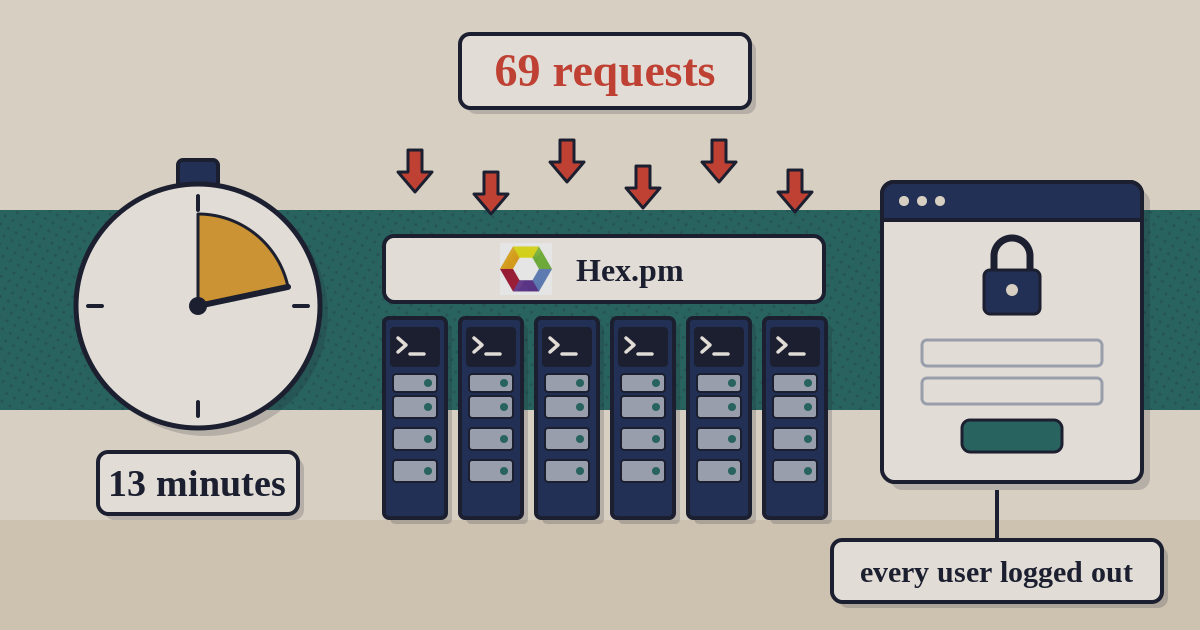
An attacker sent 69 malicious requests to hex.pm between 18:16 and 18:29 UTC on 23 November and ran commands on six of its web servers, the team behind the package registry for Elixir, Erlang and Gleam said on 24 November. Hex blocked the traffic and deployed a fix “within 20 minutes”, and it replaced the credentials its servers use, which logged everyone out of hex.pm and of the Hex clients. Because database reads are not logged, Hex “cannot rule out” that the attacker read email addresses, password hashes, API key hashes, 2FA secrets, sessions and audit logs.1 The flaw, CVE-2026-129514, carries a CVSS 4.0 score of 10, the maximum, and its record says it “was actively exploited against the hex.pm service”.2
69
malicious requests, 18:16 to 18:29 UTC on 23 November
Hex
6
web servers where the attacker’s commands ran
Hex
10
CVSS 4.0 score of CVE-2026-129514, the maximum
CVE record
27,339
packages on hex.pm, read on 28 November
hex.pm
01Thirteen minutes, and a flaw from 2016
hex.pm accepted request bodies in Erlang’s own binary format and decoded them before routing and authentication, so any anonymous POST reached the decoder. The decoder blocked functions but let through maps that pose as Elixir structs. When such a request failed, the error reporting inspected it, and the fake struct chose which code ran next: through two libraries, Ecto and DBConnection, the chain reached a function call taken from the request itself, and from there operating-system commands. Git history shows the safety check was removed on 23 February 2016.12 Six servers were hit, not three, because a restart at 18:28 brought up three new servers still on the vulnerable build.1
Fifteen minutes from the first exploit request to a patched fleet; the registry signing key is still to be replaced
Hex.pm’s incident, 23 and 24 November 2026, as Hex gives it (UTC)
Show tableHide table
| Date | Event | Detail |
|---|---|---|
| 23 Nov, 18:16 UTC | First exploit request | Sentry records the first of 69 errors at 18:16:00 |
| 23 Nov, 18:27 UTC | Firewall rule added | Full effect between 18:30 and 18:33 |
| 23 Nov, 18:29 UTC | Last exploit request | The last to reach a server, at 18:29:33 |
| 23 Nov, 18:31 UTC | Every server patched | All web, worker and job servers rebuilt from the fix between 18:30 and 18:31 |
| 23 Nov, 19:07 UTC | Outside report arrives | An emailed security report describes the same flaw |
| 23 Nov, 22:58 UTC | Breach reported | To IMY, Sweden’s data protection authority; CISA and ENISA follow by 23:26 |
| 24 Nov, 10:42 UTC | Credentials rotated | Everything the attacker could have read, except the registry signing key and a few low-impact secrets |
| 24 Nov, 13:48 UTC | CVE published | CVE-2026-129514 |
Source: Hex, Security incident on hex.pm (24 Nov 2026); CVE-2026-129514 record · as of 28 November 2026, 7:15pm IST
02What Hex checked, and what it cannot see
Hex restored a copy of its database from 18:13:59, before the attacker’s first request, and compared every row of every table with the live one; every change was explained by an audit-log entry, a background job or its own response. All 23 releases published during the incident match its audit log, and all 62 package files and 186 registry files written since 18:00 match the database. It found no shells on the servers and no new cloud keys or accounts.1
What it cannot check is reads. Passwords are stored as bcrypt hashes, which slow guessing but do not stop it for a weak password, so Hex asks everyone to change theirs. API keys are 128-bit random values stored as HMAC-SHA256, and Hex says it sees no need to rotate them because of the exposed hashes. Private-package reads in the window came from its own servers, though a read from a compromised server would look the same; Hex will contact affected organisations directly.1
The signing key is the open item. Every registry file is signed with the repository’s private key, and the client checks it against the public key before trusting a package list.3 Hex is building a signing system that supports key rotation, with new client releases “in the coming days”; until then it says not to trust third-party mirrors.1 On 28 November the post was unchanged and the newest Hex client was still version 2.7.0, of 6 November.15
03What a developer or team does
- Change your password at hex.pm.
- Reset 2FA at hex.pm/dashboard/security: under “Authenticator App”, choose “Setup New App” and verify a code. That gives a new secret and new recovery codes, and works where an organisation requires 2FA.
- Fetch packages only from repo.hex.pm, not mirrors, until the new client is out; then run
mix local.hex --force, and update rebar3 or Gleam if you use them. - Treat emails that claim to come from Hex with care: check that links lead to hex.pm, and forward suspicious ones to security@hex.pm.1
The registry is large: hex.pm lists 27,339 packages and counted 8,437,397 downloads on 27 November.4 Developer platforms were the way in elsewhere this month too: 4,837 hijacked GitHub accounts probed 61,764 repositories for CI secrets.
Sources
- Hex, Security incident on hex.pm (Peter Ullrich, Jonatan Männchen and Eric Meadows-Jönsson) — 24 November 2026
- CVE-2026-129514: Unauthenticated remote code execution through struct values in Erlang term request bodies (CNA: EEF) — published 24 November 2026
- Hex specifications, Registry v2: Signing — as published on 28 November 2026
- hex.pm, home page: packages available, downloads yesterday — read 28 November 2026
- hexpm/hex, Releases (v2.7.0) — 6 November 2026, read 28 November 2026
Disclosure. TechBag is a software reseller: it earns when companies buy through it, including from vendors named here. The analysis is TechBag’s own; no vendor paid for or saw this piece before publication. Facts are labelled reported, TechBag count or our view. How the Journal works.
Keep reading