SecurityThreats & vulnerabilitiesNote
Japan’s education ministry: up to 163,953 company records may have leaked
MEXT’s notice of 25 November, 55 days after it detected access to its government procurement system: what may have left, what Japan’s law asks, and the foreign ministry’s leak beside it.

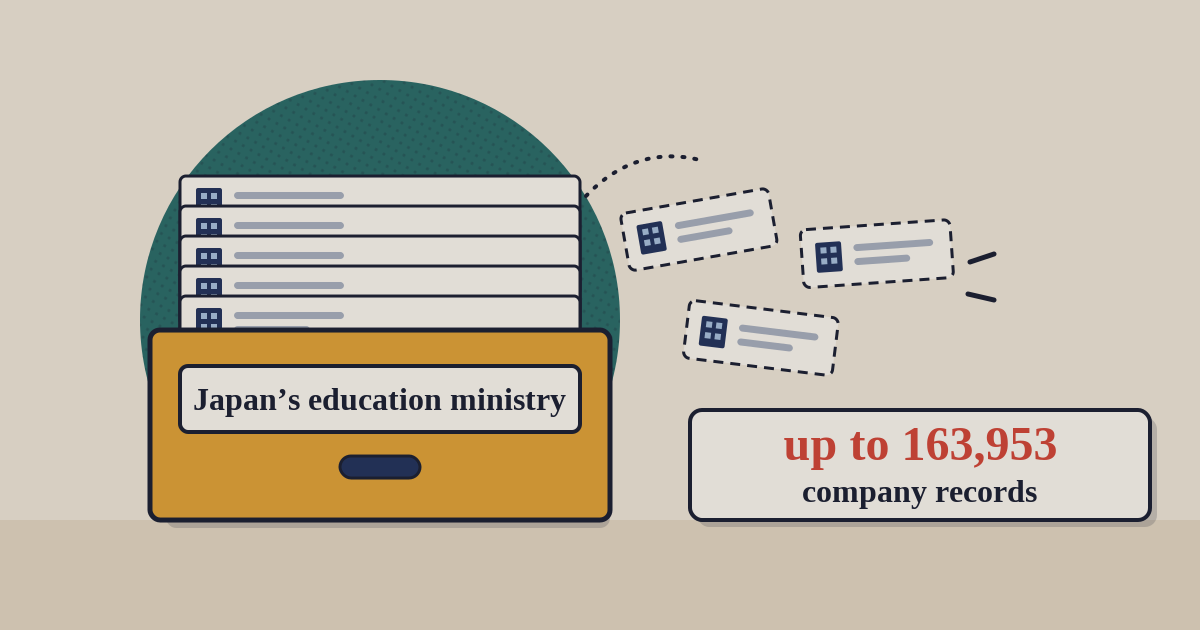
Up to 163,953 entries of company names and the names of companies’ representatives, and up to 1,778 email addresses, may have leaked from a database in Japan’s education ministry’s government procurement information system (政府調達情報システム), the ministry said on 25 November. The Ministry of Education, Culture, Sports, Science and Technology (MEXT) detected unauthorised access by a third party to a server in the system on 1 October, 55 days before the notice, and found the possible leak in an investigation with an outside specialist organisation.1
01What may have left, and what MEXT has done
The notice lists two kinds of data, “as far as can be confirmed at present”: email addresses stored in the database, up to 1,778 of them, and “businesses’ company names, representatives’ names and so on”, up to 163,953 (our translation). The ministry has cut the system’s communications in and out. It says it has confirmed no damage so far, neither the data being made public to an unspecified number of people nor its misuse. It has reported the case to the Personal Information Protection Commission (PPC) and is investigating with the bodies concerned. Enquiries go to the Minister’s Secretariat’s Accounting Division.1
The notice does not describe what the system does or how many companies the entries cover; an entry is not necessarily a separate company. It does not say how the intruder got in, and it does not say whether the companies and people in the database will be contacted one by one.1
Two Japanese ministries disclosed leaks 95 and 55 days after detecting the access
Detection and public notice, foreign ministry and education ministry, 27 July to 25 November 2026
Show tableHide table
| Date | Event | Detail |
|---|---|---|
| 27 Jul 2026 | Foreign ministry detects access | On its network that can exchange data with outside parties |
| 1 Oct 2026 | MEXT detects access | To a server of its government procurement information system |
| 30 Oct 2026 | Foreign ministry notice | About 3,600 items, mainly email addresses and names; about 900 from outside the ministry |
| 25 Nov 2026 | MEXT notice | Up to 163,953 company and representative entries; up to 1,778 email addresses |
Source: MEXT notice, 25 Nov 2026; foreign ministry release, 30 Oct 2026 (Japanese) · as of 28 November 2026, 7:00pm IST
02What Japan’s law asks of a ministry
Japan’s Act on the Protection of Personal Information binds government bodies as well as companies. Under Article 68, the head of an administrative organ must report to the PPC a leak that is highly likely to harm individuals’ rights and interests, and must tell the individuals, unless that is difficult and other measures are taken to protect them.3 The PPC’s rules count a leak caused by an act that may have had an improper purpose, and one involving more than 100 people, as such cases. The first report is due “promptly” after the organ learns of the leak; the full report within 30 days, or 60 days where the leak came from an act with an improper purpose.4 The report must say whether the leak has been made public; neither article sets a date for doing so.
Sources
- MEXT, 不正アクセスによる情報漏えいの可能性に関するお詫びとお知らせ(令和8年11月) (notice of a possible leak, in Japanese) — 25 November 2026
- Ministry of Foreign Affairs of Japan, 不正アクセスによる個人情報の漏えいの可能性について (release, in Japanese) — 30 October 2026
- Act on the Protection of Personal Information (個人情報の保護に関する法律), Article 68, e-Gov — current text, read 28 November 2026
- Enforcement Rules of the Act on the Protection of Personal Information (個人情報の保護に関する法律施行規則), Articles 43 and 44, e-Gov — current text, read 28 November 2026
Disclosure. TechBag is a software reseller: it earns when companies buy through it, including from vendors named here. The analysis is TechBag’s own; no vendor paid for or saw this piece before publication. Facts are labelled reported, TechBag count or our view. How the Journal works.
Keep reading