SecurityThreats & vulnerabilitiesNote
Idunno AntiCsrf runs code on IIS from one request; the abandoned library has no patch
Mandiant’s advisory of 18 November and CISA’s listing of 24 November: how one request runs code through an abandoned ASP.NET module, how to find it, and what replaces it.

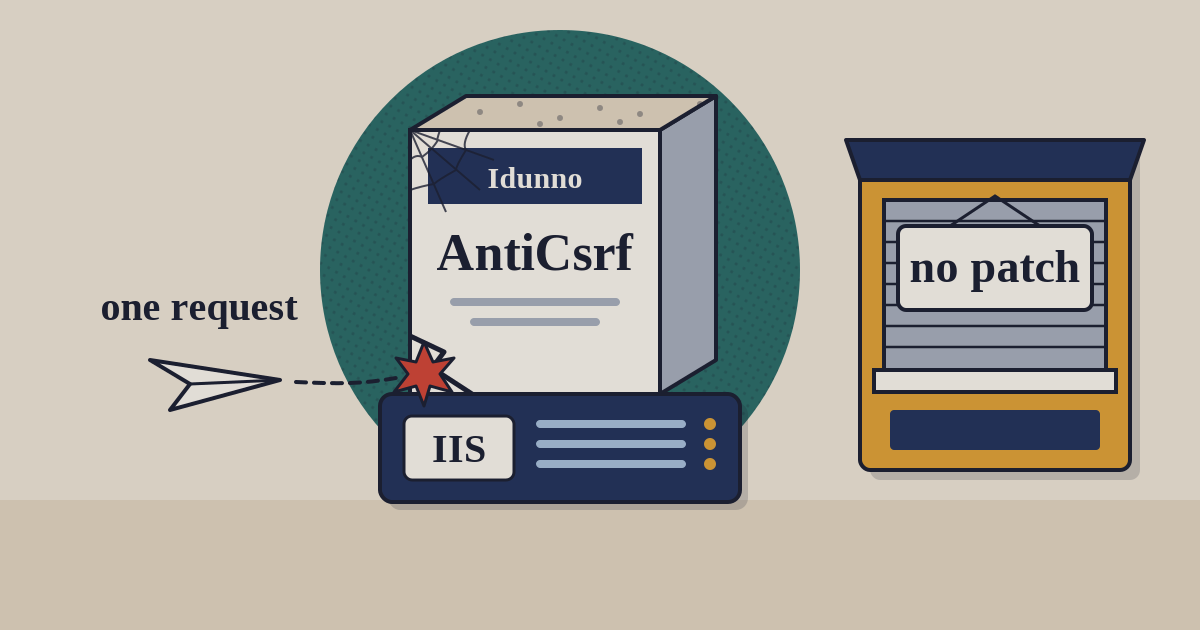
A single HTTP POST, with no sign-in and no valid token, runs code inside the IIS worker process, w3wp.exe, on an ASP.NET WebForms site that still loads Idunno.AntiCsrf, through any page anyone can reach without signing in. Mandiant published the flaw on 18 November as CVE-2026-131914, rated 9.3 of 10, and wrote: “Active exploitation in the wild has been observed.”1 2 The library was last released as 0.9.1 Beta, an official build dated December 2008, on CodePlex, Microsoft’s since-retired project site. It “has no active maintainer or official patch available”.1 CISA added it to its catalogue of exploited flaws on 24 November, with a due date of 27 November, and advised users to “discontinue use”.3
A module meant to stop forged requests runs the attacker's code before the page even loads
How one POST request exploits CVE-2026-131914 in Idunno.AntiCsrf 0.9.1, as Mandiant's advisory of 18 November 2026 describes it
- 01
One POST
Any non-empty CSRF cookie, such as__CSRFCOOKIE=1, plus a Base64 payload in the__CSRFTOKENform field - 02
Before the page
The module checks POSTs to.aspxpages ahead ofPage_Load, even on pages with no form - 03
No signature check
It decodes the field with an unkeyedObjectStateFormatter: no MAC, no machine key - 04
Code runs
The payload executes as the IIS worker process; the request then returns a 302 or a 500
Source: Mandiant, MNDT-2026-0048 · as of 25 November 2026, 7:00pm IST
01Why a 2008 library is still in production
Idunno.AntiCsrf did a useful job for WebForms sites: it set a cookie and a matching hidden form field, and refused a POST whose two values did not agree, the “double-submit cookie” defence against forged requests. To compare them, it decodes the form field with a .NET formatter that checks nothing, so the field can carry an object that runs code as it is rebuilt.1 An application picks it up as a DLL in its bin folder and a line in Web.config. Mandiant adds that organisations that recompiled it in-house will not match the published file hashes, so the search must be by name.1 CISA’s entry warns the flaw “could affect an open-source component, third-party library” used by different products.3
02What to do, in order
- Find it. Search every ASP.NET
Web.configandbinfolder forIdunno.AntiCsrfandAntiCsrfModule. The module registers under<httpModules>or<modules>asIdunno.AntiCsrf.AntiCsrfModule, Idunno.AntiCsrf; the official DLL is 69,632 bytes.1 - Remove it. Delete those module entries, the
csrfSettingssection and element, any references toISuppressCsrfCheckor[SuppressCsrfCheck], and the DLL itself.1 - Replace it. Mandiant names
System.Web.Helpers.AntiForgery,Page.ViewStateUserKeywith MAC-verified ViewState, or ASP.NET Core’sIAntiforgery.1 - Look back. Check IIS logs for POSTs to
.aspxpages that returned 302 or 500 with unusually large request sizes, where IIS logs them. Where there is evidence, rotate every secret inWeb.configandapplicationHost.config, machine keys and database credentials included, and inspect the web root for planted files.1
The three-day deadline is now normal: by our count to 23 November, CISA had given 168 of this year’s additions three days. Its entry also flags this one for forensic triage.3
Sources
- Mandiant, MNDT-2026-0048: Idunno.AntiCsrf insecure deserialisation (CVE-2026-131914) — 18 November 2026
- CVE record, CVE-2026-131914: Deserialization of untrusted data in CodePlex AntiCSRF — published 19 November 2026 (UTC), updated 25 November 2026
- CISA, Known Exploited Vulnerabilities catalogue, version 2026.11.24 (entry for CVE-2026-131914) — added 24 November 2026
Disclosure. TechBag is a software reseller: it earns when companies buy through it, including from vendors named here. The analysis is TechBag’s own; no vendor paid for or saw this piece before publication. Facts are labelled reported, TechBag count or our view. How the Journal works.
Keep reading