SecurityThreats & vulnerabilitiesNote
Drupal flaw found by Anthropic’s scanner was exploited 25 hours after the fix
Drupal’s SA-CORE-2026-017 of 18 November and CISA’s listing of 24 November: how the installer flaw works, which versions are fixed, and what an end-of-life site can do.

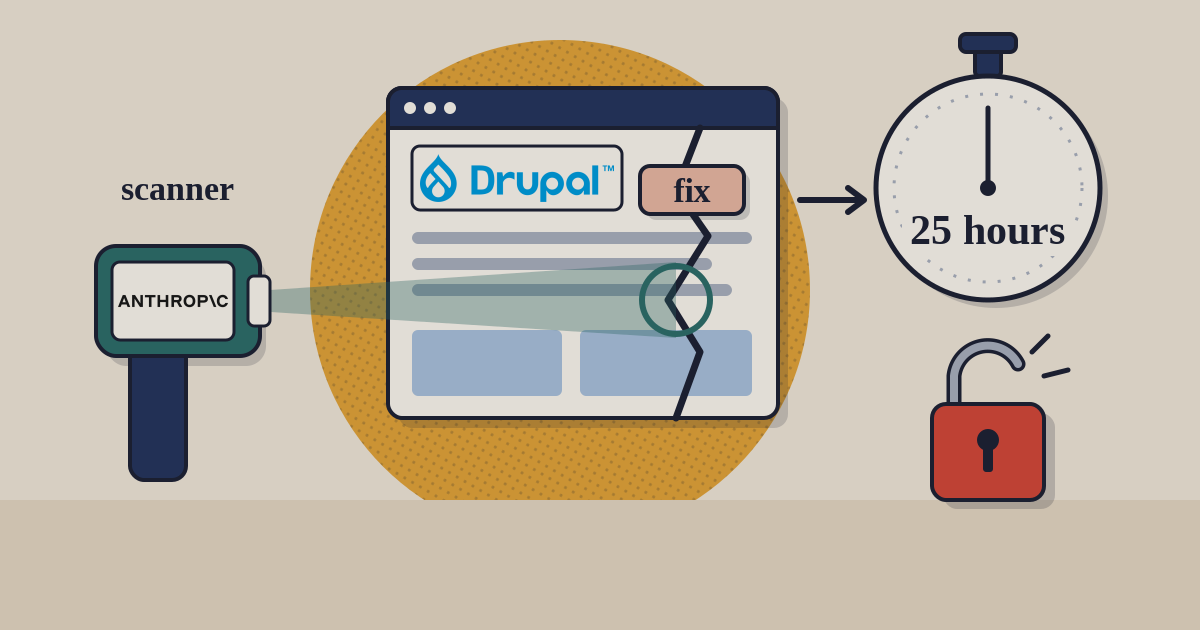
A Drupal flaw that lets an attacker use the installer on a site that is already installed was being exploited about a day after the fix shipped. Drupal’s security team published SA-CORE-2026-017 for CVE-2026-132165 at 17:43 UTC on 18 November, rated “highly critical” (20 out of 25), and later added: “the Security Team has received a report this was exploited on live sites as early as 2026-11-19 19:00 UTC.” The advisory’s credit line reads: “Discovered by Anthropic’s OSS Scanner, as vulnerability ANT-2026-GMRPK0BU.”1 CISA added it to its Known Exploited Vulnerabilities catalogue on 24 November, with a due date of 27 November for US federal agencies.3
20/25
Drupal’s risk score: highly critical, no sign-in needed
Drupal
25 hours
from the advisory to the first reported exploitation on live sites
TechBag, from Drupal’s times
3
fixed releases: 11.4.13, 11.3.22, 10.6.22
Drupal
27 Nov
CISA’s deadline for US federal agencies
CISA
01Why an installer matters on a site already installed
Drupal ships a file, core/install.php, that sets up a new site. It is needed once. The advisory says that “under specific conditions, an attacker can use the installer to attempt to reinstall Drupal. This can lead to a site takeover or remote code execution.” No account is needed. CISA’s entry classes it as a weakness in “not failing securely”: the installer, needed only before a site exists, can under those conditions be run against a live one.1 3
Drupal’s own scoring limits the exposure: access complexity is rated “complex”, and target distribution “only uncommon module configurations are exploitable”. Some, but not all, exploit paths are blocked if the web server cannot write to or change permissions on settings.php. Affected are all versions below 10.6.22, 11.0.0 up to 11.3.22, and 11.4.0 up to 11.4.13. Sites that use Drupal Steward are, the advisory says, already protected from known attack paths, but should still upgrade.1
Exploitation was reported about 25 hours after the fix, and CISA gave agencies three days
CVE-2026-132165 in Drupal core: advisory, first reported exploitation and CISA listing, 18 to 27 November 2026 (UTC)
Show tableHide table
| Date | Event | Detail |
|---|---|---|
| 18 Nov 2026 | Advisory and fix | 17:43 UTC: SA-CORE-2026-017; 11.4.13, 11.3.22 and 10.6.22 released |
| 19 Nov 2026 | Exploited on live sites | As early as 19:00 UTC, in a report to Drupal’s security team |
| 24 Nov 2026 | CISA lists it | Added to the Known Exploited Vulnerabilities catalogue |
| 27 Nov 2026 | Federal deadline | Due date for US federal agencies |
Source: Drupal SA-CORE-2026-017; CISA Known Exploited Vulnerabilities catalogue · as of 25 November 2026, 7:00pm IST
02What a site owner does
Update: Drupal 11.4.x to 11.4.13, 11.3.x to 11.3.22, and 10.6.x to 10.6.22. Then block the installer, which Drupal recommends after every installation whatever the version: deny /core/install.php in the Apache or Nginx configuration, in .htaccess, or delete the file and remove it again after each Composer run, since Composer puts it back. On Nginx, Drupal warns against an exact-match rule, which can miss /core/install.php/foo. To check, request /core/install.php, /install.php and /core/install.php/foo: all three should return 403 or 404, and update.php should still work.2
Drupal 11.2.x and earlier and 10.5.x and earlier are end-of-life and get no fix; Drupal 8 and 9 ended earlier. For those sites the installer block is the only cover the advisory offers, and an upgrade to a supported branch is the way out.1 CISA marks this entry for forensic triage, so a federal site that was exposed is expected to look for signs of compromise, not only patch.3
Sources
- Drupal Security Team, SA-CORE-2026-017: Drupal core, Highly critical, Remote code execution (CVE-2026-132165) — 18 November 2026; updated with the exploitation report
- Drupal documentation, Securing the installer (install.php) — 18 November 2026
- CISA, Known Exploited Vulnerabilities catalogue, entry CVE-2026-132165 (catalogue version 2026.11.24) — 24 November 2026
Disclosure. TechBag is a software reseller: it earns when companies buy through it, including from vendors named here. The analysis is TechBag’s own; no vendor paid for or saw this piece before publication. Facts are labelled reported, TechBag count or our view. How the Journal works.
Keep reading