
SecurityThreats & vulnerabilitiesTrend
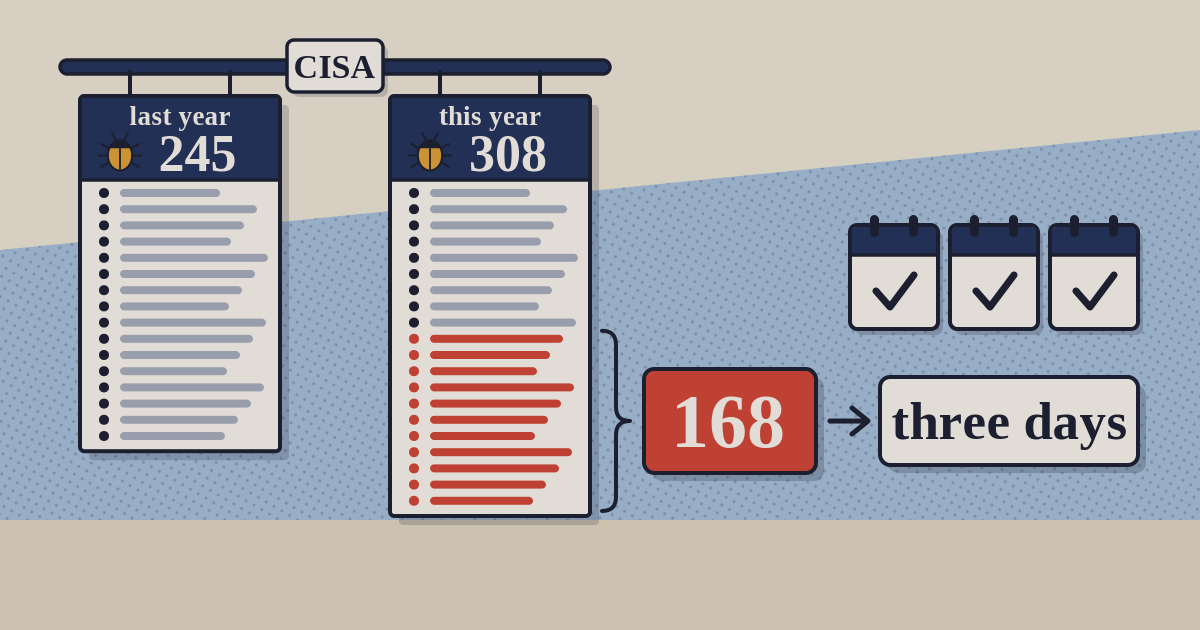
CISA added 308 exploited flaws this year against 245 last year; 168 got three days
Our count of CISA’s Known Exploited Vulnerabilities catalogue to 23 November: additions by month, the share due in three days, and the 11 flaws listed last week.

The Known Exploited Vulnerabilities (KEV) catalogue is a public list kept by CISA, the US cybersecurity agency: every flaw on it is one CISA has evidence is being used in real attacks, and every entry carries the date it was added and a due date for the fix. We downloaded the catalogue as released on 23 November and counted every entry added this year. How fast is the list growing, how short has the clock become, and what should a team outside the US government do with it?1
01308 additions in under eleven months, 43 of them in September
The catalogue held 1,792 entries on 23 November. Of those, 308 were added this year, against 245 in the whole of 2025, 186 in 2024 and 187 in 2023. In the same days of last year, 1 January to 23 November, CISA added 224. The 246th entry of 2026 went in on 30 September, so the last quarter began with last year’s total already passed.1
The first half of the year ran a little ahead of 2025, 146 additions against 132. The gap opened in the second: 26 additions in July against 20 a year earlier, 31 in August against 15, 43 in September against 16, 36 in October against 31, and 26 in the first 23 days of November against 10.1
From July, every month outran the same month of last year; September reached 43
Entries added to CISA’s Known Exploited Vulnerabilities catalogue per month, 2025 and 2026 (November: the 1st to the 23rd in both years)
- 2025
- 2026
Show tableHide table
| 2025 | 2026 | |
|---|---|---|
| Jan | 14 | 17 |
| Feb | 27 | 28 |
| Mar | 32 | 26 |
| Apr | 15 | 31 |
| May | 24 | 21 |
| Jun | 20 | 23 |
| Jul | 20 | 26 |
| Aug | 15 | 31 |
| Sep | 16 | 43 |
| Oct | 31 | 36 |
| Nov | 10 | 26 |
Source: CISA KEV catalogue, version 2026.11.23; TechBag count by date added · as of 24 November 2026, 7:45pm IST
The 308 entries cover products from 117 vendors and projects. They are not all new flaws: 90 carry CVE numbers issued before 2026, the oldest from 2008. A flaw joins the list when there is evidence of exploitation, whatever its age.1 The list is also small beside the flood of disclosures: the US National Vulnerability Database published 100,440 CVE records between 1 January and 14 November, by our count of that database.
02The due date went from 21 days to three
For each entry we subtracted the date added from the due date. In 2023, 2024 and 2025 the usual answer was 21 days; last year 226 of 245 entries got exactly that, and the seven shortest got one or two days. This year the default moved twice. The last 21-day entry was added on 5 March and the first 14-day entry on 9 March. Then, on 10 June, CISA issued Binding Operational Directive 26-04, which “supersedes and hereby revokes” the 2021 directive that created the catalogue.12
The directive sets the deadline from four questions: is the asset publicly exposed, is the flaw in the catalogue, can an adversary automate every step of the exploit, and does it give partial or total control. Days are calendar days.2 The due date printed on an entry is CISA’s own answer. Its guidance says: “if CISA determines that the vulnerability is present in a publicly exposed asset, the technical impact is total, and that it is automatable by an adversary, the KEV’s due date will reflect a 3-day patching deadline.”3
Three-day deadlines went from 2 of 17 entries in January to 34 of 43 in September
Share of each month’s additions to CISA’s KEV catalogue with a due date three days after listing, January to November 2026 (November to the 23rd)
%
Show tableHide table
| Due in three days | |
|---|---|
| Jan | 12 |
| Feb | 14 |
| Mar | 19 |
| Apr | 26 |
| May | 33 |
| Jun | 74 |
| Jul | 85 |
| Aug | 71 |
| Sep | 79 |
| Oct | 81 |
| Nov | 69 |
Source: CISA KEV catalogue, version 2026.11.23; TechBag count of due date minus date added · as of 24 November 2026, 7:45pm IST · Three-day entries of all additions: 2/17, 4/28, 5/26, 8/31, 7/21, 17/23, 22/26, 22/31, 34/43, 29/36, 18/26
Every one of the 175 entries added since 10 June cites the directive, and the catalogue has printed only two deadlines since: three days for 137 of them, 14 days for the other 38. Across the year, 168 of 308 entries were due in three days.1 Because the days are calendar days, 64 of those 168 due dates fell on a Saturday or a Sunday.1
Entries also carry a new field, forensic triage. It first read “Yes” on 25 June and has done so on 113 entries, every one of them a three-day entry.1 The directive says what it means: the agency must fix or mitigate within the three days “and carry out a forensic triage of the asset to assess whether the system is compromised”.2
03Last week: 11 added, nine due in three days
Between 17 and 23 November CISA added 11 entries. Nine were due in three days, and eight of those nine were marked for forensic triage; Puppet Enterprise and LiteLLM got 14 days. Two carry CVE numbers from 2024 and 2025.1 The week in full:
Show tableHide table
| CVE | Product | Added | Due |
|---|---|---|---|
| CVE-2026-115731 | Perforce Puppet Enterprise | 17 Nov | 1 Dec |
| CVE-2024-10441 | Synology DiskStation Manager | 18 Nov | 21 Nov |
| CVE-2026-40217 | BerriAI LiteLLM | 18 Nov | 2 Dec |
| CVE-2026-90436 | Apache Axis | 18 Nov | 21 Nov |
| CVE-2026-90817 | Vanderbilt University REDCap | 18 Nov | 21 Nov |
| CVE-2025-42884 | SAP NetWeaver | 20 Nov | 23 Nov |
| CVE-2026-123890 | Broadcom VMware vCenter | 20 Nov | 23 Nov |
| CVE-2026-129448 | Apache Roller | 20 Nov | 23 Nov |
| CVE-2026-76466 | Cisco Expressway Series | 20 Nov | 23 Nov |
| CVE-2026-133968 | MONAI Label (Project MONAI) | 23 Nov | 26 Nov |
| CVE-2026-134624 | N-able MailAssure | 23 Nov | 26 Nov |
Listing now follows disclosure closely. The vCenter flaw was listed on 20 November, the day after Broadcom’s advisory; the N-able flaw on 23 November, the day after its CVE record was published.56 It is N-able’s fourth entry this year; the first three were in N-central, the subject of our Note of 10 November.
What an IT team does with the list.
- Subscribe. CISA publishes the catalogue as JSON and CSV files and sends an email when it adds an entry. A vulnerability scanner or a short script can read the file daily.42
- Match it to what you run. An entry matters only if the product is installed, so the list is as useful as the software inventory it is checked against.
- Take the due dates as the order of work. A three-day entry on a system reachable from the internet comes first. The directive counts taking a system off the internet as a valid mitigation while the fix is prepared.2
- Plan for weekends. A three-day entry added on a Wednesday or Thursday is due on a Saturday or Sunday.
What to watch. Agencies must meet the directive’s timelines within 180 days of its issue, which is 7 December. CISA has committed to reassess the timelines once per fiscal year and to consider whether “technological or adversarial advances warrant further reductions in timelines”.2 And the year has five weeks left to add to 308.
Sources
- CISA, Known Exploited Vulnerabilities catalogue, JSON feed (version 2026.11.23; TechBag count) — released 23 November 2026, 19:43 UTC
- CISA, BOD 26-04: Prioritizing Security Updates Based on Risk — 10 June 2026
- CISA, BOD 26-04: Implementation Guidance for Prioritizing Security Updates Based on Risk (the KEV due date; forensic triage steps) — 10 June 2026, updated 25 August 2026
- CISA, Known Exploited Vulnerabilities Catalog (how to use it; CSV and JSON files) — as published on 24 November 2026
- Broadcom, VMSA-2026-0009 (CVE-2026-123890 in VMware vCenter) — 19 November 2026, updated 20 November 2026
- CVE Program, record CVE-2026-134624 (N-able as assigning authority) — 22 November 2026
Disclosure. TechBag is a software reseller: it earns when companies buy through it, including from vendors named here. The analysis is TechBag’s own; no vendor paid for or saw this piece before publication. Facts are labelled reported, TechBag count or our view. How the Journal works.
Keep reading