Ola’s cell unit lost ₹84 crore on ₹3 crore of revenue; it puts break-even at 70% yield
Ola Electric’s results for July to September: what its cell factory earned and lost, why yield sets a cell’s cost, the 70% break-even, and the auditor’s qualification.

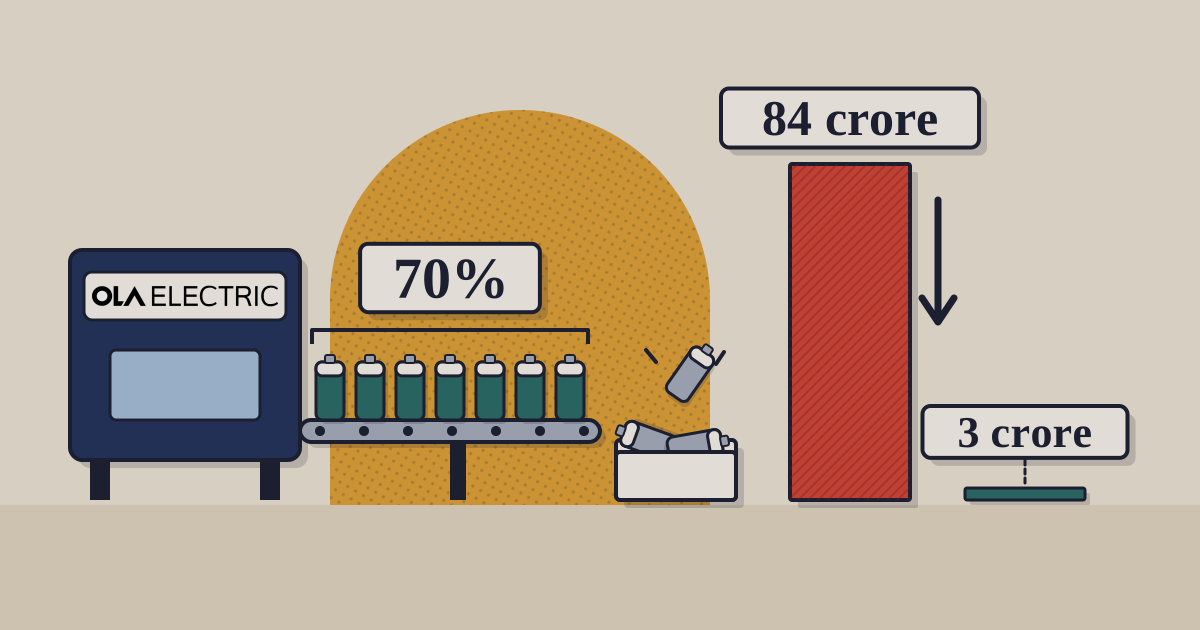
Ola Electric’s battery-cell business, which runs the 6 GWh factory the company calls its Gigafactory, earned ₹3 crore of revenue in July–September and lost ₹84 crore.1 The group as a whole, mostly electric scooters and motorcycles, took ₹421 crore of revenue, 39% less than the ₹690 crore of a year earlier, and lost ₹362 crore, against ₹418 crore.2 Ola says making its own cells now costs about the same as buying them: “At a yield of about 70%, using our own cells breaks even with buying cells from outside.” That comparison is on cell gross margin only, before the factory’s fixed and operating costs, which Ola says break even only at about 2–3 GWh a year of its own use.1
₹3 cr
cell business revenue, July–September
NSE filing
₹84 cr
cell business loss for the quarter
NSE filing
70–75%
yield on Ola’s NMC cells today
NSE filing
₹3,290 cr
cell business assets at 30 September
NSE filing
01Why yield decides what a cell costs
Yield is the share of cells a line starts that pass final testing. The factory pays for the cathode, anode, electrolyte and machine time of every cell it starts, but can only use the good ones, so the cost of a good cell is roughly the cost of a started cell divided by the yield. At 70%, each good cell carries the inputs of about 1.4 cells; at 85%, about 1.2. Ola puts break-even with bought cells at about 70% and a saving of 10–15% at 85%.1
Ola’s NMC cells (nickel-manganese-cobalt) run at 70–75% today. It expects 80–85% by the end of December and about 90% by March. Its LFP cells (lithium iron phosphate), which it says will lower the cost of its vehicles’ parts, start ramping now, with about 70% expected by March, when they go into its vehicles, and about 90% in April–June 2027. Its own vehicles will need roughly 30% NMC and 70% LFP, about 2–3 GWh in the year to March 2028.1 The government has extended Ola’s support under the production-linked incentive (PLI) scheme for advanced chemistry cells to 2031, and Ola expects incentive payments from next quarter.1 India’s other manufacturing incentive in the news this month, for chips, is in the Semicon 2.0 note.
02A factory paid for before it sells
Ola’s cell business has lost ₹28–89 crore a quarter on ₹3–9 crore of revenue
Ola Electric cell segment, revenue and loss after tax, ₹ crore, April 2025 to September 2026
- Revenue
- Loss
₹ crore
Show tableHide table
| Revenue | Loss | |
|---|---|---|
| Apr–Jun 25 | 3 | 69 |
| Jul–Sep 25 | 4 | 79 |
| Oct–Dec 25 | 9 | 89 |
| Jan–Mar 26 | 4 | 82 |
| Apr–Jun 26 | 5 | 28 |
| Jul–Sep 26 | 3 | 84 |
Source: Ola Electric, shareholders’ letter for July–September 2026, key financial metrics (unaudited), NSE filing of 12 November 2026 · as of 12 November 2026 · April–June 2026 includes a ₹57 crore provision written back; the auditor disputes its timing.
Most of the loss is the cost of owning the plant. In the reviewed segment note, depreciation, amortisation and finance costs came to ₹57 crore of the cell unit’s ₹82 crore loss before tax; staff and other costs were ₹29 crore, against ₹2 crore of other income and gross profit of ₹2 crore.2 Group deliveries fell to 34,667 vehicles from 52,666 a year earlier, in a quarter when Ola’s first dealers opened, on 4 September; it stopped taking orders in its own stores on 1 November.31
The auditor, BSR & Co, qualified its review on one cell item. The cell subsidiary had provided ₹57 crore of liquidated damages for missing an investment milestone under the PLI programme, wrote it back in April–June after asking for a waiver, and received the waiver, conditional on meeting revised timelines, from the Ministry of Heavy Industries on 11 August. In the auditor’s view the provision, plus ₹11 crore more for April–June, should have stayed until that letter and been reversed in July–September.2 On that view, the quarter’s cell loss would be ₹68 crore smaller and April–June’s that much larger. The auditor also drew attention, without qualifying, to the going-concern note, which counts the proceeds of a rights issue of about ₹1,000 crore at ₹27 a share among its supports.2 The shares closed at ₹34.65 on 13 November, down 3.0% on the day after the results.4 What to watch: the NMC yield at the end of December against Ola’s 80–85% target.
Sources
- Ola Electric Mobility, shareholders' letter for Q2 FY2026-27 (NSE) — 12 November 2026
- Ola Electric Mobility, outcome of board meeting: unaudited standalone and consolidated financial results for the quarter and half year ended 30 September 2026, with limited review reports (NSE) — 12 November 2026
- Ola Electric Mobility, key performance indicator data book for Q2 FY27 (NSE) — 12 November 2026
- Yahoo Finance, OLAELEC.NS daily closing prices, 12 and 13 November 2026 (quote data, not a primary source) — 13 November 2026
Disclosure. TechBag is a software reseller: it earns when companies buy through it, including from vendors named here. The analysis is TechBag’s own; no vendor paid for or saw this piece before publication. Facts are labelled reported, TechBag count or our view.
Keep reading